Aviv HBOT: Protocol, Evidence and What to Expect
Explore the clinic directoryIn this article
Aviv HBOT, also called the Aviv hyperbaric protocol, is a 60-session course of hyperbaric oxygen therapy delivered at 2.0 ATA that alternates 100% oxygen with ambient air roughly every 20 minutes. It was developed in Israel by the research group at the Sagol Center for Hyperbaric Medicine at Shamir Medical Center, led by Prof. Shai Efrati, whose trials report a 20 percent-plus increase in telomere length in a prospective trial and large cognitive effect sizes (0.745 for attention) in a randomized controlled trial of adults over 64. Aviv Clinics is the commercial program that offers the protocol to private patients, and all of the published evidence behind it comes from that one research group. What separates it from standard HBOT is that the oxygen swings are the therapy, not a safety measure.
The hypothesis behind the protocol is that alternating between high oxygen and normal air at a fixed pressure of 2.0 ATA stimulates cellular responses more strongly than constant high oxygen. The intermittent oxygen drops create brief hypoxic stress signals that activate mitochondrial adaptation, growth factor release, and angiogenesis in ways that steady-state hyperoxia may not.
Key Takeaways
- Aviv HBOT is a 60-session hyperbaric oxygen therapy protocol at 2.0 ATA that alternates 100% oxygen with air breaks, developed by Prof. Shai Efrati's group at the Sagol Center, Shamir Medical Center, Israel.
- In a 2020 randomized controlled trial of 63 adults over 64, Hadanny and colleagues reported improved global cognition (p=0.0017) and an attention effect size of 0.745 after 60 sessions.
- A 2020 prospective trial by Hachmo and colleagues reported telomere lengthening of more than 20 percent and a 37 percent drop in senescent T helper cells, but it had no sham control and only 35 participants.
- A 2022 randomized, sham-controlled trial by Zilberman-Itskovich and colleagues reported better cognition, fatigue and sleep in post-COVID patients after 40 sessions.
- Every published Aviv protocol trial comes from the same research group, and independent replication has not yet been published.
- Cognitive aging and longevity are not FDA-cleared uses of hyperbaric chambers, so Aviv HBOT is cash pay and is usually not covered by insurance.
Table of Contents
What Is Aviv HBOT and Where Was It Developed?
Aviv HBOT is a structured hyperbaric oxygen therapy program built on the research of the Sagol Center for Hyperbaric Medicine and Research at Shamir Medical Center (formerly Assaf Harofeh) in Israel, which is affiliated with Tel Aviv University. The protocol is also called the Aviv protocol or the Efrati protocol, and the research literature describes it as intermittent hyperoxia based on the hyperoxic-hypoxic paradox (HHP).
The name comes from Aviv Clinics, the commercial medical program built on the Sagol Center research that delivers the protocol to private patients. Israel is where the trials were run and where the protocol was first offered as a structured program.
Is Aviv HBOT the same as hyperbaric oxygen therapy?
Aviv HBOT is one specific way of delivering hyperbaric oxygen therapy, not a separate treatment. What makes it distinct is the fixed 2.0 ATA pressure, the scheduled air breaks, the long course of 40 to 60 sessions, and testing before and after treatment. Our guide to hyperbaric oxygen therapy covers the broader treatment, its accepted uses and how sessions work.
How Is the Aviv Protocol Different From Standard HBOT?
A standard HBOT session delivers 100% oxygen at elevated pressure for the whole session. The Aviv protocol alternates between 100% oxygen and normal compressed air within the same session, typically switching every 20 minutes at 2.0 ATA. That creates repeated cycles of hyperoxia and relative hypoxia in a single treatment.
The theoretical basis comes from research showing that the transition from hyperoxia back toward normoxia generates reactive oxygen species (ROS) signaling that activates HIF-1 alpha (hypoxia-inducible factor), VEGF (vascular endothelial growth factor), and mitochondrial biogenesis pathways.1 These are the same pathways activated by exercise-induced hypoxia, which is why the research group describes the effect as interval training for cells.
Hadanny and Efrati named this idea the hyperoxic-hypoxic paradox in a 2020 review in the journal Biomolecules. Their argument is that cells read a fall in free oxygen as a lack of oxygen, even when the new level is still normal, so repeated intermittent hyperoxia can switch on many of the repair signals that true hypoxia triggers. The human trials below test outcomes, not this mechanism itself.
The key distinction from soft-shell portable chambers is pressure. The Aviv protocol runs at a hard 2.0 ATA (atmospheres absolute) in a medical-grade hard chamber. Soft portable chambers sold for home use reach 1.3 to 1.5 ATA and deliver ambient air, not 100% oxygen. The gap is not minor. At 2.0 ATA, dissolved oxygen in plasma increases substantially. At 1.3 ATA, the increase is modest. The published Efrati group research uses 2.0 ATA and cannot be extrapolated to lower-pressure consumer devices. For a side-by-side of the major clinical protocols, see our comparison of the Efrati and Harch protocols.
Aviv protocol vs standard HBOT vs a mild home chamber
| Attribute | Aviv protocol | Standard clinical HBOT | Mild home chamber |
|---|---|---|---|
| Pressure | 2.0 ATA | 2.0 ATA or higher, set by the indication | 1.3 to 1.5 ATA |
| Gas breathed | 100% oxygen by mask, with scheduled air breaks | 100% oxygen | Ambient air |
| Role of the oxygen swings | The air breaks are the intended stimulus | Any air breaks are there to limit oxygen toxicity | No oxygen cycling |
| Course in published research | 40 to 60 sessions, five per week | Depends on the condition being treated | Not tested in the Aviv protocol trials |
| Setting | Hard chamber with medical supervision | Hospital or outpatient hyperbaric unit | Soft-shell chamber at home |
The practical point is that only the first two columns use the pressure and oxygen levels studied by the Efrati group. Our breakdown of mild HBOT vs clinical HBOT explains what changes at lower pressure and why the trial results do not transfer to soft chambers.
What Does the Evidence Actually Show?
The Efrati group has published multiple peer-reviewed trials using this protocol. These are the foundational studies:
| Condition | Sessions | Key Finding | Population |
| Cognitive aging | 60 | p=0.0017 global cognitive improvement; attention effect size 0.745 | 63 adults, randomized controlled trial |
| Telomere biology | 60 | 20%+ telomere lengthening; 37% senescent cell reduction | 35 adults, prospective trial (no sham) |
| Physical performance | 60 | VO2max +1.91 ml/kg/min; cardiac perfusion effect size 0.797 | 63 adults, randomized controlled trial |
| Post-COVID cognitive symptoms | 40 | Improved cognition, fatigue, sleep, and brain perfusion vs sham | 37 HBOT vs 36 sham, randomized controlled trial |
| Fibromyalgia | 40 | Brain SPECT changes and reduced pain medication use | 48 patients, crossover design |
The physical performance figures come from a 2024 randomized controlled trial in older adults, which found VO2max rose by 1.91 ml/kg/min alongside improved cardiac perfusion.4 The single strongest caveat across all of this work is that it originates from one research group, a point covered in the limitations section below.
Which conditions has the Efrati group studied with this protocol?
Beyond healthy aging, the Sagol Center has published trials in long COVID, fibromyalgia, post-stroke deficits and post-concussion syndrome after traumatic brain injury. The post-COVID trial is the strongest of these because it used a sham control: Zilberman-Itskovich and colleagues (2022) randomized 73 patients to 40 sessions of HBOT or sham and reported gains in cognition, fatigue, sleep and brain perfusion.5 None of these conditions is an FDA-cleared indication for hyperbaric chambers, so treatment for them is off label. Our overview of HBOT for long COVID covers that trial in more depth.
Cognitive Enhancement Findings
The most rigorously tested application of the Aviv protocol is cognitive enhancement in aging adults. A 2020 randomized controlled trial enrolled 63 healthy adults over age 64 and assigned them to 60 HBOT sessions or a control group over 3 months.2
Effect size for attention in healthy adults over 64 after 60 sessions of the Aviv protocol, with 0.788 for information processing speed and global cognition improving at p=0.0017 (Hadanny et al., 2020).
The HBOT group showed significant improvements in global cognitive function (p=0.0017) with large effect sizes for attention (0.745) and information processing speed (0.788). MRI perfusion imaging confirmed increased cerebral blood flow to prefrontal and parietal regions, the areas most affected by age-related cognitive decline, and the improvements were on objective neuropsychological tests rather than self-reported questionnaires.
The proposed mechanism involves increased cerebral blood flow, angiogenesis (new vessel formation), neuroplasticity signaling via BDNF upregulation, and reduced neuroinflammation. Brain imaging in this trial showed new areas of increased perfusion across multiple prefrontal and parietal regions following treatment.
The control group in this trial received no sham sessions, so participants knew whether they were being treated. Objective testing reduces, but does not remove, the chance that expectation shaped some results. The trial also enrolled healthy volunteers, so it does not show whether the protocol helps people with dementia or diagnosed cognitive impairment.
Does Aviv HBOT Change Biological Aging Markers?
A prospective trial from the same group, published the same year, measured telomere length and senescent cell counts in 35 healthy adults over 64 before, during, and after 60 HBOT sessions at 2.0 ATA.3
Reduction in senescent T helper cells after 60 sessions of the Aviv protocol at 2.0 ATA (p<0.0001). Telomere length increased by over 20% across multiple immune cell types.
Telomere length increased by more than 20 percent across T helper, T cytotoxic, NK, and B cells. B cells showed the largest increase, at 29.4 percent by session 60 (p=0.0001). Senescent T helper cells decreased by 37.3 percent (p<0.0001). These are the most striking published findings tied to the Aviv protocol and the ones that drew the most media attention. See our deeper look at the HBOT anti-aging telomere data for the full breakdown.
The important caveat: this study had no sham control, a small sample (n=35), and measured blood cell biomarkers rather than clinical outcomes. Longer telomeres in isolated blood cells may or may not translate to longer healthspan or reduced disease incidence. Independent replication of these specific findings has not yet been published.
What does a longer telomere result mean for a patient?
A longer telomere result means a laboratory marker in circulating immune cells moved in a favorable direction after treatment. It does not show that a person will live longer, avoid disease or look younger. No trial of the Aviv protocol has followed patients long enough to measure hard outcomes such as illness, disability or survival.
What Are the Side Effects and Risks?
Aviv HBOT at 2.0 ATA has a well-documented safety profile across the Efrati group’s published trials. Adverse events were predominantly minor: ear barotrauma (most common), temporary myopia, and transient fatigue or dizziness during the oxygen-switching phase. Oxygen toxicity seizures are rare at 2.0 ATA, estimated at roughly 1 in 10,000 sessions across the standard HBOT literature.

Absolute contraindications include untreated pneumothorax and certain chemotherapy drugs. Relative contraindications include claustrophobia, middle ear or sinus disease, and a history of seizures. All Aviv protocol treatments require medical evaluation before starting and ongoing monitoring during sessions. This is not a consumer wellness product. It is a clinical protocol administered in specialized facilities with trained medical staff.
How common are ear problems and vision changes?
Ear barotrauma is the side effect patients notice most, because the middle ear has to equalize as the chamber pressurizes to 2.0 ATA, roughly the pressure of 33 feet of seawater. Staff teach ear clearing, and descent can pause if needed. Temporary nearsightedness can build over a long course and usually fades in the weeks after the final session. Our article on hyperbaric chamber side effects covers the wider risk list.
How Long Is the Aviv Protocol?
| Phase | Duration | Sessions/Week | Oxygen Protocol | Pressure |
| Initial evaluation | 1 week | Medical assessment only | None | N/A |
| Treatment Round 1 | 4 weeks | 5 sessions | Intermittent hyperoxia | 2.0 ATA |
| Rest break | 1 week | No sessions | None | N/A |
| Treatment Round 2 | 8 weeks | 5 sessions | Modified protocol | 2.0 ATA |
| Follow-up monitoring | 3 months | Monthly visits | Assessment only | N/A |
Each session runs about 90 minutes including pressurization and depressurization. Active treatment time is roughly 60 minutes with the oxygen switching cycle. The sequence and timing of the oxygen cycles follow a defined protocol and cannot be replicated by a patient adjusting their own home chamber settings.
The table above reflects a typical clinic program structure. The published cognitive aging trial used a simpler schedule: 60 daily sessions, five days a week, over about 3 months, with each session described as 90 minutes of 100% oxygen by mask at 2.0 ATA and five-minute air breaks every 20 minutes, according to Hadanny and colleagues (2020).2 Because session length and the timing of breaks can differ between the trial protocol and a given clinic, ask which schedule a program follows before comparing it with the research.
What to Expect During an Aviv HBOT Program
An Aviv HBOT program follows a fixed sequence: medical screening and baseline testing, a daily course of chamber sessions, then repeat testing to compare against the baseline. Published trials and structured 2.0 ATA programs generally run in these steps.
- Medical screening. A physician reviews your history, medications, lungs, ears and sinuses to rule out contraindications such as untreated pneumothorax.
- Baseline testing. Programs modeled on the trials measure a starting point, often computerized cognitive tests, brain perfusion imaging such as MRI or SPECT, and cardiopulmonary fitness testing.
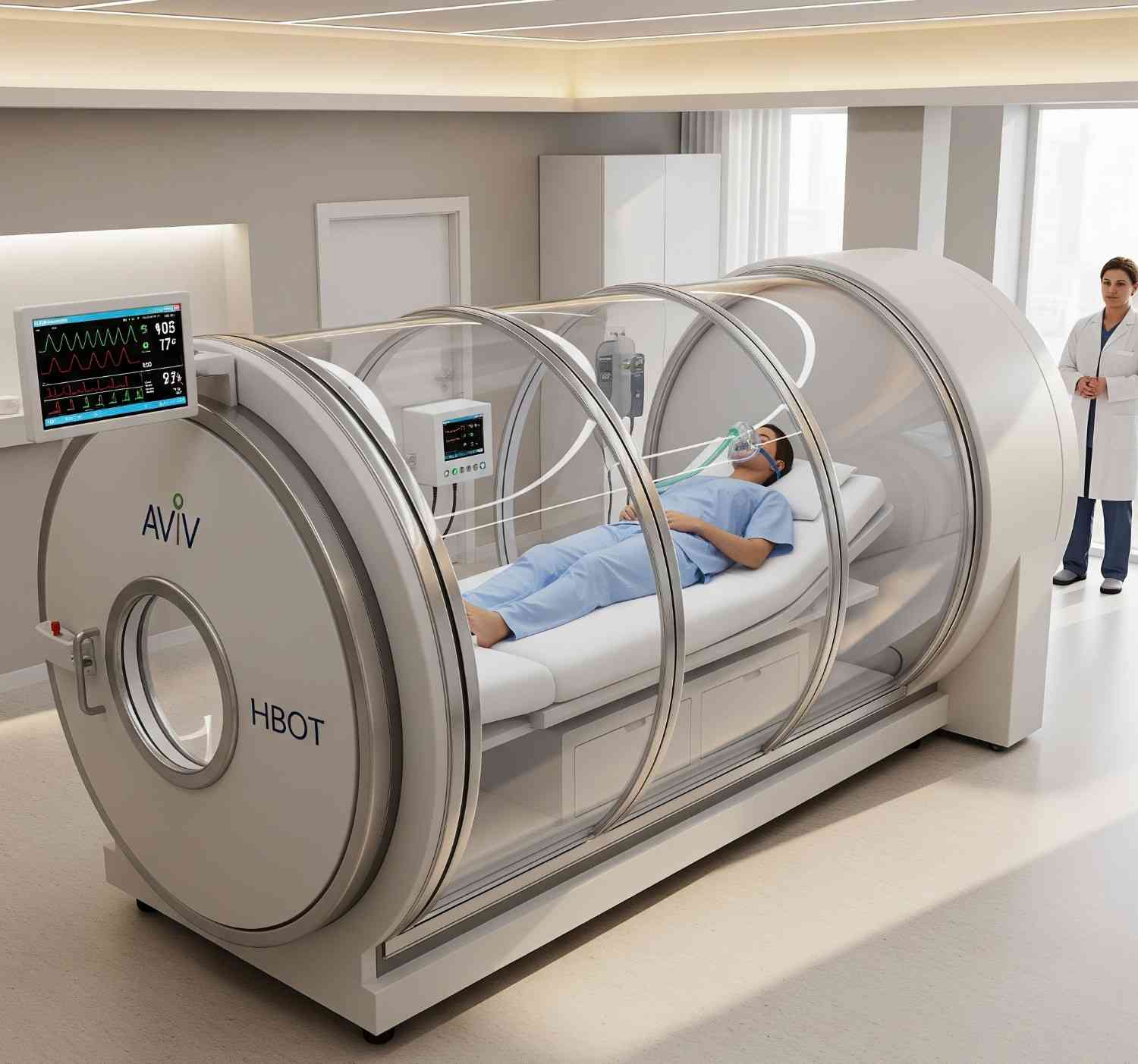
- Daily sessions. You sit in a multiplace hard chamber, breathe 100% oxygen through a mask, and remove it for scheduled air breaks while staff monitor you from outside.
- Pressure changes. The chamber pressurizes at the start and depressurizes at the end of each session, which is when you clear your ears.
- Repeat testing. At the end of the course, the baseline tests are repeated so changes can be measured rather than judged by feel.
The main demand is the schedule: five sessions a week for two to three months. Our piece on how long HBOT effects last covers what the research says about durability after the course ends.
Who delivers Aviv-style HBOT?
Clinical HBOT in the US is supervised by physicians trained in hyperbaric medicine, often board certified in Undersea and Hyperbaric Medicine, with certified hyperbaric technologists (CHTs) and hyperbaric nurses running the chamber. Structured cognitive programs add neuropsychologists or other clinicians to run the testing, and radiologists to read perfusion scans.
Is Aviv HBOT FDA Approved or Covered by Insurance?
Aviv HBOT is not FDA approved for cognitive aging, longevity or performance. The FDA regulates hyperbaric chambers as medical devices and clears them for specific conditions, such as decompression sickness, carbon monoxide poisoning and certain non-healing wounds. Healthy aging is not on that list, and our summary of FDA-cleared HBOT indications sets out what is.
The Undersea and Hyperbaric Medical Society (UHMS) publishes its own list of accepted HBO indications, which many US insurers use as a reference for coverage. Cognitive enhancement, telomere biology and post-COVID symptoms sit outside it, so the Aviv protocol is cash pay in almost every case. Our guide to what HBOT costs explains how clinics price long courses and what drives the total.
Limitations and Ongoing Questions
All of the published Aviv protocol evidence comes from a single research group at one institution in Israel. The findings appear in peer-reviewed journals and use objective measures, but independent replication by other groups has not yet been published. The scientific standard for generalizability requires that confirmation. This does not invalidate the work, but it means the landmark cognitive aging, telomere, and physical performance findings should be read as strong preliminary evidence awaiting confirmation, not established medical consensus.
The Aviv clinic model also operates commercially, providing a premium longevity service at significant cost. That does not mean the research is biased, but it is relevant context when weighing how enthusiastically the findings are communicated in public. For how these longevity applications sit within the broader performance literature, see our overview of HBOT for longevity and performance.
For patients and practitioners, the most defensible position is this: the Aviv protocol has produced the most rigorous HBOT research on cognitive aging published to date, the findings are clinically meaningful if replicated, and anyone pursuing this treatment should do so at a properly supervised medical facility using a hard chamber at 2.0 ATA, not a home soft-shell unit.
What questions are still open?
- Whether independent hyperbaric centers outside Israel see the same cognitive and telomere changes with the same 2.0 ATA schedule.
- How long any benefit lasts once sessions stop, and whether maintenance sessions are needed.
- Whether the results in healthy adults over 64 apply to younger people or to people with diagnosed dementia.
- Whether the air breaks add benefit over continuous oxygen at the same pressure, which no published head-to-head trial has tested.
How to Find a Clinic Offering 2.0 ATA HBOT in the US
To find a clinic offering 2.0 ATA hyperbaric oxygen therapy, start with facilities that run medical-grade hard chambers under physician supervision, then ask whether they offer an intermittent hyperoxia schedule modeled on the Efrati group's trials. The Regenerated.com directory of HBOT clinics across the US lists hyperbaric providers by state and city, and each profile shows the treatments that clinic lists.
Listing order in the directory is not a paid ranking. Featured slots are clearly labeled and capped, and the Verified label means a clinic completed credential checks, not that it spent more. Regenerated.com is free for patients, and inclusion in the directory is not an endorsement of any clinic. Our guide to Featured, Verified and organic listings explains each label.
What should you ask a clinic before starting?
- Is the chamber a hard chamber that reaches 2.0 ATA, and do patients breathe 100% oxygen by mask or hood?
- Which schedule do you follow, how long are the oxygen periods and air breaks, and how many sessions do you plan?
- Who supervises sessions, and is a physician trained in hyperbaric medicine on site?
- Which baseline and follow-up tests do you run, and will I receive the results?
- Is the facility accredited by the UHMS, and what is the total cost for the full course?
Our articles on HBOT for brain injury and long COVID treatment options compare hyperbaric therapy with other approaches.
FAQs
How does Aviv HBOT differ from regular hyperbaric oxygen therapy?
Aviv HBOT differs from regular HBOT in its oxygen pattern, not its pressure. Standard HBOT delivers a mostly constant 100% oxygen concentration for the session. The Aviv protocol alternates 100% oxygen with air breaks at 2.0 ATA, creating intermittent hyperoxia and relative hypoxia cycles that the Efrati group calls the hyperoxic-hypoxic paradox. The pressure is similar to standard clinical HBOT, and the course is longer, typically 40 to 60 sessions with testing before and after.
How long does it take to see results?
Published trials measured results after the full protocol of 40 to 60 sessions, which takes roughly two to three months at five sessions a week. Cognitive improvements on objective tests and brain perfusion changes on MRI were documented at the end of the treatment course. Individual variation exists, and the published literature does not consistently document results within the first 20 to 30 sessions, so early changes should not be expected or used to judge the program.
Can the Aviv protocol be done in a home chamber?
No. Home soft-shell chambers cannot replicate the Aviv protocol. They operate at 1.3 to 1.5 ATA and typically deliver ambient air rather than pure oxygen. The published evidence comes from hard-shell chambers at 2.0 ATA with medical-grade oxygen delivered by mask. The oxygen-switching schedule also requires clinical-grade equipment and medical supervision to run safely, so results from the Efrati group trials do not apply to home devices.
Is the Aviv protocol covered by insurance?
In most cases, no. The cognitive aging, longevity, and anti-aging applications are not FDA-cleared indications and are not on the UHMS list of accepted indications, so insurers typically do not cover them. Patients should expect to pay out of pocket for the full course. Some facilities offer financing for multi-month protocols, and it is worth asking for a written total price before the first session.
How many sessions are typically needed?
The published cognitive aging trial used 60 sessions over 3 months, five sessions per week, and the post-COVID trial used 40 sessions. Most Aviv clinic programs are structured around 40 to 60 sessions depending on the indication and individual response. Some conditions may require modified approaches based on interim assessment, so a clinic should explain why it recommends a given number before treatment starts.
Sources
- Efrati S, Ben-Jacob E. Reflections on the neurotherapeutic effects of hyperbaric oxygen. Expert Rev Neurother. 2014;14(3):233-236. DOI: 10.1586/14737175.2014.884928 ↩
- Hadanny A, Daniel-Kotovsky M, Suzin G, et al. Cognitive enhancement of healthy older adults using hyperbaric oxygen: a randomized controlled trial. Aging. 2020;12(13):13740-13761. DOI: 10.18632/aging.103571 ↩
- Hachmo Y, Hadanny A, Abu Hamed R, et al. Hyperbaric oxygen therapy increases telomere length and decreases immunosenescence in isolated blood cells: a prospective trial. Aging. 2020;12(22):22445-22456. DOI: 10.18632/aging.202188 ↩
- Hadanny A, Sasson E, Copel L, et al. Physical enhancement of older adults using hyperbaric oxygen: a randomized controlled trial. BMC Geriatr. 2024;24:537. DOI: 10.1186/s12877-024-05146-3 ↩
- Zilberman-Itskovich S, Catalogna M, Sasson E, et al. Hyperbaric oxygen therapy improves neurocognitive functions and symptoms of post-COVID condition: randomized controlled trial. Sci Rep. 2022;12:11252. DOI: 10.1038/s41598-022-15565-0 ↩