Hyperbaric Chamber Fire: 77 Deaths in 73 Years and What Caused Them
Explore the clinic directoryIn this article
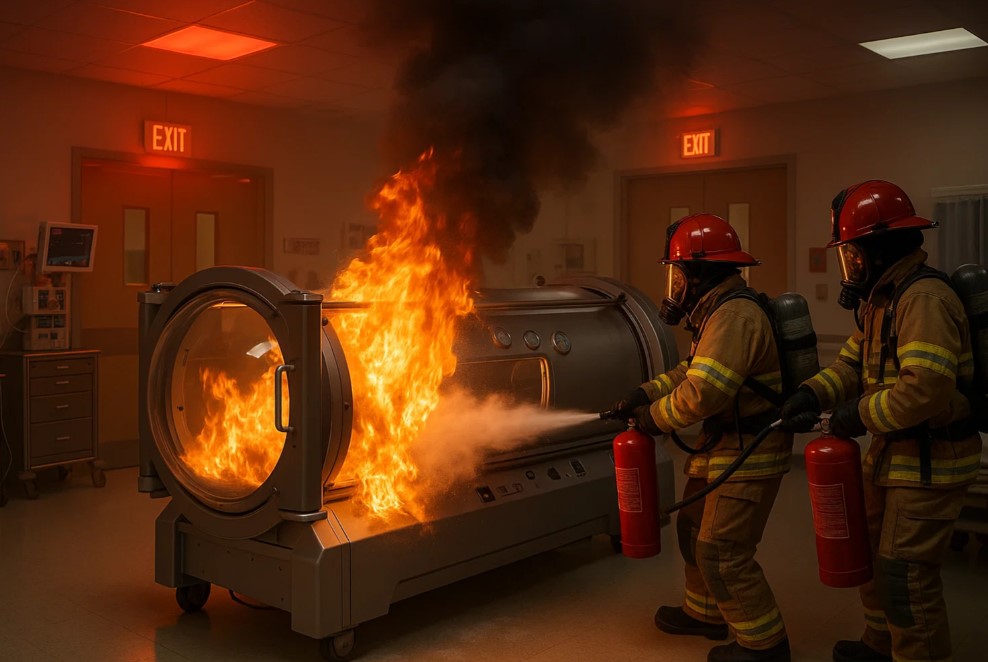
A hyperbaric chamber fire is rare but usually fatal: Sheffield and Desautels (1997) documented 35 chamber fires and 77 deaths worldwide from 1923 to 1996, and every fatal fire burned in an oxygen-enriched atmosphere above 28% oxygen. Two more deaths in US chambers in 2025, in Troy, Michigan and Lake Havasu City, Arizona, led the FDA to remind providers that fire prevention depends on strict oxygen, clothing and ignition controls under NFPA 99.
Key Takeaways
- Sheffield and Desautels (1997) counted 77 deaths in 35 hyperbaric chamber fires between 1923 and 1996, across Asia, Europe and North America.
- Every fatal fire in that 73-year analysis occurred above 28% oxygen, and the only survivors were in chambers pressurized with air below 23.5% oxygen.
- Before 1980 most chamber fires started from electrical faults; after 1980 most started from prohibited items occupants carried in, according to the same analysis.
- NFPA 99, Chapter 14 (2024 edition) sets US hyperbaric fire rules, including deluge suppression that activates within 3 seconds and a designated Hyperbaric Safety Director.
- The FDA issued a Letter to Health Care Providers on August 25, 2025, after fires in Michigan and Arizona caused serious injuries and deaths.
- UHMS Hyperbaric Facility Accreditation is the only hyperbaric-specific accreditation recognized by The Joint Commission, which makes it a useful first filter when choosing a facility.
Why are hyperbaric chamber fires so dangerous?

A fire in a hyperbaric chamber creates conditions unlike fire in any other enclosed space. Three factors combine during hyperbaric oxygen therapy (HBOT) to create extreme danger.
Oxygen enrichment above normal atmosphere. Standard air contains 21% oxygen. Inside a monoplace chamber filled with 100% oxygen, materials that resist combustion in normal air ignite easily. At elevated pressure, the partial pressure of oxygen rises sharply, making even more materials combustible. Combustion risk is the most serious entry in our review of hyperbaric chamber side effects, which also covers the far more common ear and sinus issues.
Elevated atmospheric pressure. Fire in a pressurized environment burns more intensely and spreads faster. What would be a small spark in normal air becomes a flash fire in a pressurized oxygen atmosphere.
Sealed enclosure. Patients are inside the chamber during treatment, and emergency decompression takes time. Unlike other medical emergencies where a patient can be moved quickly, hyperbaric patients cannot escape instantly.
What causes a hyperbaric chamber fire?
A hyperbaric chamber fire needs the same three elements as any fire: oxygen, fuel and an ignition source. The chamber supplies far more oxygen than room air, so the fuel and the ignition source are what safety programs work to remove. When all three meet inside a pressurized chamber, the fire develops in seconds.
What ignites a fire inside a chamber?
Sheffield and Desautels (1997) found that electrical ignition from equipment faults caused most chamber fires before 1980. After 1980 the leading cause became prohibited ignition sources that occupants carried in.[1] In practice that means battery-powered devices, chemical hand warmers that heat up on their own, and static sparks from friction on synthetic fabric.
What acts as fuel?
In an oxygen-rich atmosphere, ordinary things become fuel: bedding, clothing, hair, skin oils, petroleum jelly, cosmetics and alcohol-based sprays. The 1997 analysis found abundant burnable material present in every fatal fire. That is why NFPA 99 limits garments to approved materials and why intake staff check for lotions and hair products.[1]
Can a hyperbaric chamber explode?
An explosion and a fire are different failures. A pressure vessel failure means the chamber wall or a seal gives way and the stored pressure releases at once, while a fire is combustion inside an intact chamber. A fire can raise the internal pressure fast enough to stress the chamber, so the two can occur together. Our separate explainer on what makes a hyperbaric chamber explode covers the pressure side in detail.
How often do hyperbaric chamber fires happen?
They are rare. Sheffield and Desautels published the most comprehensive analysis in 1997, covering 73 years of incidents from 1923 to 1996.[1]
- 35 hyperbaric chamber fires documented
- 77 deaths total
- Zero fatalities in clinical hyperbaric chambers in North America during this period
- All fatal fires: oxygen-enriched atmosphere above 28%
- All fatal fires: abundant burnable material present
How the cause shifted over time: before 1980, chamber fires were primarily caused by electrical ignition from equipment malfunction. After 1980, the primary cause shifted to prohibited sources of ignition that occupants carried into the chamber, meaning phones, electronics, synthetic clothing, and personal care products.[1]
The rarity matters for perspective. Hyperbaric oxygen therapy is delivered many times a day in US hospitals and outpatient wound centers, and the published record shows that fatal fires cluster where oxygen limits and item controls broke down. For the full count of deaths from all causes, see how many people have died in a hyperbaric chamber.
What does the record of documented fatal fires show?
The table below sets out the documented fatal-fire data from the Sheffield dataset alongside the two 2025 US incidents. It reports only what published sources and official records state, with no inferred causes.
Documented Fatal Hyperbaric Chamber Fire Data
| Period / Incident | Location | Deaths | Oxygen environment | Reported cause |
|---|---|---|---|---|
| 1923 to 1996 (aggregate) | Asia, Europe, North America | 77 (in 35 fires) | All above 28% oxygen | Pre-1980 electrical ignition; post-1980 prohibited items carried into the chamber (Sheffield & Desautels) |
| Jan 31, 2025 | Troy, Michigan (Oxford Center) | 1 (5-year-old patient) | Oxygen-enriched chamber | Under investigation; criminal charges allege improper safety protocols |
| July 2025 | Lake Havasu City, Arizona | 1 (clinic operator) | Oxygen-enriched chamber | Cause not publicly established at time of writing |
For the fuller incident dataset and analysis, see our hyperbaric chamber fire incident data, and for the physics of pressure-vessel failure see how a hyperbaric chamber can explode.
Is a monoplace or multiplace chamber more likely to catch fire?
A monoplace chamber filled with 100% oxygen carries the highest fire intensity, because the whole atmosphere around the patient is pure oxygen under pressure. A multiplace chamber is pressurized with air and patients breathe oxygen through a mask or hood, so a fire there burns closer to normal air conditions as long as the room oxygen stays controlled. Sheffield and Desautels (1997) found survivors only in air-pressurized chambers held below 23.5% oxygen.[1]
NFPA 99 groups human chambers into Class A (multiplace) and Class B (monoplace), with separate fire suppression and ventilation rules for each. Mild soft-shell chambers used for wellness sessions run at lower pressure on room air, sometimes with added oxygen from a concentrator. The comparison of mild HBOT and clinical HBOT explains how those sessions differ from hospital treatment.
| Chamber type | NFPA 99 class | Chamber atmosphere | What the patient breathes | Fire risk profile |
|---|---|---|---|---|
| Multiplace (several occupants, staff often inside) | Class A | Compressed air, oxygen kept below 23.5% | 100% oxygen by mask or hood | Lower fire intensity while room oxygen is monitored; survivors in the 1997 data were all in chambers like this |
| Monoplace (one patient, acrylic tube) | Class B | Usually 100% oxygen | The chamber atmosphere itself | Highest fire intensity; any spark meets pure oxygen under pressure |
| Mild soft-shell chamber (about 1.3 ATA) | Varies; ask the operator which code the chamber is installed under | Room air, sometimes with concentrator oxygen added | Room air or concentrator oxygen | Lower, not zero; a fire in a sealed fabric enclosure is still dangerous |
What happened in the 2025 incidents?
January 31, 2025, Troy, Michigan: five-year-old Thomas Cooper died and his mother was injured when a chamber at the Oxford Center caught fire. The facility’s CEO, safety manager, and others were charged with second-degree murder and involuntary manslaughter, with the charges alleging improper safety protocols.[3]
July 2025, Lake Havasu City, Arizona: Walter Foxcroft, a 43-year-old physical therapist, died in a fire inside a chamber at his own clinic.[3]
On August 25, 2025, the FDA issued a Letter to Health Care Providers on the safe use of hyperbaric oxygen therapy devices, citing recent reports of fires that resulted in serious injuries and deaths and urging strict fire-prevention protocols, staff training, and oxygen-compatible patient attire.[3]
Both 2025 deaths happened outside the hospital-based programs that dominate the North American safety record. The official causes were still being established when these cases were reported, so the table above lists only what investigators and the FDA have stated.
What safety standards prevent hyperbaric chamber fires?
NFPA 99, the Health Care Facilities Code, Chapter 14, governs hyperbaric facility safety in the United States. The 2024 edition sets these requirements.[2]
Fire suppression: primary and secondary fire suppression systems are required. Deluge fire suppression must activate within 3 seconds.
Construction: 2-hour fire-rated construction. Noncombustible or limited-combustible finishes. Lockable rooms for exclusive hyperbaric use.
Ventilation: Class A chambers require a minimum 3 cubic feet per minute per occupant; Class B a minimum 1 cubic foot per minute.
Clothing: only approved garments are permitted. Approved materials include 100% cotton or specific approved blends. No synthetic fibers (nylon, polyester, rayon, wool, Gore-Tex).
Personnel: every program must designate an on-site Hyperbaric Safety Director responsible for equipment oversight and operational safety.
Electrical: all electrical equipment inside the chamber must meet strict isolation requirements, and all circuitry entering the chamber must be de-energizable in emergencies. Oxygen monitoring is required for shared spaces.
Who enforces hyperbaric fire safety?
Three bodies share the job. The National Fire Protection Association writes NFPA 99, and state and local fire authorities adopt and inspect against it. The FDA regulates hyperbaric chambers as medical devices and issues safety communications such as the August 2025 letter.[3] The Undersea and Hyperbaric Medical Society (UHMS) runs voluntary facility accreditation, which reviews safety programs, staffing and emergency drills.[4]
What is prohibited inside a hyperbaric chamber?
The following items are prohibited in all hyperbaric chambers regardless of type.
- All electronic devices: smartphones, tablets, smartwatches, hearing aids (unless specifically approved), e-cigarettes, cameras, Bluetooth headphones
- Synthetic fabrics: nylon, polyester, rayon, wool, spandex, lycra, Gore-Tex
- Petroleum-based products: petroleum jelly, lip balm, sunscreen, oil-based cosmetics
- Alcohol-based products: deodorants, body spray, hair spray, perfume, nail polish
- Wigs and hair extensions (fire risk from synthetic materials)
- Hand warmers and heating pads
Any facility that does not enforce these prohibitions at intake is operating outside NFPA 99 standards. That is a direct red flag for patient safety.
Phones are the item patients most often ask about. The answer is the same in every chamber type, and our note on bringing a phone into a hyperbaric chamber explains why a battery is an ignition source in oxygen.
What injuries do hyperbaric chamber fires cause?
Hyperbaric chamber fires cause severe burns and smoke inhalation injury, often over large areas of the body, because the fire envelops the occupant rather than starting at one point. Survivors need care in a burn center, where burn surgeons and critical care teams manage skin grafting, airway injury and infection.
The burn record also explains why survival tracks oxygen levels. In an air-filled multiplace chamber, staff can trigger deluge suppression and the fire burns with less intensity, while in a 100% oxygen monoplace chamber there is little time for anyone to act. The published data show these injuries are rare, and that when they occur they are severe.
Hyperbaric oxygen therapy itself is also used to treat thermal burns in some hospital programs, as one of the indications UHMS recognizes. The burn treatment guide covers where HBOT fits alongside standard wound care.
How can I tell if a hyperbaric facility is safe?
Before your first session at any hyperbaric facility, ask or observe the following.
- Does the facility conduct thorough intake screening? Every patient should be screened for contraindicated items before entering the chamber.
- What is the staff’s certification? Look for CHT (Certified Hyperbaric Technologist) or CHRN credentials. UHMS-accredited facilities meet the highest safety standard.
- Is the facility UHMS-accredited? UHMS Hyperbaric Facility Accreditation is the only hyperbaric-specific accreditation recognized by The Joint Commission.[4]
- What fire suppression system is in place? Ask directly. A legitimate facility will explain its fire suppression, emergency decompression, and evacuation procedures.
- When was the last safety inspection? NFPA 99 compliance requires regular inspection and maintenance. Ask for documentation.
The CHT credential is issued by the National Board of Diving and Hyperbaric Medical Technology, and CHRN (Certified Hyperbaric Registered Nurse) by the Baromedical Nurses Association Certification Board. A supervising physician trained in undersea and hyperbaric medicine should be available whenever the chamber runs. Ask who that physician is and who holds the Hyperbaric Safety Director role required by NFPA 99.[2]
Regenerated.com lists hyperbaric oxygen therapy clinics across the US, and the questions above are the way to read that list. Listing order is not paid ranking, Featured slots are labeled and capped, and Verified means a clinic completed credential checks, not that it spent more. The directory is free for patients, and inclusion is not an endorsement or a fire safety inspection, so confirm accreditation and safety staffing yourself. The guide to Featured, Verified and organic listings explains each label.
Should the fire risk stop you from having hyperbaric oxygen therapy?
For the conditions HBOT is cleared to treat, the fire risk is small next to the condition itself, provided the facility follows NFPA 99. The FDA has cleared hyperbaric chambers for a defined list of uses, including decompression sickness, carbon monoxide poisoning and some nonhealing diabetic wounds. The summary of FDA-cleared HBOT indications lists them, and the hyperbaric oxygen therapy guide covers how a course of treatment works.
Many uses offered at wellness clinics, such as sessions for traumatic brain injury or long COVID, are off label, and the evidence for them is thinner and still developing. These sessions are usually cash pay and often take place outside hospital programs. The fire controls on this page apply in every setting, so ask an elective provider the same safety questions a hospital program would answer.
People treated for carbon monoxide poisoning or diving injuries are usually treated in hospital-based chambers with full-time hyperbaric staff. If your session is elective, choose a facility that can answer every safety question above without hesitation.
Frequently Asked Questions
Can you survive a hyperbaric chamber fire?
Survival depends mainly on the oxygen level inside the chamber. In Sheffield and Desautels’ 73-year analysis, the only survivors were in chambers pressurized with air below 23.5% oxygen, and every fatal fire burned above 28% oxygen. In a 100% oxygen monoplace chamber the fire is far more intense and survival is much less likely, so prevention through item checks and approved clothing matters more than any rescue plan.[1]
Are soft-shell home chambers also a fire risk?
Soft-shell chambers carry a lower but real fire risk. They run at about 1.3 ATA, usually on room air, so the oxygen level is far below that of a clinical 100% oxygen monoplace chamber, and adding concentrator oxygen raises the risk again. The same prohibitions apply: no electronics, no synthetic fabrics, no petroleum-based products and no hand warmers. A fire in a sealed fabric enclosure at any pressure is dangerous.
What should I do if I witness a chamber fire?
Alert all staff at once and let them run the facility’s emergency plan. Do not try to open a pressurized chamber by hand: it must be decompressed first, because opening it under pressure releases the stored gas violently. Trained operators activate fire suppression, decompress the chamber, remove the patient and call emergency services. Stay clear of the chamber room unless staff ask for help.
What could cause a hyperbaric chamber to explode?
A hyperbaric chamber can fail explosively when the pressure vessel itself gives way, for example through a damaged acrylic tube, a failed seal or a door that is not fully latched. A fire inside the chamber can also drive pressure up quickly. Fires are the catastrophic event that dominates the published record: Sheffield and Desautels (1997) documented 35 chamber fires and 77 deaths between 1923 and 1996.[1]
How many people have died in hyperbaric chamber fires?
The most complete published count is 77 deaths in 35 hyperbaric chamber fires worldwide from 1923 to 1996, according to Sheffield and Desautels (1997). That analysis found no fire deaths in clinical hyperbaric chambers in North America during its study period. Two further deaths occurred in US chamber fires in 2025: a five-year-old patient in Troy, Michigan and a clinic operator in Lake Havasu City, Arizona.[1]
Can you get burned in a hyperbaric chamber?
Burns in a hyperbaric chamber come almost entirely from fire, and chamber fires are rare. Normal treatment does not burn the skin, although the chamber can feel warm while it pressurizes. The serious risk is a flash fire in oxygen, which causes extensive burns and smoke inhalation injury. Approved cotton gowns, no lotions or hair products, and no devices are the controls that prevent it.
Sources
- Sheffield PJ, Desautels DA. Hyperbaric and hypobaric chamber fires: a 73-year analysis. Undersea Hyperb Med. 1997;24(3):153-164. PMID: 9308138 ↩
- National Fire Protection Association. NFPA 99 Health Care Facilities Code, Chapter 14 (Hyperbaric Facilities), 2024 edition. nfpa.org ↩
- US Food and Drug Administration. Letter to Health Care Providers: Follow Instructions for Safe Use of Hyperbaric Oxygen Therapy Devices. August 25, 2025. fda.gov ↩
- Undersea and Hyperbaric Medical Society. Hyperbaric Facility Accreditation. uhms.org/accreditation ↩