

In this article
M54.9 is the US ICD-10-CM diagnosis code for "Dorsalgia, unspecified," the label used when back pain is recorded without a named spinal region.[1] Its official entry includes unspecified backache and back pain, and the code alone does not identify a specific spinal region, cause or duration.[1][3]
Official code files checked October 24, 2026. This guide explains record terminology. It does not diagnose back pain, assign a claim code or determine insurance coverage.
Key takeaways
- M54.9 is the ICD-10-CM code for "Dorsalgia, unspecified," according to the CMS FY 2027 code descriptions.[1]
- The CMS Tabular List gives M54.9 two inclusion terms, "Backache NOS" and "Back pain NOS," and places it under the M54 dorsalgia category.[3]
- M54.9 names no spinal region, while M54.50 names the lower back, M54.6 the thoracic spine and M54.2 the neck, per the CMS descriptions.[1]
- The M54.9 description contains neither "acute" nor "chronic," and the official guidelines set no fixed duration for chronic pain coding.[1][2]
- CMS applies the FY 2027 diagnosis files to encounters from October 1, 2026, through September 30, 2027.[4]
What is the M54.9 diagnosis code?
M54.9 is a diagnosis code in ICD-10-CM, the International Classification of Diseases, Tenth Revision, Clinical Modification. ICD-10-CM is the US adaptation of the World Health Organization's ICD-10, maintained by the National Center for Health Statistics (NCHS, part of the CDC) together with CMS. US providers and payers have used it for diagnoses since October 1, 2015.
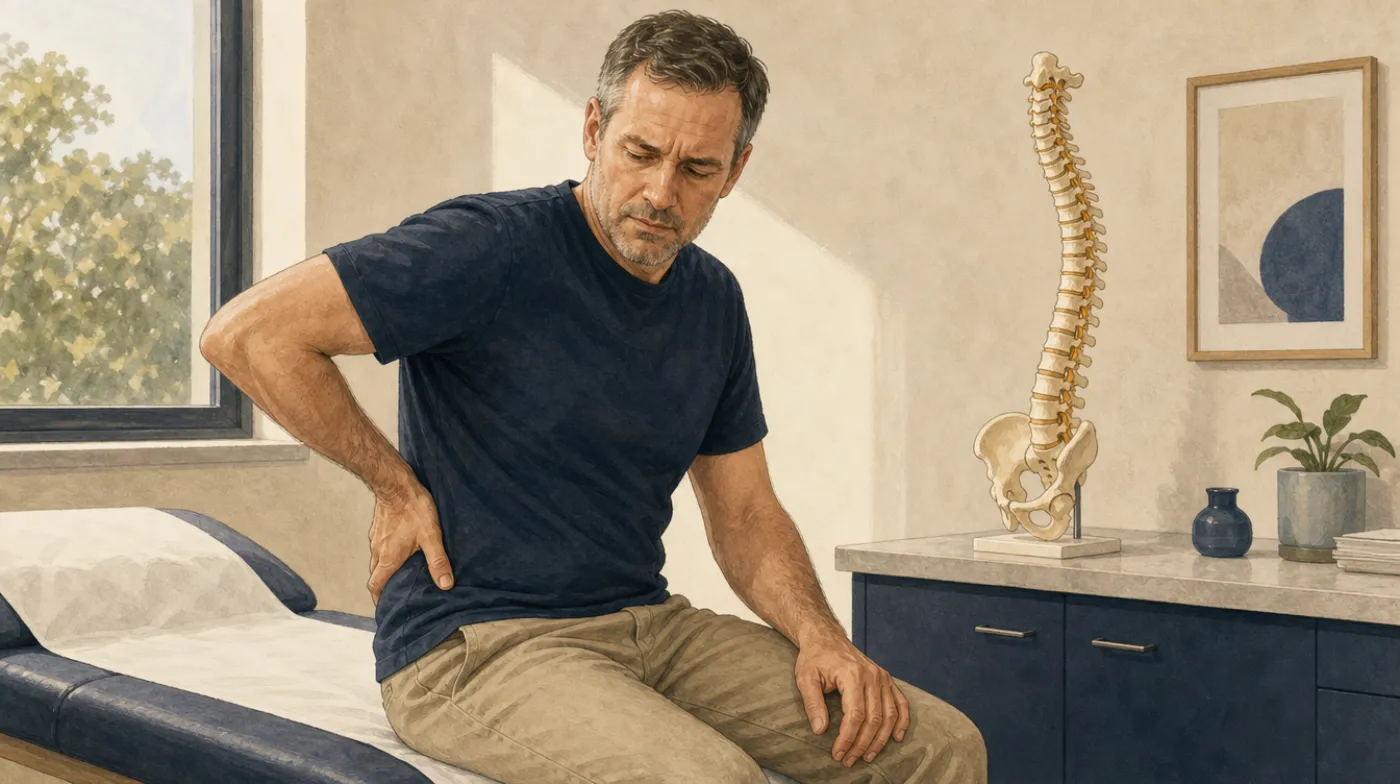
The code sits in Chapter 13 of ICD-10-CM, which covers diseases of the musculoskeletal system and connective tissue (codes M00 to M99). Within that chapter it belongs to the M50-M54 block of other dorsopathies and the M54 dorsalgia category.[3] M54.9 has no further subcodes beneath it, so the four characters are the complete code.
Why do some records show M549 instead of M54.9?
M549 and M54.9 are the same code. Electronic claims and many billing exports drop the decimal point, so a dx code field can read M549 while the clinical note or online lookup shows M54.9. Searches for "M549 diagnosis code" or "dx code M549" point to the same "Dorsalgia, unspecified" entry.
What does dorsalgia mean on an M54.9 record?
Dorsalgia means back pain. The word joins the Latin dorsum, meaning back, with the Greek algos, meaning pain, and ICD-10-CM uses it as the heading for the whole M54 category. On a record, "dorsalgia, unspecified" is the formal way of writing back pain whose region the code does not name.
The official Tabular List places M54.9 beneath the M54 dorsalgia category.[3] It gives two inclusion terms: "Backache NOS" and "Back pain NOS."[3] These are the entry's published terms, not a list of diagnosed causes.[3]
NOS means "Not otherwise specified" in the official guidelines.[2] Unspecified concerns the detail available for coding; it is not a pain-intensity score.[2]
For a record-reading conversation, keep three items together: the exact code, the written assessment and the encounter date. Ask the issuing office to explain any difference between the short code label and the longer clinical note.
Why would a clinician record dorsalgia, unspecified?
An unspecified code reflects what the documentation supports at that visit. The official guidelines describe unspecified codes as appropriate when the record lacks the detail for a more specific code.[2] An early visit, a telehealth check or a note focused on another problem can all end with back pain that has not yet been localized or explained.
A later assessment by a primary care physician, a physiatrist (physical medicine and rehabilitation physician), an orthopedic specialist or a physical therapist may add detail. That detail can lead to a different, more specific code on a later record. The MedlinePlus overview of back pain from the National Library of Medicine describes the range of causes clinicians consider.
How is M54.9 different from M54.50 and M54.89?
M54.9 does not name a spinal region.[1] Other entries name the lower back, thoracic spine or neck.[1] The comparison below preserves the official descriptions rather than choosing a code from the location where a reader feels pain.[1]
The "other" and "unspecified" labels have different coding meanings.[2] The guidelines associate "other" with documented detail lacking its own specific code, and "unspecified" with insufficient detail for a more specific code.[2]
For the lower-back subcategory and its related entries, see the separate M54.50 low back pain code guide. This page focuses on the broader M54.9 label.
| Code | Official description | Detail named in the label |
|---|---|---|
| M54.9 | "Dorsalgia, unspecified" | No named spinal region.[1] |
| M54.50 | "Low back pain, unspecified" | Lower-back location.[1] |
| M54.51 | "Vertebrogenic low back pain" | Lower-back location with a named vertebral source.[1] |
| M54.6 | "Pain in thoracic spine" | Thoracic location.[1] |
| M54.2 | "Cervicalgia" | A separate cervical entry.[1] |
| M54.30 | "Sciatica, unspecified side" | Pain along the sciatic nerve, side not named.[1] |
| M54.89 | "Other dorsalgia" | The other-dorsalgia entry.[1] |
The table shows the core difference in one line each: M54.9 is the broadest dorsalgia label, and every neighboring entry adds a region, a side or a named source. Before October 1, 2021, low back pain had a single code, M54.5; CMS expanded it into M54.50, M54.51 and M54.59 in the FY 2022 release, so older records may still show M54.5.
Is M54.9 the same as lumbago or low back pain?
No. Lumbago is an older word for low back pain, and ICD-10-CM indexes low back pain to the M54.5 subcategory, not to M54.9.[3] M54.9 stays the general dorsalgia entry when the record does not name the lower back. Readers whose paperwork names the lumbar region can compare options in the low back pain treatment guide.
Does M54.9 mean chronic back pain?
The M54.9 description contains neither "acute" nor "chronic."[1] Separate descriptions identify G89.29 as "Other chronic pain" and G89.4 as "Chronic pain syndrome."[1] Those labels are not synonyms for M54.9.[1]
The official chronic-pain coding guidance sets no fixed duration threshold and instead refers to provider documentation.[2] It also distinguishes chronic pain syndrome from chronic pain.[2] This is a coding distinction, not a clinical definition based on elapsed weeks.[2]
Ask: "Does the assessment document duration separately from the back-pain location?" Do not use this comparison to add, replace or sequence codes on a claim.
The G89.4 chronic pain syndrome code explainer covers that separate label in more depth. For the clinical side of long-lasting pain, the chronic pain condition page and the overview of chronic pain treatment approaches describe how clinicians assess and manage it.
Why look beyond the single M54.9 description?
The Tabular List carries notes above the individual code.[3] M54 has an Excludes1 note for psychogenic dorsalgia.[3] The M50-M54 block carries Excludes1 notes for current injury and discitis NOS.[3]
These are examples of ancestor notes, not a complete coding checklist. A short description alone omits that surrounding classification. Ask the coding office to review the complete entry and its context rather than treating this page as a claim-submission tool.
An Excludes1 note means the two conditions are not coded together, according to the official guidelines.[2] Certified coders and health information staff read these notes alongside the clinician's documentation, which is why the same symptom can end up under different codes in different records.
Which ICD-10-CM year applies to the record?
CMS identifies the FY 2027 diagnosis files for encounters and discharges from October 1, 2026, through September 30, 2027.[4] A late-2026 encounter therefore falls within a release named 2027.[4]
Ask which release matches the encounter date, especially when comparing an older record with a current online lookup. The source-check date on this page is not the date of your assessment.
What should you ask about an M54.9 code on your paperwork?
A short list of questions keeps the conversation about the record, not about the code in isolation. These work at a primary care office, a spine clinic or a billing department.
- Which part of the back does the clinical note describe, and does a more specific code fit that note?
- Does the assessment record how long the pain has lasted, and is any chronic pain label listed separately?
- Which ICD-10-CM release year was used for this encounter date?
- Has any imaging, exam finding or referral added detail since this visit?
Where can you compare a service already discussed with a clinician?
If PRP is already being discussed with your clinician, use the PRP clinic directory to compare recorded services separately from the diagnosis-code question. Regenerated.com's September 2026 export contains 2,082 PRP-tagged listings among 9,042 published clinic records, across 48 states plus Washington, DC. Source: September 2026 clinic export, recounted October 24, 2026.
This is directory category coverage, not market size, a live inventory total or a count of M54.9-specific providers. It is not a recommendation to use PRP for back pain. Inclusion is not an endorsement.
For local records, browse PRP clinics in Carlsbad, California or PRP clinics in Piedmont, California. Ask the clinic what service it actually provides and who performs the assessment. Keep that conversation separate from questions about the code on your paperwork.
Platelet-rich plasma (PRP) injections for back pain are usually cash pay, and the evidence for spinal uses is still limited and mixed. The PRP treatment guide sets out what the injections involve and where research is thin, and the post on regenerative medicine for back pain compares PRP with related options such as prolotherapy and stem cell therapy. To see listings by service, the national platelet-rich plasma clinic list is organized by state and city. Listing order is not paid ranking, Featured slots are labeled and capped, Verified means credential checks rather than spend, and Regenerated.com is free for patients.
Frequently asked questions
What is the M54.9 diagnosis code?
M54.9 is the ICD-10-CM diagnosis code for "Dorsalgia, unspecified," which means back pain recorded without a named spinal region.[1] It sits in the M54 dorsalgia category of Chapter 13, the musculoskeletal chapter, and lists "Backache NOS" and "Back pain NOS" as inclusion terms.[3] The code does not state a cause or duration, so the written assessment carries the clinical detail.
Does M54.9 identify the cause of back pain?
No, M54.9 does not identify a cause. The entry names unspecified dorsalgia, with unspecified backache and back pain as its inclusion terms.[3] Those words do not establish a particular cause such as a disc, joint, nerve or muscle problem.[3] Ask the issuing clinician what the accompanying assessment says, since the note usually holds more detail than the four-character code shows on a bill or summary.
Is M54.9 the same as M54.50?
No. M54.9 is the unspecified dorsalgia label and names no spinal region.[1] M54.50, "Low back pain, unspecified," explicitly names the lower back.[1] The descriptions differ even though both contain unspecified wording.[1] A record that documents lower back pain generally points toward the M54.5 subcategory, while M54.9 stays the broader label for back pain whose region the code does not name.
What does NOS mean after back pain?
NOS means "Not otherwise specified" in ICD-10-CM.[2] It describes unspecified terminology, not how severe the symptom feels.[2] "Back pain NOS" is one of the two inclusion terms under M54.9, alongside "Backache NOS," and signals that the record did not add region or cause detail.[3] NOS works much like the word unspecified in a code title.
Is M549 a valid diagnosis code?
Yes, M549 is the same code as M54.9 written without its decimal point. Claim forms and billing systems commonly store ICD-10-CM codes without the decimal, so a dx code of M549 refers to "Dorsalgia, unspecified."[1] M54.9 has no subcodes beneath it, which makes the four-character form complete. Whether a payer accepts it for a given service is a separate coverage question for the billing office.
Does the 2027 release begin in January 2027?
No. CMS lists October 1, 2026, as the start of the FY 2027 ICD-10-CM diagnosis release, with an end date of September 30, 2027.[4] The US federal fiscal year starts in October, so each release is named for the year it ends. An encounter in November 2026 falls under the FY 2027 files, and comparing it against an older lookup can show different wording.
Sources
- CMS: FY 2027 ICD-10-CM code descriptions. Checked October 24, 2026.
- CMS and NCHS: FY 2027 ICD-10-CM Official Guidelines. Checked October 24, 2026.
- CMS: FY 2027 ICD-10-CM Tabular List, M54.9 and ancestors. Checked October 24, 2026.
- CMS: ICD-10 releases and diagnosis-file effective dates. Checked October 24, 2026.