

In this article
PRP under the eyes is an injection of platelet-rich plasma, concentrated from your own blood, into the tear trough and lower eyelid area to target dark circles, fine wrinkles and mild hollowness. The evidence is small: a 2026 split-face trial of 24 people by Behrangi and colleagues reported improvement in under-eye pigmentation and fine wrinkles with both PRP and PRF, while Mehryan's 2014 study of 10 people found a significant change only in color uniformity.[4][2]
PRP under-eye injections use platelet-rich plasma prepared from a person's own blood. Published research has measured under-eye pigmentation and wrinkles rather than treating every cosmetic concern as a single outcome.[1][2]
Key takeaways
- PRP under-eye treatment injects platelet-rich plasma separated from a person's own blood, and the American Academy of Dermatology (AAD) says evidence for PRP skin rejuvenation is still thin.[1]
- Behrangi et al. (2026) gave 24 people PRP on one side and PRF on the other in three sessions; both sides improved in pigmentation and fine wrinkles, with no significant difference.[4]
- Mehryan et al. (2014) found a significant change only in color uniformity after one PRP session in 10 people.[2]
- Al Hassan et al. (2025) found no significant change on blinded dermatologist ratings after combined PRP and microneedling in 13 adults.[3]
- The AAD lists pain, bruising and swelling that usually settle within a few days, and says insurance does not cover cosmetic PRP.[1]
Sources and directory links checked October 28, 2026. The FDA source is an October 12, 2026 archive. This guide describes procedures and research, not a treatment recommendation.
What is PRP under-eye treatment?
PRP stands for platelet-rich plasma. The American Academy of Dermatology describes blood collection, separation in a centrifuge and use of the platelet-concentrated portion in a cosmetic procedure.[1]
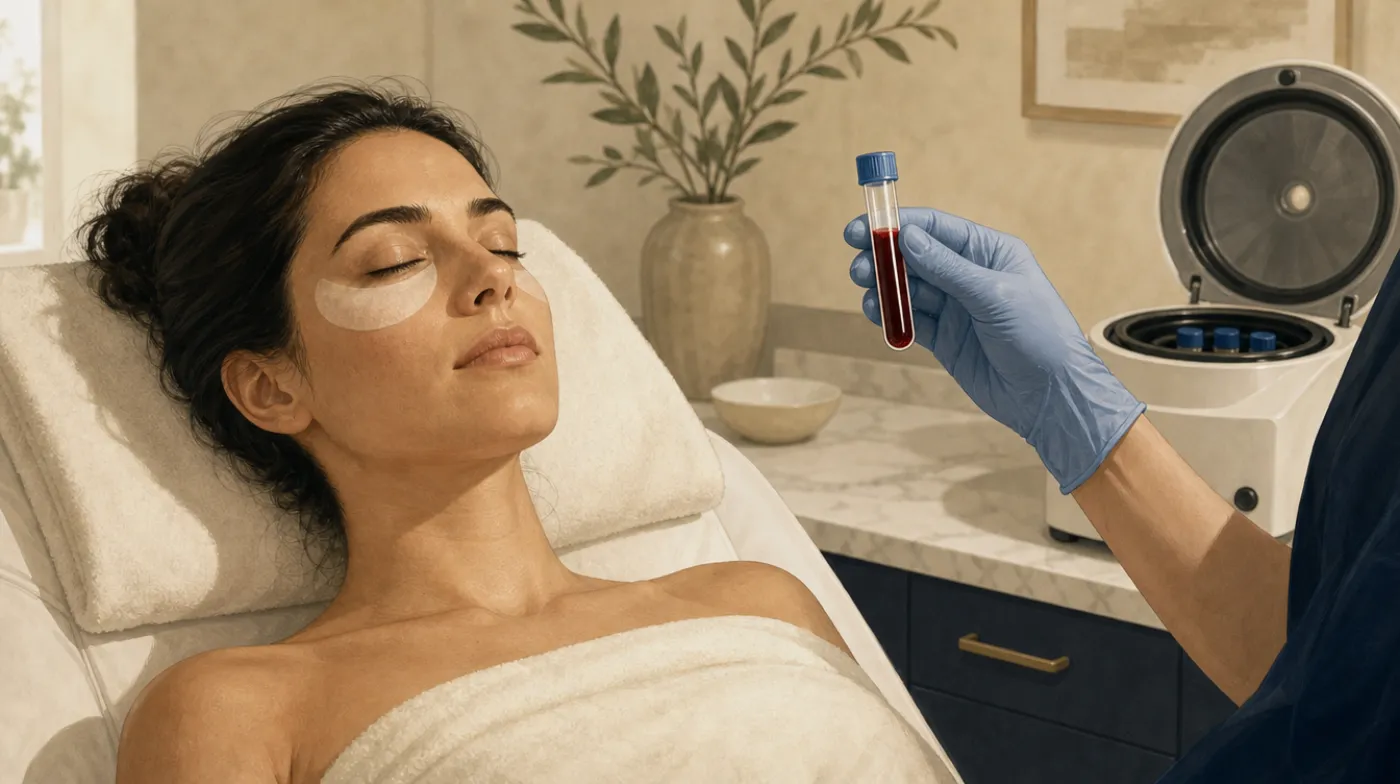
Clinics describe the same idea as under-eye PRP, PRP for dark circles, tear trough PRP or periorbital PRP. The concerns studied are infraorbital or periorbital hyperpigmentation (dark circles), crow's feet, fine wrinkles and tear trough hollowness. PRP is also used outside the face, and the platelet-rich plasma treatment guide covers its uses for joints, tendons and hair.
An under-eye injection and a combined microneedling procedure are different study interventions. Mehryan's study used injections; Al Hassan's study combined injections, topical PRP and microneedling.[2][3]
Ask the provider to name every part of the proposed procedure. Is it an injection, microneedling with PRP, or a combination? Is a separate filler included? AAD notes that some cosmetic appointments also include filler, so the word PRP alone does not describe every component.[1]
Does PRP under the eyes work for dark circles and wrinkles?
PRP under the eyes has limited, mixed evidence for dark circles and fine wrinkles. Three original studies cover 47 people in total, none with an untreated control group, and they measured different things in different ways.[2][3][4]
The most positive report is Behrangi et al. (2026) in the Journal of Cosmetic Dermatology. Clinician grading of periorbital hyperpigmentation and wrinkles improved on both the PRP side and the PRF side, and patient satisfaction rose. The weakest result came from Al Hassan et al. (2025), where three blinded dermatologists saw no significant change after one combined PRP and microneedling session.[4][3]
The AAD says there is little evidence on whether PRP skin rejuvenation works, and insurance does not cover it for appearance. Under-eye PRP is a cash-pay cosmetic procedure backed by small studies.[1]
What have PRP under-eye studies measured?
The table separates participants, follow-up and reported endpoints. It is a comparison of study designs and observations, not a ranking of procedures or a prediction of an individual's result.
| Original report | People and comparison | Follow-up | What the investigators reported |
|---|---|---|---|
| Mehryan et al., 2014 | 10 participants; before-and-after injection study | Baseline versus 3 months | Color uniformity changed significantly, P=0.010. Melanin content, hydration, wrinkle volume and visibility index did not show significant changes.[2] |
| Al Hassan et al., February 2025 issue | 13 adults; combined PRP and microneedling cohort without an untreated comparison group | Photographs before treatment, at 1 week and 3 months | Blinded dermatologist ratings did not differ significantly across visits for crow's feet, texture, pigmentation or wrinkles. Patient questionnaires reported perceived changes.[3] |
| Behrangi et al., 2026 | 25 enrolled; 24 completed. Each person received PRP on one side and PRF on the other | Assessments at months 3, 4 and 7 | Table 2: median periorbital hyperpigmentation grade (0 to 4 scale) was 2.00 at baseline and 1.00 at month 7 on each side. Month-7 between-side P=0.564.[4] |
The studies also differed in sessions and technique. Mehryan's participants had a single session of intradermal injections, 1.5 mL of PRP into the tear trough and crow's feet on each side. Al Hassan's participants had one combined session. Behrangi's participants had three sessions four weeks apart, delivered by blunt cannula along the tear trough.[2][3][4]
How were patient reports and photographs assessed?
Al Hassan's study collected patient questionnaires at one week and had three independent dermatologists grade standardized photographs. The photograph order was randomized; participants were not randomly assigned to different treatments. The title's randomized wording should not be read as a randomized treatment comparison.[3]
Its Table 3 reports P=0.553 for pigmentation across visits. The authors identify the small cohort and absent control group as limitations.[3]
Mehryan's original abstract was available, but its full text was not inspected. Its significant color-uniformity finding and nonsignificant melanin result are separate endpoints; neither should replace the other in a summary.[2]
For any before-and-after image, ask whether lighting, positioning, assessment timing and additional procedures were consistent. Al Hassan's investigators explicitly standardized their photography setup.[3]
Is PRF the same preparation as PRP?
No. PRF means platelet-rich fibrin. In Behrangi's trial, the PRF preparation used no anticoagulant, while PRP used acid citrate dextrose. Those are the trial's preparations, not a recipe or a guarantee of what a clinic offers.[4]
The participant and evaluating dermatologist were blinded to side assignment, but the treating dermatologist was not. Both sides received an active procedure; there was no untreated side. A nonsignificant between-side comparison does not establish that the preparations are equivalent.[4]
Our broader PRP Therapy guide includes the preparation comparison and additional measurements from this trial. Ask a provider to identify the preparation rather than using PRP and PRF interchangeably.
PRF or PRP under eyes: what did the head-to-head trial find?
Behrangi et al. (2026) found no significant difference between PRP and PRF for under-eye pigmentation, wrinkles or hollowness, and both sides improved over seven months. The ethics committee of Iran University of Medical Sciences approved the trial, and one experienced provider performed every injection. The PRF used is the liquid, injectable form, sometimes called i-PRF.[4]
| Attribute | PRP side | PRF side |
|---|---|---|
| Anticoagulant | Acid citrate dextrose (ACD-A) added to the blood | None |
| Centrifuge spin | 1500 RPM for 10 minutes | 1100 RPM for 3 minutes |
| Pigmentation and wrinkle grades | Improved significantly from baseline | Improved significantly from baseline |
| Melanin and redness readings | Rose at month 3, then declined | Declined steadily from month 3 |
| Severe hollowness | Not enough correction | Not enough correction |
| Post-injection pain | Nearly half of participants said this side hurt more | About one in eight said this side hurt more |
The authors suggested PRF may suit people whose main goal is lighter dark circles, because its melanin readings fell more steadily. That is a reading of one trial with 24 people, not a settled answer to PRF or PRP under eyes.[4]
Does microneedling device clearance cover delivery of PRP?
The FDA microneedling page, as archived October 12, 2026, states that microneedling devices are not approved to deliver blood products, including PRP, into skin. That statement concerns this combined device use; it is not a blanket finding about every PRP injection.[5]
If a clinic cites FDA clearance, ask for the device name, its record and the specific cleared use. Keep the device claim separate from any claim about the proposed combination. The current FDA page could not be retrieved directly for this source check; the citation identifies the archived version.
What happens during a PRP under-eye appointment?
A PRP under-eye appointment follows the same three steps as other cosmetic PRP, according to the AAD, and the whole procedure takes about 45 minutes to one hour.[1]
- A small amount of blood, about 2 to 4 tablespoons in the AAD's description, is drawn from the arm.[1]
- The tube is spun in a centrifuge, which separates the blood into layers, and the platelet-concentrated layer is drawn into a syringe.[1]
- The clinician numbs the entry point and places the plasma under the eye. Behrangi's team used lidocaine and a blunt cannula; Mehryan's team used intradermal needle injections.[4][2]
The AAD describes little to no downtime, and in Al Hassan's study most participants reported no downtime after the combined procedure. For a fuller picture of the days after treatment, see the separate post on PRP recovery time.[1][3]
What are the side effects of PRP under the eyes, and who should avoid it?
The common side effects of PRP under the eyes are pain, bruising and swelling, which the AAD says tend to go away within a few days. In Behrangi's trial, 15 of 24 participants reported swelling that resolved within several days, and no major side effects were observed.[1][4]
The AAD names blood handling as the biggest risk. Blood must stay sterile to avoid infection, and the facility should check identity the way transfusion centers do, so that each person receives only their own blood.[1]
The AAD does not recommend PRP rejuvenation for people with hepatitis C, HIV or AIDS, any blood cancer, cardiovascular disease that requires a blood thinner, or skin cancer in the area to be treated. Tell the evaluating clinician about every medication and diagnosis before blood is drawn.[1]
How long do PRP under-eye results last, and how does PRP compare with filler?
No study has established how long PRP under-eye results last for an individual. Behrangi's team saw partial reversal of some measures by month 7 and wrote that repeat sessions every 3 to 4 months may be required to maintain results. The AAD says that when results appear, the full effect shows within a few weeks to months.[4][1]
PRP and PRF mainly improve skin quality rather than replace lost volume, according to Behrangi's authors. That is why some dermatologists inject a filler in the same visit for immediate change, as the AAD notes. Ask which part of any visible change comes from the filler and which from the PRP.[4][1]
The general post on how long PRP lasts covers other body areas, and exosome therapy compared with PRP covers a newer, less studied alternative.
What should you ask before comparing PRP appointments?
Start with the concern the clinician is assessing: pigmentation, a hollow, wrinkles or something else. Behrangi's trial graded these as separate outcomes rather than treating them as one interchangeable measurement.[4]
Ask who will evaluate you and who will perform the procedure, and request their licensing information. Ask which published study matches the proposed preparation and method. Request an explanation of alternatives, possible complications, follow-up arrangements and the limits of the evidence for your situation.
Under-eye PRP is offered by dermatologists, oculoplastic surgeons, facial plastic surgeons and nurse injectors or physician assistants working under medical supervision. The AAD advises seeing a board-certified dermatologist before trying PRP for skin.[1]
For a written quote, ask whether consultation, blood processing, each procedure component and follow-up are included. Ask whether the quoted amount covers one visit or a package. This page provides no price promise or recommended number of visits.
Where can you compare PRP clinic records?
Browse the PRP Therapy clinic directory for recorded services and locations. Regenerated.com's September 2026 export contains 2,082 records listing PRP among 9,042 US clinic records, across 48 states plus DC. Source: seo/clinics-export-2026-09.csv, summarized in data/directory-facts/prp.json. This is directory coverage, not a count of under-eye specialists or a measure of treatment outcomes.
State comparisons include PRP Therapy clinics in Nebraska, PRP Therapy clinics in Oklahoma and PRP Therapy clinics in South Dakota. A broad PRP category does not confirm a particular cosmetic procedure.
Two aesthetic-practice profiles recording PRP are NK Aesthetics & Wellness Lounge in Ridgewood, New Jersey and Dallas Medicine & Aesthetics in Frisco, Texas. These are examples, not endorsements. Confirm current under-eye services, practitioner credentials and fees directly with the practice.
When you scan the national list of clinics offering platelet-rich plasma, read the order with the site's rules in mind. Listing order is not paid ranking, Featured slots are labeled and capped, Verified means credential checks rather than spend, and Regenerated.com is free for patients. The guide to Featured, Verified and organic listings explains each label, and inclusion in the directory is not an endorsement.
Frequently asked questions
Does a PRP appointment always include microneedling?
No, a PRP appointment does not always include microneedling. The studies summarized here used different interventions: Mehryan reported intradermal injections alone, while Al Hassan combined injections, topical PRP and microneedling in one session. The FDA's archived page also states that microneedling devices are not approved to deliver PRP into skin. Ask the clinic to list every proposed component, including any filler, before you compare appointments.[2][3][5]
Did the 2026 PRP versus PRF trial include 48 people?
No, Behrangi's 2026 trial did not include 48 people. It enrolled 25 people and 24 completed it. Each participant received PRP on one side of the face and PRF on the other, so the trial compared two sides of the same 24 faces. Treating two sides of each face did not create two independent groups of 24 people, which matters when reading its between-side results.[4]
Does a three-month study visit establish how long PRP lasts?
No, a three-month study visit does not establish how long PRP lasts. Mehryan compared measurements at baseline and three months, and its abstract does not establish the duration of an individual cosmetic result beyond that assessment. Behrangi's team followed people for seven months, saw partial reversal of some measures and suggested repeat sessions every 3 to 4 months may be required.[2][4]
Does a directory PRP listing confirm under-eye injections?
No, a directory PRP listing does not confirm under-eye injections. It records a broad PRP service category, which can cover joint, hair or skin procedures. Confirm the exact procedure, the preparation used, who performs it and current availability with the provider. The listing is not a recommendation, and inclusion in the directory is not an endorsement of any practice.
Is PRP or PRF better for under eyes?
Neither PRP nor PRF has been shown to be better for under eyes. In Behrangi's 2026 split-face trial of 24 people, both improved pigmentation and fine wrinkles with no significant difference between sides. PRF showed steadier melanin readings, and nearly half of participants said the PRP side hurt more after injection. One small trial cannot settle the question.[4]
What are the side effects of PRP under the eyes?
The usual side effects of PRP under the eyes are pain, bruising and swelling that tend to settle within a few days, according to the AAD. In Behrangi's trial, 15 of 24 people had swelling that resolved within several days and no major side effects were seen. The AAD names unsterile blood handling, with infection risk, as the biggest concern.[1][4]
Sources
- American Academy of Dermatology: Platelet-rich plasma and cosmetic procedures. Checked October 28, 2026.
- Mehryan et al. (2014): PRP for infraorbital dark circles and crow's feet. Checked October 28, 2026.
- Al Hassan et al. (2025): Combined PRP and microneedling around the eyes. Checked October 28, 2026.
- Behrangi et al. (2026): Randomized split-face PRP and PRF comparison. Checked October 28, 2026.
- FDA: Microneedling devices, archived October 12, 2026. Checked October 28, 2026.