Perry BARA-MED Hyperbaric Chamber: Models, Specs, and 2026 Pricing
Explore the clinic directoryIn this article
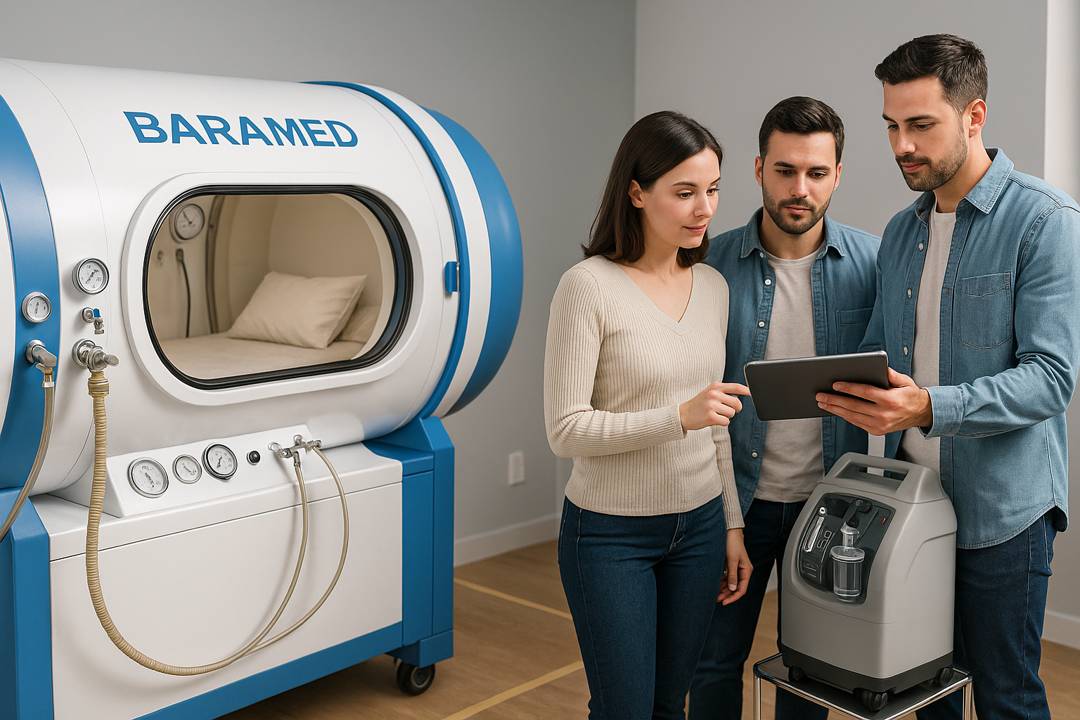
The BARA-MED is a clinical monoplace hyperbaric chamber line built by Environmental Tectonics Corporation and now sold and serviced by Perry Baromedical, which acquired the ETC hyperbaric division in February 2020. It treats one patient at a time in a 100% oxygen acrylic tube at pressures up to 3.0 ATA, is FDA-cleared as a Class II device (510(k) K020974), and ships in three configurations: the BARA-MED, the BARA-MED Select, and the BARA-MED XD. New clinical monoplace systems are quote-only and typically run into the low six figures; used BARA-MED units sell case by case.
What Is the Perry BARA-MED?
The BARA-MED is a single-patient acrylic monoplace chamber for hospital and wound-care use. Environmental Tectonics Corporation designed it, and Perry Baromedical took over the line when it bought ETC’s hyperbaric division in February 2020, so current buyers deal with Perry for sales, parts, and service on both new and installed BARA-MED equipment.1
The chamber fills entirely with 100% medical oxygen and pressurizes to a maximum of 3.0 ATA, which is the pressure range the Undersea and Hyperbaric Medical Society ties to its 14 approved indications, including diabetic wounds, radiation injury, and carbon monoxide poisoning.3 That is the practical dividing line between clinical HBOT and the 1.3 ATA soft-shell units built for home wellness use. If you are shopping for a home chamber, the BARA-MED is not the right context; start with the home chamber guide instead.
ETC’s design signature is a curvilinear compression profile it markets as Smooth Ride, which the company says cuts barotrauma incidence by 67% by controlling how fast the chamber pressurizes.1 All three models carry it, along with an air-break system, a patient call button, and two-way communication.
What Models and Specs Does the BARA-MED Line Include?
Three configurations share the same 3.0 ATA acrylic vessel and Smooth Ride compression, then separate on control system, patient capacity, and oxygen efficiency. The XD is the current flagship; the Select adds the computerized O.S.C.A.R. record system and a heavier gurney; the base BARA-MED is the entry configuration.
BARA-MED Models Compared
| Feature | BARA-MED | BARA-MED Select | BARA-MED XD |
|---|---|---|---|
| Max pressure | 3.0 ATA | 3.0 ATA | 3.0 ATA |
| Acrylic diameter | 34 in | 34 in | 34 in |
| Pressure control | BARA-PRESS computerized | O.S.C.A.R. computerized, tamperproof record | BARA-PRESS with manual pneumatic backup |
| Gurney capacity | 500 lb | 700 lb | 700 lb |
| Oxygen consumption | 90 to 400 SLPM | 90 LPM (vs 240 LPM competing chambers, per ETC) | 90 to 400 SLPM |
| Emergency features | Air break, two-way comms, call button | Air break, passive pressure-relief mattress | Air break, scoop-litter gurney, manual backup |
| FDA status | Class II, 510(k) K020974 (cleared 2002) | ||
The Select’s low oxygen consumption is the line’s headline operating claim. ETC states the Select runs on roughly 90 liters of oxygen per minute against about 240 liters in competing chambers, which it translates into approximately $8,000 per year in oxygen savings for a busy program.1 Treat both figures as manufacturer marketing rather than independently audited numbers; the exact savings depend on session volume, local oxygen pricing, and duty cycle.
How Much Does a BARA-MED Chamber Cost?
New BARA-MED pricing is quote-only. Perry sells clinical monoplace systems through direct quotes rather than list prices, and the total depends on model, gurney, facility oxygen infrastructure, and service contract. As market context, new clinical monoplace chambers generally run from roughly $80,000 to $150,000 installed, and used or refurbished units sell well below that.
On the used market, comparable clinical monoplace chambers list from about $49,500 for a used Perry Sigma 34 to roughly $128,625 for a low-cycle Sechrist 3600H, and used BARA-MED XD units are sold contact-for-quote with a 6-month warranty and extended options.7 For current figures across new, used, and per-session pricing, see the hyperbaric chamber price index and the broader cost guide.
BARA-MED vs Sechrist: Which Clinical Monoplace?
The BARA-MED XD and the Sechrist 3600H are the two acrylic monoplace chambers most US clinical buyers cross-shop. Both are FDA-cleared Class II devices that reach 3.0 ATA with 100% oxygen. The practical differences are diameter, control philosophy, and how each brand’s parts and service network is positioned.
BARA-MED XD vs Sechrist 3600H
| Spec | BARA-MED XD | Sechrist 3600H |
|---|---|---|
| Internal diameter | 34 in | 35.5 in |
| Max pressure | 3.0 ATA | 3.0 ATA |
| Control | BARA-PRESS with manual pneumatic backup | Manual and semi-automated control |
| FDA status | Class II, 510(k) K020974 | Class II, FDA-cleared |
| Used price (indicative) | Contact for quote, 6-mo warranty | $107,000 to $128,625 used |
Neither chamber gives you an inside attendant. If you treat unstable or critically ill patients who need staff at the bedside during compression, a monoplace of either brand is the wrong tool and a multiplace chamber is the clinical answer. A pro/con review by Lind (2015) in Diving and Hyperbaric Medicine concluded that multiplace chambers are better suited to HBOT of critically ill patients, while monoplace units are the cost-efficient choice for stable outpatients.5 See the multiplace chamber guide for that comparison.
One monoplace-specific data point is worth knowing: a study by Churchill et al. (2016) found that 32% of monoplace patients reached 20/40 vision or worse during a treatment course versus 18% in multiplace settings, a transient refractive shift that resolves after therapy ends.6
Should You Buy New or Refurbished?
Refurbished BARA-MED and Sigma units let a clinic reach clinical-grade capability at a fraction of new-unit pricing, which matters for a startup wound-care program watching capital cost. Perry offers used and refurbished chambers with OEM warranty on select units, and Sechrist runs a Certified Pre-Owned program with a 90-day limited OEM warranty.
The trade-offs on used equipment are acrylic age, cycle count, and remaining service life on the pressure vessel. A low-cycle recent unit with documented maintenance history is a different purchase from a decade-old chamber near its recertification window. For any refurbished clinical chamber, verify the acrylic inspection record, the compression cycle count, and whether the OEM will still support parts before you sign.
Who Is the BARA-MED For?
The BARA-MED is a clinical device for hospitals, wound-care centers, and hyperbaric practices treating physician-supervised patients under UHMS-approved indications. It is not a home or wellness chamber, and no BARA-MED model is sold for unsupervised use.
Clinical pressure is the reason these chambers exist. Tissue oxygenation scales with chamber pressure: a study by Sack et al. (2024) measured transcutaneous oxygen in 130 chronic ulcer patients at an average of 161 mmHg at 1.4 ATA versus 333 mmHg at 2 ATA, roughly double the oxygen delivery at the higher pressure.4 That gap is why UHMS-approved wound and radiation-injury protocols run at 2.0 to 3.0 ATA rather than the 1.3 to 1.5 ATA ceiling of home units. If your program treats those indications, a 3.0 ATA monoplace like the BARA-MED is the appropriate class of equipment; if you are a wellness buyer, it is not. For the parent brand’s full clinical lineup, see the Perry Baromedical chamber guide.
Sources
- Environmental Tectonics Corporation / Perry Baromedical. “BARA-MED, BARA-MED Select and BARA-MED XD monoplace hyperbaric chamber specifications.” bara-medhyperbaric.com. Accessed August 2026. (Smooth Ride 67% barotrauma reduction, 90 LPM oxygen consumption, and ~$8,000/year savings are manufacturer claims.)
- US Food and Drug Administration. “510(k) Premarket Notification K020974: BARA-MED Acrylic Monoplace Hyperbaric Chamber.” Class II, product code CBF, cleared June 26, 2002. fda.innolitics.com/device/K020974
- Undersea and Hyperbaric Medical Society. Hyperbaric Oxygen Therapy Indications, 14th ed. uhms.org. Accessed August 2026.
- Sack RA, Pikkel YY, Leitner Shemy O, Ramon Y, Ullmann Y, Zeltzer AA. “Transcutaneous oximetry values in chronic ulcer patients during hyperbaric treatment at 1.4 ATA compared to 2 ATA.” Undersea & Hyperbaric Medicine, 2024;51(1):1-5. PMID: 38615347
- Lind F. “A pro/con review comparing the use of mono- and multiplace hyperbaric chambers for critical care.” Diving and Hyperbaric Medicine, 2015;45(1):56-60. PMID: 25964041
- Churchill S, Deru K, Wilson G, Cable R, Bell JE, Weaver LK. “Rates of visual acuity change in patients receiving hyperbaric oxygen in monoplace and multiplace chambers.” Undersea & Hyperbaric Medicine, 2016;43(3):217-23. PMID: 27416689
- Regenerated.com. “Hyperbaric Chamber Price Index.” Used Perry Sigma 34 ($49,500) and Sechrist 3600H ($128,625) listings; used BARA-MED XD sold contact-for-quote. regenerated.com/blog/hyperbaric-chamber-price-index. Accessed August 2026.