Perry Baromedical Hyperbaric Chambers: Models, Prices, and How They Compare (2026)
Explore the clinic directoryIn this article
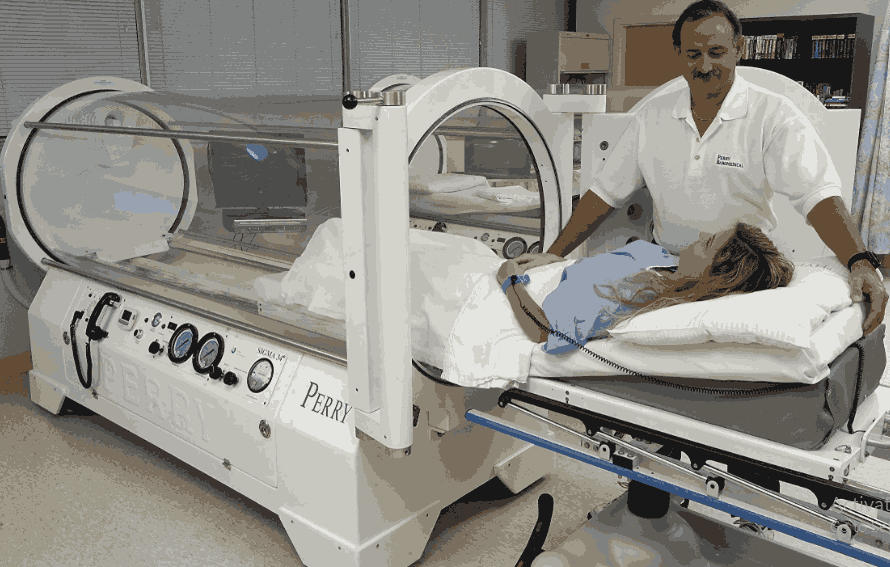
A Perry hyperbaric chamber is an FDA-cleared clinical hard-shell chamber for hyperbaric oxygen therapy (HBOT) made by Perry Baromedical, and new monoplace units typically sell for $80,000 to $150,000, with multiplace systems running $250,000 to $500,000+ depending on configuration (Regenerated.com market estimates; Perry quotes each system individually). The company traces to Perry Submarine Builders (1956), formed its Baromedical division in 1979, and today is the only full-line US manufacturer building monoplace, dualplace, and multiplace systems, including the BARA-MED line acquired from ETC in 2020.[1][2][3]
Key Takeaways
- Perry Baromedical does not publish list prices; Regenerated.com market estimates put a new Perry monoplace chamber at $80,000 to $150,000 and a multiplace system at $250,000 to $500,000+, before installation, room construction and training.
- Perry describes itself as the only full-line hyperbaric manufacturer, with the Sigma monoplace series, the Sigma 40-II dualplace and multiplace systems for 2 to 18 patients, according to its product pages.
- Perry Baromedical acquired the hyperbaric division of Environmental Tectonics Corporation (ETC) in February 2020, bringing the BARA-MED monoplace line into its Riviera Beach, Florida facility, according to the PR Newswire announcement.
- Any US clinical installation answers to ASME PVHO-1 for the pressure vessel and NFPA 99 Chapter 14 for the hyperbaric room, on top of FDA clearance of the device.
- The Cochrane review by Kranke and colleagues (2015) found HBOT improved diabetic foot ulcer healing at six weeks, but the benefit was not evident at one year, so the evidence for the biggest wound care use is mixed.
How Much Does a Perry Hyperbaric Chamber Cost?
Perry does not publish list prices; systems are quoted by configuration. Based on dealer listings and market pricing for US clinical chambers, budget $80,000-$150,000 for a new monoplace unit and $250,000-$500,000+ for multiplace systems, before installation, room construction, and training (Regenerated.com market estimates; request a written quote for your configuration).
Total cost of ownership includes installation, operator training, annual maintenance, and parts. Facilities evaluating Perry against lower-cost alternatives should factor these ongoing costs into the comparison. A chamber that requires less downtime and repairs over a 10-year lifespan often costs less overall than a cheaper unit that needs frequent servicing. Certified pre-owned Perry units with OEM warranty offer a lower entry point; our used hyperbaric chamber guide covers what refurbished clinical units cost.
For the broader pricing picture across chamber classes, see our hyperbaric chamber cost guide.
What should a Perry chamber quote include?
A written quote is the only reliable Perry hyperbaric chamber price, because the same model can land at very different totals once site work is counted. Ask for each of these as a separate line so two vendors can be compared like for like:
- The vessel itself, with model name, bore size and the control and communication package.
- Delivery, rigging and installation by the manufacturer's technicians.
- Oxygen supply work, such as piping, regulators and any bulk or manifold oxygen system the facility needs.
- Room construction needed to meet NFPA 99 Chapter 14, including fire protection and electrical work.
- Operator training for each staff member who will run treatments.
- The warranty term, the annual service plan and the expected cost of common wear parts.
Patients pay a separate per-session fee at the clinic, which is a different number from the equipment price. Our guide to buying a hyperbaric chamber and the hyperbaric chamber price index put Perry's band next to other clinical and home chamber classes.
What Models Does Perry Baromedical Make?
Perry describes itself as the only full-line manufacturer in the industry, covering monoplace through multiplace systems.[2] The current product line:
Perry Baromedical Model Line
| Model | Type | Capacity | Typical Price (Regenerated.com market estimate) |
|---|---|---|---|
| Sigma ICON 30 | Compact monoplace | 1 patient | $80,000-$110,000 |
| Sigma 34 / Sigma 36 / Sigma 40 | Monoplace, progressively larger bores | 1 patient | $90,000-$150,000 |
| Sigma Elite | Premium single-user unit | 1 patient | $120,000-$150,000 |
| Sigma 40-II | Dualplace | 2 patients | $150,000-$250,000 |
| Sigma Multiplace Series | Multiplace | 2-18 patients | $250,000-$500,000+ |
| BARA-MED line | Monoplace (ex-ETC, acquired 2020) | 1 patient | $80,000-$130,000 |
Model names, types, and capacities are from Perry’s product pages; Perry supplies pressure ratings and dimensional specs on request, so confirm the tech sheet for your model before site planning.[2] The BARA-MED brand joined the line when Perry acquired the hyperbaric division of Environmental Tectonics Corporation in February 2020 and moved BARA-MED manufacturing to its Riviera Beach, Florida facility.[3] We review that line separately in our BARA-MED hyperbaric chamber guide, and the multiplace class in our multiplace chamber overview.
Monoplace, dualplace or multiplace: what is the difference?
A monoplace chamber treats one patient, who usually breathes pure oxygen from the pressurized chamber atmosphere itself. A dualplace chamber such as the Sigma 40-II treats two patients at once in one vessel. A multiplace chamber holds a group of patients, and often an attendant, pressurized with air while each patient breathes oxygen through a mask or hood.
The choice drives everything downstream: room size, oxygen consumption, staffing and the number of sessions a facility can run per day. Our two-person hyperbaric chamber guide covers the dualplace class in more depth.
Who Is Perry Baromedical, and What Did It Acquire?
Perry Baromedical Corporation is a US manufacturer of clinical hyperbaric chambers whose roots go back to Perry Submarine Builders, founded in 1956, with the Baromedical division formed in 1979.[1] The submarine heritage explains the company's focus on pressure vessels built for human occupancy, the same engineering problem a hyperbaric chamber solves on land.
The company's best known acquisition came in February 2020, when Perry Baromedical acquired the hyperbaric division of Environmental Tectonics Corporation (ETC), the maker of the BARA-MED monoplace chamber.[3] With that deal, BARA-MED production moved to Perry's Riviera Beach, Florida facility, and BARA-MED became part of the Perry catalog alongside the Sigma series.[3]
For buyers, the practical result is that searches for "Perry chambers" and "BARA-MED hyperbaric chamber" now lead to the same manufacturer. Owners of older ETC-built BARA-MED units should confirm with Perry which service, parts and documentation support applies to their serial number, since the acquisition announcement is the public record of the transfer.[3]
How Does Perry Compare to Sechrist?
Sechrist Industries is the other major US clinical chamber manufacturer, focused on monoplace systems with a certified pre-owned program backed by a 90-day OEM warranty.[4] Perry’s differentiator is breadth: it is the only manufacturer covering monoplace, dualplace, and multiplace under one roof, which matters for hospital programs that expect to scale.
Perry vs Sechrist
| Feature | Perry | Sechrist |
|---|---|---|
| Model range | Monoplace, dualplace, multiplace (2-18 patients) | Primarily monoplace clinical chambers |
| Pre-owned program | Certified used/refurbished with OEM warranty | Certified Pre-Owned with 90-day OEM warranty |
| Heritage | Baromedical division since 1979 (Perry Submarine Builders, 1956) | Respiratory and hyperbaric equipment maker, decades in clinical HBOT |
| Typical price band | $80K-$500K+ by configuration (market estimate) | $70K-$150K monoplace (market estimate) |
| Best for | Programs that may scale to dualplace/multiplace | Monoplace-only clinics and wound care centers |
Tekna and other manufacturers also sell multiplace systems; spec-level comparisons there require direct quotes, since published pricing and independent spec sheets are scarce. Qualitative claims about build quality and support responsiveness circulate in marketing copy on all sides; we found no independent source that measures them, so we do not repeat them here.
A fair comparison asks each manufacturer the same questions in writing: the PVHO-1 documentation for the vessel, the FDA clearance for the model, the service response time written into the contract and the parts availability commitment. Our overview of hyperbaric chamber manufacturers lists the other makers worth adding to that request.
What Certifications and Safety Standards Apply?
Perry’s hyperbaric systems are FDA-cleared medical devices.[2] Beyond FDA clearance, two standards govern any US clinical installation: ASME PVHO-1, the safety standard for pressure vessels for human occupancy,[5] and NFPA 99 Chapter 14, which sets facility requirements for hyperbaric suites including fire protection, gas handling, and room construction.[6] Ask the manufacturer for the PVHO-1 documentation for your specific vessel and budget for NFPA 99 compliance in the room housing the chamber.
On the clinical safety side, a 2024 review in Annals of African Medicine (Mago, 106 patients over two years) reported only minor complications (4 ear barotrauma cases, 1 claustrophobia episode, no oxygen toxicity, no fires) and concluded HBOT is among the safer medical treatments when pre-assessment and operating protocols are followed.[7] Operator training, which Perry provides with installation, is what converts that safety record from paper to practice.
FDA clearance applies to the device and its cleared uses, not to every condition a clinic may advertise. In its consumer update Hyperbaric Oxygen Therapy: Get the Facts (2021), the FDA warns that some centers promote chambers for uses it has not cleared and advises patients to seek treatment at a facility accredited by the Undersea and Hyperbaric Medical Society (UHMS). Our post on FDA-cleared HBOT indications sets out where that line sits. Pressure-related ear injury and oxygen-related fire risk are the two hazards every protocol is written around; hyperbaric chamber side effects covers the patient side of that list.
What Clinical Applications Do Perry Chambers Serve?

Facilities running Perry equipment treat across the UHMS-accepted indication list:[8]
- Chronic wound healing and diabetic foot ulcers
- Decompression sickness
- Delayed radiation injury to soft tissue and bone
- Necrotizing soft tissue infections
- Compromised surgical grafts and flaps
- Carbon monoxide poisoning
The same UHMS list also includes arterial gas embolism, crush injury, acute thermal burns, refractory osteomyelitis, central retinal artery occlusion and idiopathic sudden sensorineural hearing loss.[8] Our guides to carbon monoxide poisoning treatment, burn treatment and HBOT for wound healing explain how hyperbaric oxygen fits each of those uses.
Most clinical protocols run 20 to 40 sessions, so patient comfort affects compliance, and compliance affects outcomes. That is an argument for evaluating chamber ergonomics in person before purchase rather than from a brochure.
Many cash-pay clinics also offer hyperbaric sessions for uses outside the UHMS list, such as traumatic brain injury recovery and long COVID. Those uses are off label, the evidence is early and insurance rarely pays for them. The hyperbaric oxygen therapy treatment guide covers the mechanism, the conditions studied and where evidence is thin.
What Does the Clinical Evidence Actually Support?
Any equipment investment case should start with the honest evidence picture, and for HBOT’s biggest wound care indication it is mixed. The Cochrane review by Kranke and colleagues (2015; five trials, 205 participants) found HBOT increased diabetic foot ulcer healing at six weeks (risk ratio 2.35, 95% CI 1.19-4.62), but the benefit was not evident at one-year follow-up, the reduction in major amputations was not statistically significant (RR 0.36, 95% CI 0.11-1.18), and the authors flagged design flaws that limit confidence in the results.[9]
Emerging research is expanding the clinical conversation beyond wounds. In healthy adults over 64, a 60-session HBOT protocol lengthened immune-cell telomeres by more than 20% in a 35-person prospective trial (Hachmo et al., Aging, 2020),[10] and a separate 63-person randomized controlled trial reported improved attention, processing speed, and executive function (Hadanny et al., Aging, 2020).[11] These are small single-center studies; the applications are not FDA-cleared indications, and no one should buy a chamber on their strength alone. They do suggest where clinical demand may grow over a chamber’s 10-year service life.
The chamber brand does not change the medicine. A Perry, Sechrist or BARA-MED monoplace delivering the same pressure and oxygen dose is running the same treatment, so the evidence above applies to the protocol, not the manufacturer. Our roundup of HBOT research tracks newer trials as they publish.
Buying, Installation, and Service
When ordering a Perry chamber, the general process involves an initial needs assessment with their sales team to select the appropriate model, site planning and preparation (electrical requirements, room dimensions, ventilation), delivery and installation by certified technicians, and operator training for all staff who will run the equipment. Lead times vary by model; monoplace units are typically available more quickly than custom multiplace configurations, and the installation team coordinates electrical load, oxygen supply infrastructure, and any construction needed to meet NFPA 99.[6]
Regular maintenance for a clinical chamber includes pressure seal inspection, oxygen delivery system checks, electrical safety testing, and emergency system verification. Parts availability matters enormously for facilities running daily HBOT programs: an unplanned chamber shutdown affects patient scheduling and clinic revenue, and Perry’s established US parts and service network reduces the risk of extended downtime compared with less widely distributed brands.
Who operates a Perry chamber?
A clinical hyperbaric program is run by a supervising physician, often trained in undersea and hyperbaric medicine, together with certified hyperbaric technologists (CHT), a credential issued by the National Board of Diving and Hyperbaric Medical Technology, and certified hyperbaric registered nurses (CHRN). Hospital wound care centers usually add wound care nurses and vascular or podiatry specialists to the referral chain. Staffing is a recurring cost that belongs in the same budget as the chamber.
Is a Perry Chamber Right for Your Facility?
Perry suits clinics with steady HBOT volume running multiple sessions per day, hospital-based wound care programs where equipment reliability is critical, and facilities that value long-term support and parts availability over the lowest upfront price. The full-line catalog also suits programs that expect to scale from monoplace into dualplace or multiplace capacity without switching vendors.
Perry may not be the right fit if your facility only plans occasional HBOT sessions; a certified pre-owned unit or a rental makes more financial sense at low volume. And if you are comparing clinical hard-shell systems against the consumer market, our home hyperbaric chamber guide explains why the two categories are not interchangeable: home soft-shell units cannot reach the pressures the UHMS indication list requires.
Patients do not buy Perry chambers; they book sessions at a clinic that owns one. The national directory of HBOT clinics lists hyperbaric providers by state and city. Listing order there is not paid ranking, Featured slots are labeled and capped, Verified means credential checks rather than spend, and the directory is free for patients. Inclusion is not an endorsement, so ask any clinic which chamber it runs and who supervises treatment.
Frequently asked questions
How much does a Perry hyperbaric chamber cost?
A new Perry hyperbaric chamber typically costs $80,000 to $150,000 for a monoplace unit and $250,000 to $500,000+ for a multiplace system, based on Regenerated.com market estimates from dealer listings. Perry does not publish list prices and quotes each configuration. Installation, oxygen supply work, NFPA 99 room construction, staff training and service plans are added on top, so request an itemized written quote before comparing it with other manufacturers.
Did Perry Baromedical acquire BARA-MED?
Yes. Perry Baromedical acquired the hyperbaric division of Environmental Tectonics Corporation (ETC), the maker of the BARA-MED monoplace chamber, in February 2020, according to the company announcement on PR Newswire. BARA-MED manufacturing then moved to Perry's facility in Riviera Beach, Florida. BARA-MED chambers are now sold as part of the Perry Baromedical line, next to the Sigma monoplace, dualplace and multiplace series.
What models of Perry chambers are there?
Perry Baromedical makes the Sigma ICON 30 compact monoplace, the Sigma 34, 36 and 40 monoplace chambers with progressively larger bores, the Sigma Elite single-user unit, the Sigma 40-II dualplace chamber, the Sigma Multiplace Series for 2 to 18 patients and the BARA-MED monoplace line. Perry supplies pressure ratings and dimensions on request, so ask for the technical sheet for the exact model before planning a room.
Are Perry hyperbaric chambers FDA cleared?
Perry hyperbaric chambers are FDA-cleared medical devices, according to Perry Baromedical's product pages. FDA clearance covers the device, not every condition a clinic may advertise for hyperbaric oxygen therapy. A US clinical installation must also meet ASME PVHO-1 for the pressure vessel and NFPA 99 Chapter 14 for the hyperbaric room, so ask for the PVHO-1 documentation for the specific vessel you are buying.
Is Perry Baromedical better than Sechrist?
Neither manufacturer is better in every case; they fit different programs. Perry covers monoplace, dualplace and multiplace systems, which suits hospital programs that expect to grow. Sechrist focuses on monoplace chambers and runs a certified pre-owned program with a 90-day OEM warranty. We found no independent study comparing build quality or service response, so compare written quotes, warranty terms and parts commitments directly.
Where can I get treatment in a Perry hyperbaric chamber?
Perry chambers are installed in hospital wound care centers and outpatient hyperbaric clinics, not sold for home use. To find hyperbaric oxygen therapy near you, browse the Regenerated.com HBOT clinic directory by state and city, then ask each clinic which chamber brand it uses, whether treatment is physician supervised and whether your condition is on the UHMS indication list, since that usually decides insurance coverage.
Sources
- Perry Baromedical. “History.” perrybaromedical.com. Link ↩
- Perry Baromedical. “Hyperbaric Oxygen Therapy Chambers” (product line). perrybaromedical.com. Link ↩
- PR Newswire. “Perry Baromedical Acquires Hyperbaric Division of ETC.” February 2020. Link ↩
- Sechrist Industries. “Certified Pre-Owned Hyperbaric Chambers.” sechristusa.com. Link ↩
- ASME. PVHO-1: Safety Standard for Pressure Vessels for Human Occupancy. American Society of Mechanical Engineers, 2023 edition. Link ↩
- NFPA. NFPA 99: Health Care Facilities Code, Chapter 14 (Hyperbaric Facilities). National Fire Protection Association, 2024 edition. Link ↩
- Mago V. “Safety of Hyperbaric Medicine in Clinical Scenarios.” Annals of African Medicine, 23(1):1-4, 2024. PMC10922184 ↩
- UHMS. “HBO2 Indications.” Undersea & Hyperbaric Medical Society. Link ↩
- Kranke P, Bennett MH, Martyn-St James M, Schnabel A, Debus SE, Weibel S. “Hyperbaric oxygen therapy for chronic wounds.” Cochrane Database of Systematic Reviews, 2015. DOI: 10.1002/14651858.CD004123.pub4 ↩
- Hachmo Y, Hadanny A, et al. “Hyperbaric oxygen therapy increases telomere length and decreases immunosenescence in isolated blood cells: a prospective trial.” Aging, 12(22):22445-22456, 2020. DOI: 10.18632/aging.202188 ↩
- Hadanny A, et al. “Cognitive enhancement of healthy older adults using hyperbaric oxygen: a randomized controlled trial.” Aging, 12(13), 2020. PMID: 32589613 ↩