Dr. Hugo Hyperbaric Chamber Review: 1.5 ATA Sit-In Pod for $6,000-$10,000
Explore the clinic directoryIn this article
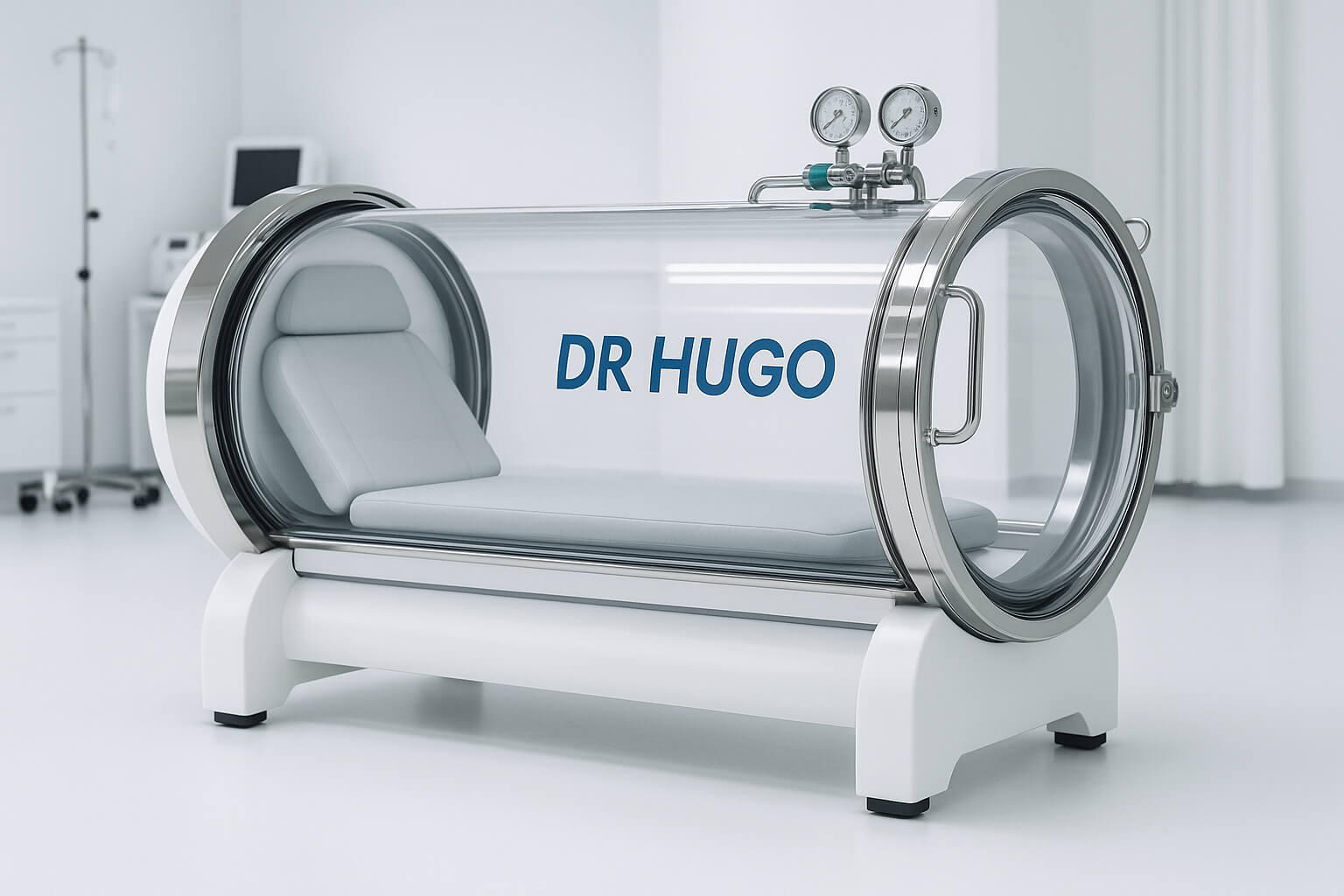
The Dr. Hugo hyperbaric chamber is a hard-shell, upright sit-in pod made by LANNX Bio&Med Co. that pressurizes to 1.5 ATA and sells for roughly $6,000 to $10,000 for the entry Sitting Pod, according to manufacturer and dealer figures. It holds CE and ISO 13485 certification but not FDA 510(k) clearance, which places it between 1.3 ATA soft chambers and the 2.0 ATA or higher pressures used for clinical hyperbaric oxygen therapy (HBOT).
The Dr. Hugo is one of the most popular mild hyperbaric oxygen therapy chambers for clinics, wellness centers, and home users who want higher pressure than the 1.3 ATA soft-shell ceiling without a clinical-grade price. Mild HBOT, sometimes written mHBOT, means pressures below the 2.0 ATA used in hospital programs. The missing FDA clearance is the key limitation for US buyers, and the sections below cover cost, the evidence at 1.5 ATA, safety at home, and how the pod compares with cleared chambers.
Key Takeaways
- The Dr. Hugo Sitting Pod reaches a maximum of 1.5 ATA, according to LANNX specifications, compared with the 1.3 ATA ceiling of FDA-cleared soft-shell chambers from OxyHealth, Summit to Sea and Newtowne.
- The entry Sitting Pod sells for roughly $6,000 to $10,000 through dealers, compared with $80,000 or more for clinical monoplace units from Perry or Sechrist.
- The chamber holds CE and ISO 13485 certification, and the FDA states that hyperbaric chambers are Class II devices that need 510(k) clearance, which CE marking does not replace.
- A 2022 systematic review by Harch in Frontiers in Neurology found the strongest mild HBOT evidence for persistent post-concussion syndrome at 1.5 ATA with oxygen over 40 sessions.
- The Undersea and Hyperbaric Medical Society (UHMS) indications, such as diabetic foot wounds and radiation injury, are treated at 2.0 to 3.0 ATA, so a 1.5 ATA pod does not replace clinical treatment for them.
What Makes the Dr. Hugo Sitting Pod Different?
The defining feature of Dr. Hugo’s most popular model is its upright seated design. Most portable chambers require you to lie down in a cylinder measuring 6 to 8 feet long. The Sitting Pod lets you sit in a compact cabin roughly the size of a phone booth, which changes the floor-space math for a home or clinic room.
- Floor footprint: about 4 by 4 feet vs 4 by 8 feet for lying chambers
- Ceiling clearance: standard 8-foot ceilings are sufficient
- During-session activities: users can read, use a laptop on external power, or meditate
- Entry style: a walk-in door rather than a horizontal zipper, easier for older users or those with mobility limits
Dr. Hugo Sitting Pod Specifications
| Specification | Detail |
|---|---|
| Footprint | Approx. 4 by 4 ft (upright cabin) |
| Entry style | Walk-in door |
| Max pressure | 1.5 ATA |
| Oxygen delivery | Concentrator O2 via mask |
| Construction | Hard-shell cabin |
| Certification | CE, ISO 13485 (not FDA-cleared) |
| Warranty | Manufacturer warranty, terms vary by dealer |
| Price | $6,000 to $10,000 (Sitting Pod) |
How Much Does a Dr. Hugo Hyperbaric Chamber Cost?
A Dr. Hugo Sitting Pod costs roughly $6,000 to $10,000 in US dollars, based on LANNX and dealer figures listed in source 1 below. The spread reflects the dealer, the configuration and which accessories ship with the unit. The specification table above lists oxygen delivered by concentrator through a mask, so confirm the concentrator is included in any quote.
The purchase price is only part of the cost. Freight, import duty, installation, electricity, replacement masks and filters, and servicing all add to the total, and dealers set these terms differently. Our home chamber versus clinic cost comparison walks through how ownership costs stack up against paying per session, and the hyperbaric chamber price index tracks list prices across brands.
What does a Dr. Hugo chamber cost in Australia?
Australian prices are set by local dealers in Australian dollars, and this review does not carry a verified Australian price. Use the US range as a starting point only, then ask for a written quote that states tax, freight and installation. Australian buyers should also check whether the exact model is included on the Australian Register of Therapeutic Goods (ARTG), which the Therapeutic Goods Administration (TGA) maintains, before treating it as a medical device.
Does 1.5 ATA Matter More Than 1.3 ATA?
Dr. Hugo’s selling point over FDA-cleared US brands is pressure. The Sitting Pod and UDR-series models reach 1.5 ATA versus the 1.3 ATA maximum for all OxyHealth, Summit to Sea, and Newtowne soft-shell chambers. The 0.2 ATA difference is not trivial, but its clinical relevance is specific rather than general.
- Mild TBI evidence sits at 1.5 ATA: a systematic review by Harch (2022) in Frontiers in Neurology found the strongest clinical evidence for mild HBOT in persistent post-concussion syndrome at 1.5 ATA with oxygen, not 1.3 ATA. Four randomized trials met Centre for Evidence-Based Medicine Level 1 criteria at that pressure and dose (40 sessions).3
- Tissue oxygenation scales with pressure: a study by Sack et al. (2024) measured transcutaneous oxygen in chronic ulcer patients at roughly 161 mmHg at 1.4 ATA versus 333 mmHg at 2 ATA, about half the oxygen delivery at the lower pressure.4
- 1.5 ATA is still below the clinical threshold: Burman (2019) in the South African Medical Journal notes that chambers at 1.4 ATA or below are recognized only for acute mountain sickness, and that therapeutic HBOT for UHMS-approved conditions requires a minimum of 2 ATA with near-100% oxygen.5 The Dr. Hugo sits in a middle tier: above the soft-shell ceiling, below clinical pressure.
The honest reading is that 1.5 ATA buys you the pressure at which the best post-concussion evidence exists, but it does not turn a wellness chamber into a device for UHMS-approved indications like diabetic wounds or radiation injury, which still need 2.0 to 3.0 ATA.6
Readers weighing concussion or traumatic brain injury as the reason to buy should note that the Harch trials were run under medical supervision with a fixed protocol. Our overview of mild HBOT versus clinical HBOT explains how those pressure tiers differ in practice.
Is the Dr. Hugo Chamber FDA Approved?
No. The Dr. Hugo holds CE certification and ISO 13485 quality-management certification, and neither is equivalent to FDA clearance. This is the most important section for US buyers.2 CE certification means the device meets European safety standards; ISO 13485 means the manufacturing quality system meets an international standard.
The FDA classifies hyperbaric oxygen therapy devices as Class II medical devices that are cleared through the 510(k) process, and cleared chambers can be found under product code CBF in the 510(k) database, according to a 2025 FDA letter to health care providers.
The three differences that matter in the US:
- Legal sale as a medical device: requires FDA 510(k) clearance. CE does not satisfy this requirement.
- Liability: in a US product-liability claim, the absence of FDA clearance is a significant factor.
- Insurance: some health and home policies do not cover damages from non-FDA-cleared medical devices.
If FDA clearance is non-negotiable for you, the FDA-cleared alternatives are the OxyHealth and Summit to Sea lines, both cleared but capped at 1.3 ATA.
Is a Dr. Hugo Chamber Safe to Use at Home?
A pressurized chamber at home carries the same basic risks as any hyperbaric session, plus the absence of trained staff. Mayo Clinic lists ear pain, middle ear injury including eardrum rupture, sinus pressure, short-term vision changes and low blood sugar in people on insulin as the more common complications of hyperbaric oxygen therapy, with lung collapse and oxygen seizures as rare, more serious events.
Fire is the hazard that matters most with oxygen. Mayo Clinic notes that oxygen-rich environments raise fire risk and that heat-generating, battery-powered devices are kept out of clinical chambers. The FDA reminds facilities to follow the manufacturer’s instructions, use proper grounding and train staff, because it has received reports of serious injuries and deaths with HBOT devices. Read the LANNX manual on oxygen routing and electronics before using a laptop or phone in the cabin.
- Talk to a physician first if you have a lung condition, ear or sinus problems, insulin-treated diabetes, a seizure history or a pacemaker.
- Equalize your ears during pressurization by swallowing or yawning, and stop if pain builds.
- Keep heat sources, lotions and oils out of the cabin, following the manufacturer’s list.
Our pages on hyperbaric chamber side effects and hyperbaric chamber fire risk cover these hazards in more depth.
Who Should Buy a Dr. Hugo Chamber?
Dr. Hugo makes sense for buyers who want 1.5 ATA in a hard-shell sit-in format and accept CE certification instead of FDA clearance. It is a poor fit for US buyers who need a cleared device or who expect clinical-grade treatment.
It fits:
- Clinic and wellness operators who want a commercially capable chamber below clinical-grade pricing ($6,000 to $10,000 vs $80,000-plus for Perry or Sechrist monoplace units)
- Home users outside the US where CE certification is the relevant standard
- Space-constrained buyers who cannot fit a lying chamber but want a hard-shell upright option
It does not fit:
- US buyers who require FDA clearance for regulatory, insurance, or liability reasons
- Users needing clinical-grade treatment, since 1.5 ATA is still below the 2.0 to 3.0 ATA required for UHMS-approved conditions
Before you commit, run the numbers against comparable units in the hyperbaric chamber cost guide and the best home chamber rankings.
Is the Dr. Hugo chamber good or bad?
The Dr. Hugo is a reasonable buy for a narrow group and a poor one for everyone else. Its strengths are 1.5 ATA in a hard shell, a small upright footprint and a price well below clinical equipment. Its weaknesses are the lack of FDA clearance, dealer-dependent warranty terms and a pressure that still falls short of the 2.0 ATA minimum for UHMS-approved indications.
How Does Dr. Hugo Compare to OxyHealth and Summit to Sea?
Against its closest competitors, Dr. Hugo offers the lowest entry price to 1.5 ATA in a sit-in format. The trade-off is CE certification rather than FDA clearance, which for US buyers is a real regulatory difference, not a technicality.
Dr. Hugo vs Closest Competitors
| Brand | Max Pressure | FDA Cleared | Price | Made In |
|---|---|---|---|---|
| Dr. Hugo Sitting Pod | 1.5 ATA | No (CE) | $6,000 to $10,000 | China |
| OxyHealth Vitaeris 320 | 1.3 ATA | Yes | $18,000 to $23,000 | USA |
| Summit to Sea Grand Dive | 1.3 ATA | Yes | $6,500 to $8,500 | USA |
| OxyRevo Apex32 | 1.5 ATA | No (CE) | $8,499 | International |
| Newtowne C4-27 | 1.3 ATA | Yes | $4,495 | USA |
The pattern is clear: you can pay less for FDA clearance at 1.3 ATA (Newtowne, Summit to Sea), or pay a similar price for 1.5 ATA without clearance (Dr. Hugo, OxyRevo). Which trade-off is right depends entirely on whether FDA status matters for your use, location, and liability exposure.
Buyers who prefer to lie down will find 1.5 ATA lying chambers from other makers, usually with a longer footprint. Our 1.5 ATA hyperbaric chamber overview and the hard-shell versus soft-shell comparison cover those formats.
Where Can You Get Supervised HBOT Instead of Buying?
Paying per session at a clinic lets you try hyperbaric oxygen therapy under supervision before spending thousands on a chamber. Hospital-based programs run by physicians board certified in undersea and hyperbaric medicine treat UHMS indications at 2.0 to 3.0 ATA, while wellness centers more often offer mild pressures. The FDA advises patients to seek treatment at a facility accredited by the UHMS when a provider recommends HBOT.
You can compare providers on the national directory of hyperbaric oxygen therapy clinics, which is free for patients. Listing order there is not paid ranking, Featured slots are labeled and capped, and Verified means credential checks rather than spend, as the guide to Featured, Verified and organic listings explains. Inclusion in the directory is not an endorsement, so ask each clinic about pressure, supervision and accreditation.
Frequently asked questions
How much does a Dr. Hugo hyperbaric chamber cost?
The Dr. Hugo Sitting Pod sells for roughly $6,000 to $10,000, according to LANNX and dealer figures. The final price depends on the dealer, the configuration and which accessories are included, such as the oxygen concentrator. Freight, import duty, installation and servicing add to the total, so ask for a written quote that lists every item before you compare it with FDA-cleared 1.3 ATA chambers or with paying per session at a clinic.
Is the Dr. Hugo hyperbaric chamber FDA cleared?
No. The Dr. Hugo carries CE marking and ISO 13485 quality certification, but it does not have FDA 510(k) clearance. The FDA treats hyperbaric chambers as Class II medical devices that need 510(k) clearance before they are marketed in the US as medical devices. For US buyers this affects legal status, product liability and insurance, which is why some choose FDA-cleared 1.3 ATA soft chambers instead.
What pressure does the Dr. Hugo Sitting Pod reach?
The Dr. Hugo Sitting Pod reaches a maximum of 1.5 ATA, according to LANNX specifications. That is higher than the 1.3 ATA limit of FDA-cleared soft-shell chambers and lower than the 2.0 to 3.0 ATA used for UHMS-approved indications such as diabetic foot wounds and radiation injury. The 1.5 ATA level matches the pressure used in the post-concussion trials reviewed by Harch in 2022.
Is a 1.5 ATA chamber enough for clinical HBOT?
A 1.5 ATA chamber is not enough for the conditions the Undersea and Hyperbaric Medical Society recognizes, which are treated at 2.0 to 3.0 ATA with near 100% oxygen. Burman (2019) notes that low-pressure chambers at 1.4 ATA or below are recognized only for acute mountain sickness. The most consistent evidence at 1.5 ATA is for persistent post-concussion syndrome, studied over about 40 supervised sessions.
Can I use a Dr. Hugo chamber at home?
Home use is possible, since the Sitting Pod fits a room of about 4 by 4 feet under a standard 8-foot ceiling. Ear and sinus pressure, oxygen-related fire risk and the lack of trained staff are the main concerns. Speak with a physician first if you have lung, ear or seizure conditions or insulin-treated diabetes, and follow the manufacturer’s rules on electronics and oxygen.
Sources
- LANNX Bio&Med Co. “Dr. Hugo Sitting Pod and UDR-series hyperbaric chamber specifications.” lannx.net. Accessed August 2026. (Pressure, footprint, and pricing are manufacturer and dealer figures.)
- US Food and Drug Administration. “Medical Device Overview and 510(k) Premarket Notification.” fda.gov/medical-devices. Accessed August 2026. CE certification and FDA clearance are separate regulatory frameworks; CE does not satisfy FDA 510(k) requirements.
- Harch PG. “Systematic Review and Dosage Analysis: Hyperbaric Oxygen Therapy Efficacy in Mild Traumatic Brain Injury Persistent Postconcussion Syndrome.” Frontiers in Neurology, 2022;13:815056. PMID: 35370898. DOI: 10.3389/fneur.2022.815056
- Sack RA, Pikkel YY, Leitner Shemy O, Ramon Y, Ullmann Y, Zeltzer AA. “Transcutaneous oximetry values in chronic ulcer patients during hyperbaric treatment at 1.4 ATA compared to 2 ATA.” Undersea & Hyperbaric Medicine, 2024;51(1):1-5. PMID: 38615347
- Burman F. “Low-pressure fabric hyperbaric chambers.” South African Medical Journal, 2019;109(4):238-240. PMID: 31084683
- Undersea and Hyperbaric Medical Society. Hyperbaric Oxygen Therapy Indications, 14th ed. uhms.org. Accessed August 2026.