LeBron’s Hyperbaric Chamber: What He Uses and Whether It Works
Explore the clinic directoryIn this article
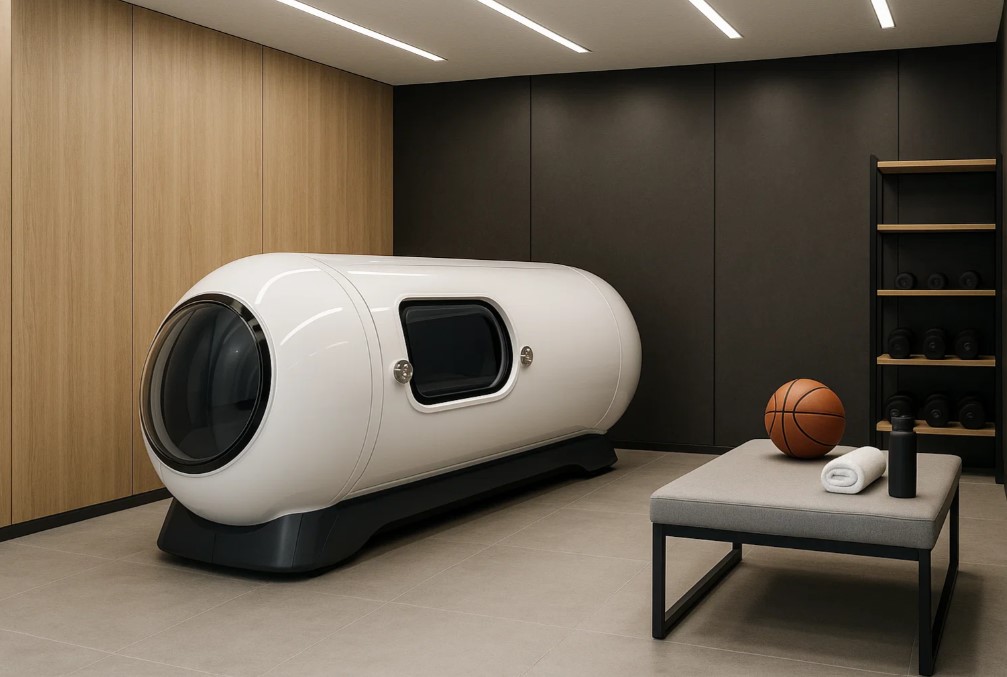
The LeBron James hyperbaric chamber is a soft-shell portable unit that pressurizes to about 1.3 to 1.5 ATA, well below the 2.0 to 2.4 ATA hard chambers used in clinical research, and he uses it for recovery sessions of roughly 90 minutes. The evidence does not back it for recovery: according to Huang and colleagues (2021, Frontiers in Physiology), a meta-analysis of 10 studies found no significant benefit of hyperbaric oxygen therapy (HBOT) on athletic performance or post-exercise recovery.
- LeBron James uses a soft-shell hyperbaric chamber, based on his own posted photos and videos, that reaches about 1.3 to 1.5 ATA rather than the 2.0 to 2.4 ATA of a hard clinical chamber.
- LeBron reportedly spends about $1.5 million a year on his body, and the chamber is one visible tool in a much larger routine of sleep, nutrition, training and medical care.
- A 2021 meta-analysis by Huang and colleagues in Frontiers in Physiology pooled 10 studies with 166 participants and found no significant effect of pre- or post-exercise HBOT on performance or recovery.
- A 2025 narrative review by Johnson-Arbor in Undersea and Hyperbaric Medicine found that human evidence for HBOT in athletes remains inconclusive.
- The Undersea and Hyperbaric Medical Society (UHMS) recognizes HBOT for conditions such as decompression sickness, carbon monoxide poisoning and diabetic foot ulcers, and athletic recovery is not on that list.
LeBron James reportedly spends about $1.5 million a year on his body, and a soft-shell hyperbaric chamber is one of his visible recovery tools, used in roughly 90-minute sessions. The catch is that the best evidence does not back it for recovery: a 2021 meta-analysis of 10 studies found no significant benefit of HBOT on athletic performance or post-exercise recovery. Celebrity use is not proof, and the sections below separate the two.
When LeBron posted videos of himself relaxing in what looks like a clear sleeping bag, curiosity followed. At 39 he was still dominating a league most players leave a decade earlier. Visibility, though, is not the same as proof, and the gap between the two is the whole point.
Is LeBron’s healing chamber a hyperbaric chamber?
Yes. The tube LeBron is seen lying in, often called his healing chamber or oxygen chamber online, is a portable hyperbaric chamber. It is a zippered, inflatable soft-shell vessel that a compressor pressurizes slightly above sea level, a setup usually sold as mild hyperbaric oxygen therapy (mHBOT).

Mild HBOT is not the same treatment as clinical hyperbaric oxygen therapy. Clinical HBOT means breathing close to 100% oxygen at 2.0 ATA or higher inside a rigid chamber, under a hyperbaric medicine physician. Our comparison of mild HBOT and clinical HBOT explains where the two diverge.
| Attribute | LeBron’s chamber, as shown in his posts |
|---|---|
| Chamber type | Soft-shell portable chamber |
| Pressure | About 1.3 to 1.5 ATA |
| Breathing gas | Typically ambient air or concentrator oxygen, not 100% medical oxygen |
| Session length | Roughly 90 minutes |
| Evidence for athletic recovery | No significant benefit in a 2021 meta-analysis of 10 studies |
Why does LeBron use a hyperbaric chamber?
LeBron treats sleep, nutrition, and body maintenance as non-negotiable, and HBOT entered that toolkit as it gained traction among NBA trainers for muscle soreness and between-game recovery. The rationale is straightforward: pressurized oxygen raises the amount of oxygen dissolved in blood plasma, which in theory reaches tissue that normal blood flow does not fully saturate after hard exertion.
Whether that rationale produces a measurable benefit in a professional basketball context is a separate question. Elite athletes face a selection problem: they will invest in anything that might help, so they often adopt interventions before the evidence catches up. The same pattern shows up with other high-profile biohackers, such as Bryan Johnson.
How is pressurized oxygen supposed to help recovery?
Raising the pressure around the body raises the partial pressure of oxygen in the lungs, and by Henry’s law more oxygen dissolves directly into blood plasma. The proposed recovery benefits, less muscle soreness, less swelling and faster tissue repair, all follow from that extra oxygen reaching damaged tissue.
The size of that effect depends on pressure and on the oxygen fraction breathed. A soft chamber at 1.3 ATA with room air raises dissolved oxygen only modestly, while a hard chamber at 2.0 ATA or more with 100% oxygen raises it many times over. That gap is why results from clinical chambers do not transfer to the soft chamber in LeBron’s videos.
What other recovery tools sit alongside it?
Elite basketball recovery programs typically stack HBOT with sleep tracking, massage and soft-tissue work, whole-body cryotherapy and cold plunges, compression boots and red light therapy. Each tool has its own evidence base, and most are thinner than the marketing suggests.
What type of chamber does LeBron use?
The chamber in LeBron’s widely shared photos is a soft-shell portable unit, the type that reaches about 1.3 to 1.5 ATA. That matters clinically, because the most rigorous HBOT research on cognition and telomere biology uses hard-shell chambers at 2.0 ATA with 100% oxygen. Soft chambers deliver far less dissolved oxygen and sit below the pressure most clinical protocols use.
| Feature | Soft chamber (LeBron’s type) | Hard clinical chamber |
|---|---|---|
| Pressure | 1.3 to 1.5 ATA | 2.0 to 2.4 ATA |
| Oxygen | Often ambient air or concentrator | 100% medical oxygen |
| Used in the main research | No | Yes |
It is possible a soft-shell chamber at 1.3 ATA helps post-exercise recovery, but the published evidence does not support it at that pressure. This distinction matters most for anyone about to buy home equipment after seeing his posts. Our full breakdown of hard-shell versus soft-shell chambers covers the trade-offs.
Portable soft chambers are regulated by the U.S. Food and Drug Administration (FDA) as medical devices, and their clearance centers on acute mountain sickness rather than sports recovery. A hard chamber in a hospital or outpatient center is run under a physician’s order, usually with a certified hyperbaric technologist at the controls.
Does HBOT actually improve athletic recovery?
The most directly relevant evidence says no, or at least not measurably. A 2021 systematic review and meta-analysis pooled 10 studies covering 166 participants and found that pre-exercise and post-exercise HBOT had no statistically significant effect on athletic performance or recovery markers (p>0.05 across outcomes).1 Intra-exercise HBOT showed a possible effect on muscle endurance, but the data were too thin for formal meta-analysis. The authors’ conclusion was that the best available evidence does not support HBOT as a routine sports recovery tool.
A 2025 narrative review reached a similar verdict: in animal models, HBOT accelerates muscle healing after soft-tissue injury, but human evidence remains inconclusive.2 The review flagged specific safety concerns about mild hyperbaric chambers at 1.3 ATA marketed aggressively for recovery without clinical evidence. HBOT is not banned in competitive sport, but not-banned is not the same as effective.
pooled in a 2021 meta-analysis found no significant benefit of HBOT for athletic performance or post-exercise recovery
Huang et al., 2021, Frontiers in Physiology
Where HBOT does have stronger footing is injury recovery: acute soft-tissue damage, bone healing, and wound care. If LeBron uses it to recover from a specific injury rather than as a general wellness habit, that application has more backing, though still not from large controlled human trials. That is rarely the story the headlines tell.
Researchers have also studied HBOT after concussion and traumatic brain injury, a question that matters in contact sports. Those trials use clinical chambers and medical protocols, and the results remain mixed. Our guide to HBOT for athletes walks through the sport-specific studies one by one.
Does LeBron’s use mean it will work for you?
No. LeBron’s durability is almost certainly the product of world-class genetics, decades of disciplined training, elite nutrition, exceptional sleep, and outstanding medical support. Isolating any single tool’s contribution from that stack is impossible, and HBOT is one item in a very large stack. Attributing his career length to a chamber is not supported by evidence.
Celebrity endorsements of health technology are marketing events. They build awareness and sell products; they do not generate clinical evidence. For anyone weighing HBOT, the meta-analysis and peer-reviewed literature carry far more weight than an Instagram post.
LeBron is not the first famous name tied to a hyperbaric chamber. The story of Michael Jackson’s hyperbaric chamber in the 1980s followed the same arc: a striking photo, a wave of public interest and very little evidence underneath.
What does HBOT have strong evidence for?
HBOT has solid evidence for a defined set of indications recognized by the Undersea and Hyperbaric Medical Society, including decompression sickness, carbon monoxide poisoning, diabetic foot ulcers, delayed radiation injury, and necrotizing soft-tissue infections.4 Athletic recovery and general performance enhancement are not among them, and the FDA has specifically warned consumers against marketing that oversells unproven uses.5
indications recognized by UHMS for hyperbaric oxygen therapy; athletic recovery and performance are not on the list
Undersea and Hyperbaric Medical Society
The marketing around celebrity HBOT use often blurs these categories. A therapy with strong evidence for wound healing does not automatically carry that evidence over to recovery optimization, because the two involve different mechanisms, pressures, and evidence standards.
Insurance follows the same line. Medicare and most private insurers cover HBOT only for recognized indications such as carbon monoxide poisoning treatment and chronic diabetic wounds, so recovery and wellness sessions are almost always cash pay. The full list is in our overview of FDA-cleared HBOT indications, and our hyperbaric oxygen therapy treatment guide covers how a clinical course is planned.
What happens during a session, and is it safe?
A clinical HBOT session uses a hard-shell monoplace or multiplace chamber pressurized to 1.5 to 2.4 ATA, with the patient breathing 100% oxygen through a mask or hood for 60 to 90 minutes and short air breaks every 20 minutes to limit oxygen toxicity. Soft chambers like LeBron’s pressurize to about 1.3 ATA and usually deliver ambient air, so the physiological effect is milder.
HBOT is generally safe when supervised by trained staff in a maintained chamber. The most common adverse effect is ear barotrauma, with temporary myopia and mild claustrophobia also reported, while oxygen-toxicity seizures are rare at standard clinical pressures, estimated at roughly 1 in 10,000 sessions.3 Risks rise with unsupervised soft-shell use, and compressed oxygen in any form carries fire risk. For a fuller picture, see our guide to HBOT side effects and the athletic recovery data.
approximate rate of oxygen-toxicity seizures at standard clinical HBOT pressures
Heyboer et al., 2017, Advances in Wound Care
People with an untreated collapsed lung (pneumothorax) should not enter a pressurized chamber, and ear or sinus congestion, certain lung conditions, some medications and pregnancy all call for a conversation with a physician first. A hyperbaric medicine physician screens for these before a clinical course begins.
How to try hyperbaric oxygen therapy without copying LeBron
A medical reason, not a celebrity routine, is the right starting point for HBOT. These steps keep the decision grounded:
- Name the goal. Recovery from a hard workout has weak evidence, while a nonhealing wound, radiation injury or carbon monoxide exposure falls within recognized indications.
- Talk with a physician who knows hyperbaric medicine, such as a board certified undersea and hyperbaric medicine specialist, a wound care physician or a sports medicine doctor.
- Ask what pressure and oxygen level the chamber delivers. A soft chamber at 1.3 ATA and a hard chamber at 2.0 ATA with 100% oxygen are different treatments.
- Confirm who supervises each session and how the facility handles fire safety and ear pressure problems.
- Ask about cost up front. Outside covered indications, sessions are cash pay, and our HBOT cost guide explains what drives the price.
When you are ready to compare providers, the national directory of hyperbaric oxygen therapy clinics lists clinics by state and city. Listing order on Regenerated.com is not paid ranking, Featured slots are labeled and capped, and Verified means the clinic completed credential checks, not that it spent more. The directory is free for patients, and inclusion in it is not an endorsement. Our guide to Featured, Verified and organic listings explains each label in detail.
Frequently asked questions
What chamber does LeBron James use?
Based on his own posted photos and videos, LeBron uses a soft-shell portable chamber that operates at roughly 1.3 to 1.5 ATA, not a hard clinical chamber at 2.0 to 2.4 ATA. Soft chambers deliver less dissolved oxygen and sit below the pressure used in the main HBOT research, which is why buying similar home equipment does not reproduce the conditions studied in clinical trials.
Does hyperbaric therapy improve sports recovery?
The best available evidence says no. A 2021 meta-analysis of 10 studies found no significant effect of pre- or post-exercise HBOT on performance or recovery.1 A 2025 review found human evidence inconclusive even though animal models show faster muscle healing.2 HBOT has firmer footing for treating specific acute injuries than for general recovery, where the data remain thin.
Is HBOT banned in professional sports?
No. HBOT is not prohibited in competitive sport, so athletes can use it without a doping violation. Being allowed is not evidence that it works, though. The performance and recovery data remain negative or inconclusive, so its legality says nothing about whether it delivers the benefit celebrity marketing implies.
What is the LeBron healing chamber?
The LeBron healing chamber is a soft-shell portable hyperbaric chamber, the inflatable clear tube seen in videos he has posted. It pressurizes to about 1.3 to 1.5 ATA, a level usually sold as mild hyperbaric oxygen therapy. It is not the rigid 2.0 to 2.4 ATA chamber that hospitals use with 100% oxygen, and a 2021 meta-analysis of 10 studies found no significant recovery benefit from HBOT in athletes.
Can you buy the same kind of hyperbaric chamber LeBron uses?
Yes, soft-shell chambers like the one in LeBron’s videos are sold for home use, and the FDA regulates them as medical devices cleared mainly for acute mountain sickness. A home soft chamber at about 1.3 ATA does not reproduce the 2.0 ATA, 100% oxygen conditions of clinical research. Unsupervised use also carries ear injury and fire risks, so a physician conversation should come before any purchase.
Where can I get hyperbaric oxygen therapy near me?
Hospital wound care centers and outpatient hyperbaric clinics offer clinical HBOT, usually with a physician’s order and a screening visit first. The Regenerated.com HBOT clinic directory lists providers by state and city, is free for patients, and does not sell listing order. Ask each clinic about chamber type, pressure, oxygen level, supervision and whether your condition is a covered indication.
Sources
- Huang X, Wang R, Zhang Z, Wang G, Gao B. “Effects of Pre-, Post- and Intra-Exercise Hyperbaric Oxygen Therapy on Performance and Recovery: A Systematic Review and Meta-Analysis.” Frontiers in Physiology. 2021;12:791872. DOI: 10.3389/fphys.2021.791872
- Johnson-Arbor K. “Hyperbaric oxygen therapy for high performance athletes: a narrative review.” Undersea and Hyperbaric Medicine. 2025. DOI: 10.22462/694
- Heyboer M 3rd, Sharma D, Santiago W, McCulloch N. “Hyperbaric Oxygen Therapy: Side Effects Defined and Quantified.” Advances in Wound Care. 2017;6(6):210-224. DOI: 10.1089/wound.2016.0718
- Undersea and Hyperbaric Medical Society. “Hyperbaric Oxygen Therapy Indications.” uhms.org
- U.S. Food and Drug Administration. “Hyperbaric Oxygen Therapy: Don’t Be Misled.” fda.gov