Hard Shell vs Soft Shell Hyperbaric Chamber: Complete Evidence Comparison
Explore the clinic directoryIn this article
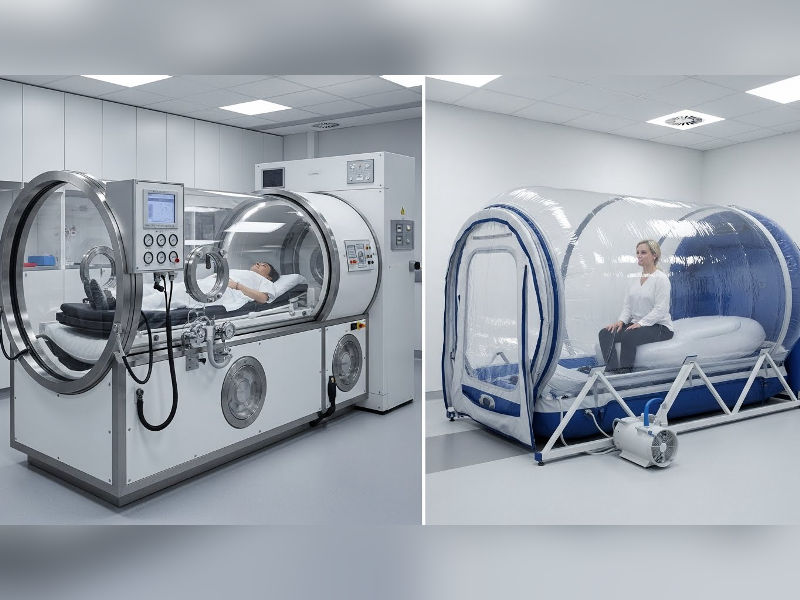
The hard-shell versus soft-shell hyperbaric chamber choice is decided by physics, not preference. A hard-shell (medical) chamber runs at 2.0 to 3.0 ATA with 100% oxygen and produces roughly 1,824 mmHg of arterial oxygen at 2.4 ATA. A soft-shell (mild) chamber is capped at 1.3 ATA on air or masked concentrator oxygen and produces about 230 mmHg, close to an 8x difference (Burman, 2019). Every one of the conditions the UHMS and FDA recognize for hyperbaric oxygen was studied in a hard chamber. Soft chambers are FDA-cleared for altitude sickness only.
- ATA (atmospheres absolute): total pressure inside the chamber. Sea level is 1.0 ATA. Clinical HBOT runs at 2.0 to 2.4 ATA.
- Arterial pO2: the partial pressure of oxygen dissolved in arterial blood, in mmHg. It rises with both chamber pressure and the fraction of oxygen breathed.
- Hard-shell (Type I) chamber: a rigid steel or acrylic pressure vessel built to hold 100% oxygen at 2.0 ATA or higher.
- Soft-shell (mild) chamber: a fabric or bag chamber limited by its materials to about 1.3 ATA, usually filled with air.
This is not one product being slightly better than another. Hard-shell and soft-shell chambers are two device categories with different regulatory status, different oxygen delivery, and different evidence behind them. Matching the right chamber to a goal means understanding exactly what each one delivers, which is what the rest of this page lays out.
What is the real difference between hard-shell and soft-shell chambers?
A hard-shell chamber is a rigid pressure vessel that reaches 2.0 to 3.0 ATA and fills with 100% medical oxygen. A soft-shell chamber is a fabric enclosure capped near 1.3 ATA, usually on ambient air. The gap in pressure and oxygen source is what separates clinical hyperbaric oxygen therapy from mild pressurization (Burman, 2019).
- 2.0 to 3.0 ATA pressure
- 100% medical-grade oxygen
- ~1,824 mmHg arterial O2 at 2.4 ATA
- Basis for all 14 recognized indications
- Rigid steel or acrylic, ASME PVHO-1 built
- 1.3 ATA maximum pressure
- Ambient air or masked concentrator O2
- ~230 mmHg arterial O2
- FDA-cleared for altitude sickness only
- Portable fabric shell for home use
Soft chambers are limited by their fabric construction to roughly 1.3 ATA. Most run on ambient room air (about 21% oxygen) compressed to that pressure. Even paired with a concentrator delivering 90 to 95% oxygen by mask, the effective oxygen dose stays far below clinical thresholds. Burman’s 2019 analysis in the South African Medical Journal put it plainly: a mild exposure on air delivers no more oxygen to the body than breathing oxygen through a mask at sea level, and exposure below 2.0 ATA on air does not meet the working definition of therapeutic hyperbaric oxygen therapy. The therapy-level distinction is covered in our mild versus clinical HBOT comparison.
Hard chambers use rigid steel, aluminum, or thick acrylic to reach 2.0 to 3.0 ATA. Monoplace units fill entirely with 100% oxygen; multiplace units pressurize with air while patients breathe oxygen by mask or hood. A 2024 study by Sack and colleagues in Undersea and Hyperbaric Medicine measured tissue oxygen directly in 130 chronic ulcer patients and found transcutaneous oxygen averaged 161 mmHg at 1.4 ATA versus 333 mmHg at 2.0 ATA, more than double (p<0.001). The gap between chamber types is even larger, because a soft chamber sits below 1.4 ATA and runs on air rather than oxygen. For the two hard-chamber subtypes, see our multiplace chamber guide.
How much more oxygen does a hard chamber actually deliver?
Oxygen dissolves into blood plasma in direct proportion to its partial pressure, following Henry’s Law (Thom, 2011; Gill and Bell, 2004). A hard chamber raises both the pressure and the oxygen fraction, so it multiplies dissolved oxygen many times over. A soft chamber raises only pressure, and only slightly, which is why its arterial oxygen barely moves above what a sea-level oxygen mask provides.
Arterial and Tissue Oxygen by Chamber Configuration and Pressure
| Configuration | Pressure (ATA) | Oxygen source | Approx. arterial O2 (mmHg) | Reaches tissue level to suppress infection? | Source |
|---|---|---|---|---|---|
| Normal breathing | 1.0 | Air (21%) | ~100 | No | Thom 2011 |
| Soft chamber (air) | 1.3 | Air (~24% effective) | ~230 | No | Burman 2019 |
| Sea-level O2 mask | 1.0 | ~90% O2 | ~600 | Borderline | Burman 2019 |
| Hard chamber (low clinical) | 1.5 | 100% O2 | ~1,140 | Yes | Harch 2022 |
| Hard chamber (standard) | 2.0 | 100% O2 | ~1,520 | Yes | Sack 2024 |
| Hard chamber (clinical high) | 2.4 | 100% O2 | ~1,824 | Yes | Burman 2019 |
The pattern is clear. Adding pressure alone (the soft chamber) barely doubles arterial oxygen. Adding 100% oxygen at clinical pressure (the hard chamber) multiplies it roughly 15 to 18 times over baseline. Tissue oxygen tracks the same way: Sack’s 2024 oximetry data showed even 1.4 ATA on oxygen delivered only half the tissue oxygen of 2.0 ATA, and a soft chamber sits below that on air. For a deeper walkthrough of the numbers, see our soft versus hard chamber clinical data breakdown and the 2.0 ATA chamber explainer.
Which conditions is each chamber type evidenced for?
Hard chambers carry the entire recognized evidence base for hyperbaric oxygen therapy. The UHMS lists 14 approved indications and the European Committee for Hyperbaric Medicine maintains a parallel list, all built on trials run at 2.0 ATA or higher in hard chambers (Mathieu, 2017). Soft chambers have published evidence for one use only: acute mountain sickness.
What Each Chamber Pressure Is Evidenced For
| Indication | Pressure used in trials (ATA) | Chamber type | Evidence grade | Source |
|---|---|---|---|---|
| Carbon monoxide poisoning | 2.8 to 3.0 | Hard | Strong (RCT) | Weaver 2002 |
| Diabetic foot ulcer | 2.5 | Hard | Moderate (RCT; Cochrane) | Löndahl 2010; Kranke 2015 |
| Late radiation tissue injury | 2.0 to 2.4 | Hard | Moderate (RCT; Cochrane) | Clarke 2008; Bennett 2016 |
| Post-stroke recovery (off-label) | 2.0 | Hard | Emerging (single-center RCT) | Efrati 2013 |
| Long COVID (off-label) | 2.0 | Hard | Emerging (sham-controlled RCT) | Zilberman-Itskovich 2022 |
| Persistent post-concussion (off-label) | 1.5 | Hard | Emerging (RCTs; dose-dependent) | Harch 2022; Boussi-Gross 2013 |
| Acute mountain sickness | 1.3 (relative) | Soft | Accepted (only cleared soft-chamber use) | FDA; UHMS |
| General wellness, neuro, anti-aging claims | 1.3 | Soft | Limited (no supporting RCT) | Burman 2019 |
The table makes the split visible. Wherever hyperbaric oxygen has earned an indication, the pressure came from a hard chamber. The soft-chamber rows carry either a single narrow clearance or no controlled evidence at all. For the formal list, see our guide to FDA-cleared HBOT indications.
Is there real clinical evidence for soft-shell chambers?
No randomized controlled trial has compared a soft-shell chamber to a hard-shell chamber for any medical condition, and no RCT has shown a soft chamber at 1.3 ATA producing the outcomes attributed to clinical HBOT. The published evidence base for soft chambers is limited to altitude sickness and small, uncontrolled reports (Burman, 2019).
Where soft-chamber pressures do appear in neurological research, they sit at the bottom of a dose-response curve. Harch’s 2022 systematic review in Frontiers in Neurology analyzed hyperbaric dosing in persistent post-concussion syndrome and found the strongest, Level 1 evidence at 1.5 ATA with 100% oxygen across four randomized trials. At 1.3 ATA on air, results were mixed (one positive study), and at 1.2 ATA on air they were split. Harch’s conclusion was that pressure within a narrow therapeutic window matters more than raw oxygen dose, which is precisely the window a 1.3 ATA air chamber fails to reach. Boussi-Gross and colleagues (2013) likewise produced their post-concussion improvements in a hard chamber, not a fabric one. The overselling of soft chambers for brain conditions is examined in detail in our piece on soft chambers oversold for neurological conditions.
This does not make soft chambers worthless. At 1.3 ATA they deliver a modest, real increase in plasma oxygen, and many home users report better sleep and recovery. What the evidence does not support is treating a 1.3 ATA air exposure as equivalent to the 2.0 ATA oxygen protocols the clinical trials actually used. See our mild hyperbaric chamber overview and soft chamber guide for realistic use cases.
Why can’t a soft chamber treat infections or wounds?
Oxygen fights infection only when tissue oxygen tension climbs high enough to power neutrophil oxidative killing and to directly suppress anaerobic and microaerophilic organisms (Knighton, 1984; Park, 1992). That level is reached at the tissue oxygen tensions produced above roughly 1.5 ATA on 100% oxygen. A soft chamber at 1.3 ATA on air never approaches it.
Knighton, Halliday, and Hunt showed in 1984 that raising inspired oxygen sharply reduced the size and number of necrotic lesions from bacterial injection in tissue, establishing oxygen tension as a direct determinant of infection resistance. Park’s 1992 review in Clinical Infectious Diseases mapped the mechanisms: elevated oxygen restores leukocyte oxidative killing and drives reactive oxygen species that damage bacterial DNA and membranes. Burman’s 2019 analysis is blunt about the threshold, holding that exposure below 2.0 ATA on air does not meet the definition of therapeutic hyperbaric oxygen. This is why infected wounds, gas gangrene, and necrotizing soft-tissue infections are treated exclusively in hard chambers, and why the Cochrane review of hyperbaric oxygen for chronic wounds (Kranke, 2015) drew entirely on hard-chamber trials. Soft chambers have no role in wound healing for infected tissue.
What does FDA clearance actually mean for each type?
Hard-shell clinical chambers are FDA-regulated Class II devices used for the recognized hyperbaric indications. Soft-shell bag chambers are FDA-cleared only to treat acute mountain sickness, and only without supplemental oxygen. No chamber is “FDA approved” for wellness or off-label conditions; clearance confirms the device is safe to market, not that a given use works (FDA).
The FDA consumer update Hyperbaric Oxygen Therapy: Get the Facts states directly that the large zippered bag chambers are cleared to treat altitude sickness only, are not cleared for use with oxygen tanks or concentrators, and that HBOT devices are not proven to treat cancer, Lyme disease, autism, or Alzheimer’s disease. The UHMS has issued a formal consumer warning about soft-sided bag chambers, stating they do not meet clinical HBOT standards. Regulatory clearance for a soft chamber therefore says nothing about efficacy for any condition beyond altitude sickness. The practical cost and clinic-access picture is in our hyperbaric chamber cost guide.
How do cost, safety, and fire risk compare?
Hard-shell clinical chambers cost $50,000 to $150,000 or more and carry a low but real fire risk that requires trained operators and formal protocols. Soft-shell chambers cost roughly $4,000 to $15,000, are portable, and have very low fire risk because they do not use a concentrated oxygen atmosphere. Both are safe when used as intended; the hazards differ by design (Sheffield and Desautels, 1997; Heyboer, 2017).
| Criterion | Soft Shell (Mild) | Hard Shell (Medical) |
|---|---|---|
| Max pressure | 1.3 ATA | 2.0 to 3.0 ATA clinical |
| Oxygen source | Air (~21%) or masked concentrator (~90 to 95%) | 100% medical-grade O2 |
| Arterial O2 | ~230 mmHg | ~1,824 mmHg at 2.4 ATA |
| FDA status | Cleared for altitude sickness only | Class II device for recognized indications |
| Recognized medical indications | None of the 14 (altitude only) | All 14 |
| Infection-suppressing tissue oxygen | No, below the threshold | Yes, exceeds the threshold |
| Clinical evidence base | Limited, no head-to-head RCTs | Extensive, RCTs and Cochrane reviews |
| Typical cost | $4,000 to $15,000 | $50,000 to $150,000+ (clinical) |
| Fire risk | Very low, no concentrated O2 atmosphere | Low but real, protocols required |
| Home use feasibility | High, portable, no O2 supply needed | Low for clinical units |
On safety, the hyperbaric record is strong. Sheffield and Desautels catalogued every reported chamber fire across 73 years and found them rare and almost always tied to ignition sources or oxygen-enriched conditions that modern protocols now control. Heyboer’s 2017 review in Advances in Wound Care quantified HBOT side effects as generally mild and reversible (ear barotrauma is the most common), and Camporesi’s 2014 review reached the same conclusion. A 2024 UHMS survey by Laspro and colleagues found practitioners overwhelmingly use 2.0 to 2.4 ATA, with 2.4 ATA the single most common pressure, underscoring that clinical HBOT lives well above the soft-chamber ceiling. Home-purchase options are compared in our best home chamber guide and portable chamber overview.
When should you choose a hard or soft chamber?
Choose a hard-shell chamber for any recognized medical indication or any goal that requires clinical-grade oxygen: wound healing, radiation injury, carbon monoxide poisoning, serious infection, or the off-label neurological protocols studied at 1.5 to 2.0 ATA. Choose a soft-shell chamber only for mild home wellness use, with the clear understanding that 1.3 ATA on air is not clinical HBOT (Burman, 2019).
If a specific condition with published evidence is the goal, that evidence was generated in a hard chamber, and matching it means matching the pressure. Long COVID is a good example: the only positive sham-controlled trial used 40 sessions at 2.0 ATA in a hard chamber, as detailed in our HBOT long COVID clinical data review. If the goal is general recovery, relaxation, or athletic maintenance, a soft chamber is a reasonable and far cheaper option, provided expectations match what 1.3 ATA can actually deliver.
Frequently asked questions
Can a soft-shell chamber treat the same conditions as a hard-shell chamber?
No. Soft chambers cap at 1.3 ATA and cannot reach the pressures or tissue oxygen levels required for any of the 14 recognized hyperbaric indications. Every clinical trial behind those indications used a hard chamber at 2.0 ATA or higher, and no randomized trial has shown a soft chamber producing the same outcomes (Burman, 2019; Mathieu, 2017). Soft chambers are FDA-cleared for acute mountain sickness only.
Is the oxygen delivery difference really that large?
Yes. At 1.3 ATA on air, arterial oxygen is roughly 230 mmHg, similar to breathing supplemental oxygen by mask at sea level. At 2.4 ATA on 100% oxygen, arterial oxygen is about 1,824 mmHg, close to eight times higher (Burman, 2019). Tissue oxygen follows the same pattern: even 1.4 ATA on oxygen delivered only half the tissue oxygen of 2.0 ATA in a 130-patient study (Sack, 2024).
Which chamber type is safer for home use?
Soft chambers carry lower inherent fire risk because they do not use a concentrated oxygen atmosphere. Hard chambers at clinical pressures require trained operators and formal fire protocols, though the historical record shows chamber fires are rare and tied to controllable ignition sources (Sheffield and Desautels, 1997). Reported HBOT side effects in either setting are usually mild and reversible, most often ear barotrauma (Heyboer, 2017).
Why do clinics use hard chambers if soft chambers are cheaper?
Because the therapeutic effect depends on reaching clinical oxygen levels, which only a hard chamber at 2.0 ATA or higher on 100% oxygen can do. A 2024 UHMS survey found practitioners overwhelmingly treat at 2.0 to 2.4 ATA (Laspro, 2024). At those pressures oxygen becomes high enough to suppress infection and drive the healing and neuroplastic effects documented in the trials, which a 1.3 ATA air chamber cannot reproduce (Knighton, 1984; Park, 1992).
Sources
- Burman F. “Low-pressure fabric hyperbaric chambers.” South African Medical Journal. 2019;109(4):12574. PMID: 31084683. Link
- Sack RA, Pikkel YY, Leitner Shemy O, et al. “Transcutaneous oximetry values in chronic ulcer patients during hyperbaric treatment at 1.4 ATA compared to 2 ATA.” Undersea and Hyperbaric Medicine. 2024;51(1):1-5. PMID: 38615347. Link
- Thom SR. “Hyperbaric oxygen: its mechanisms and efficacy.” Plastic and Reconstructive Surgery. 2011;127 Suppl 1:131S-141S. PMID: 21200283. Link
- Gill AL, Bell CNA. “Hyperbaric oxygen: its uses, mechanisms of action and outcomes.” QJM. 2004;97(7):385-395. PMID: 15208426. Link
- Knighton DR, Halliday B, Hunt TK. “Oxygen as an antibiotic. The effect of inspired oxygen on infection.” Archives of Surgery. 1984;119(2):199-204. PMID: 6365032. Link
- Park MK, Myers RA, Marzella L. “Oxygen tensions and infections: modulation of microbial growth, activity of antimicrobial agents, and immunologic responses.” Clinical Infectious Diseases. 1992;14(3):720-740. PMID: 1562664. Link
- Harch PG. “Systematic Review and Dosage Analysis: Hyperbaric Oxygen Therapy Efficacy in Mild Traumatic Brain Injury Persistent Postconcussion Syndrome.” Frontiers in Neurology. 2022;13:815056. PMID: 35370898. DOI: 10.3389/fneur.2022.815056
- Boussi-Gross R, Golan H, Fishlev G, et al. “Hyperbaric Oxygen Therapy Can Improve Post Concussion Syndrome Years after Mild Traumatic Brain Injury: Randomized Prospective Trial.” PLoS One. 2013;8(11):e79995. PMID: 24260334. Link
- Efrati S, Fishlev G, Bechor Y, et al. “Hyperbaric Oxygen Induces Late Neuroplasticity in Post Stroke Patients: Randomized, Prospective Trial.” PLoS One. 2013;8(1):e53716. DOI: 10.1371/journal.pone.0053716
- Efrati S, Golan H, Bechor Y, et al. “Hyperbaric oxygen therapy can diminish fibromyalgia syndrome: prospective clinical trial.” PLoS One. 2015;10(5):e0127012. PMID: 26010952. Link
- Hachmo Y, Hadanny A, Abu Hamed R, et al. “Hyperbaric oxygen therapy increases telomere length and decreases immunosenescence in isolated blood cells: a prospective trial.” Aging. 2020;12(22):22445-22456. PMID: 33206062. DOI: 10.18632/aging.202188
- Zilberman-Itskovich S, Catalogna M, Sasson E, et al. “Hyperbaric oxygen therapy improves neurocognitive functions and symptoms of post-COVID condition: randomized controlled trial.” Scientific Reports. 2022;12:11252. PMID: 35821512. DOI: 10.1038/s41598-022-15565-0
- Löndahl M, Katzman P, Nilsson A, Hammarlund C. “Hyperbaric Oxygen Therapy Facilitates Healing of Chronic Foot Ulcers in Patients With Diabetes.” Diabetes Care. 2010;33(5):998-1003. PMID: 20427683. Link
- Weaver LK, Hopkins RO, Chan KJ, et al. “Hyperbaric Oxygen for Acute Carbon Monoxide Poisoning.” New England Journal of Medicine. 2002;347(14):1057-1067. PMID: 12362006. Link
- Clarke RE, Tenorio LMC, Hussey JR, et al. “Hyperbaric oxygen treatment of chronic refractory radiation proctitis: a randomized and controlled double-blind crossover trial with long-term follow-up.” International Journal of Radiation Oncology Biology Physics. 2008;72(1):134-143. PMID: 18342453. Link
- Kranke P, Bennett MH, Martyn-St James M, et al. “Hyperbaric oxygen therapy for chronic wounds.” Cochrane Database of Systematic Reviews. 2015;(6):CD004123. PMID: 26106870. DOI: 10.1002/14651858.CD004123.pub4
- Bennett MH, Feldmeier J, Hampson NB, Smee R, Milross C. “Hyperbaric oxygen therapy for late radiation tissue injury.” Cochrane Database of Systematic Reviews. 2016;(4):CD005005. PMID: 27123955. DOI: 10.1002/14651858.CD005005.pub4
- Lind F. “A pro/con review comparing the use of mono- and multiplace hyperbaric chambers for critical care.” Diving and Hyperbaric Medicine. 2015;45(1):56-60. PMID: 25964041. Link
- Heyboer M, Sharma D, Santiago W, McCulloch N. “Hyperbaric Oxygen Therapy: Side Effects Defined and Quantified.” Advances in Wound Care. 2017;6(6):210-224. PMID: 28616361. DOI: 10.1089/wound.2016.0718
- Camporesi EM. “Side effects of hyperbaric oxygen therapy.” Undersea and Hyperbaric Medicine. 2014;41(3):253-257. PMID: 24984321. Link
- Laspro M, Brydges HT, Onuh OC, et al. “Hyperbaric Oxygen Therapy Regimens, Treated Conditions, and Adverse Effect Profile: an Undersea and Hyperbaric Medical Society Survey Study.” Undersea and Hyperbaric Medicine. 2024;51(4):369-376. PMID: 39821765. Link
- Sheffield PJ, Desautels DA. “Hyperbaric and hypobaric chamber fires: a 73-year analysis.” Undersea and Hyperbaric Medicine. 1997;24(3):153-164. PMID: 9308138. Link
- Mathieu D, Marroni A, Kot J. “Tenth European Consensus Conference on Hyperbaric Medicine: recommendations for accepted and non-accepted clinical indications and practice of hyperbaric oxygen treatment.” Diving and Hyperbaric Medicine. 2017;47(1):24-32. PMID: 28357821. Link
- Undersea and Hyperbaric Medical Society. “Hyperbaric Oxygen Therapy Indications” (14 approved indications). 2020. Link
- Undersea and Hyperbaric Medical Society. “Consumer Warning: The Dangers of Soft-Sided Bag Chambers.” Link
- U.S. Food and Drug Administration. “Hyperbaric Oxygen Therapy: Get the Facts.” Consumer Update. Link
- ASME. “PVHO-1: Safety Standard for Pressure Vessels for Human Occupancy.” American Society of Mechanical Engineers. Link
- National Fire Protection Association. “NFPA 99: Health Care Facilities Code, Chapter 14 (Hyperbaric Facilities).” Link