Soft Chamber vs Hard Chamber: Pressure, O2 Delivery & 2026 Clinical Data Compared
Explore the clinic directoryIn this article
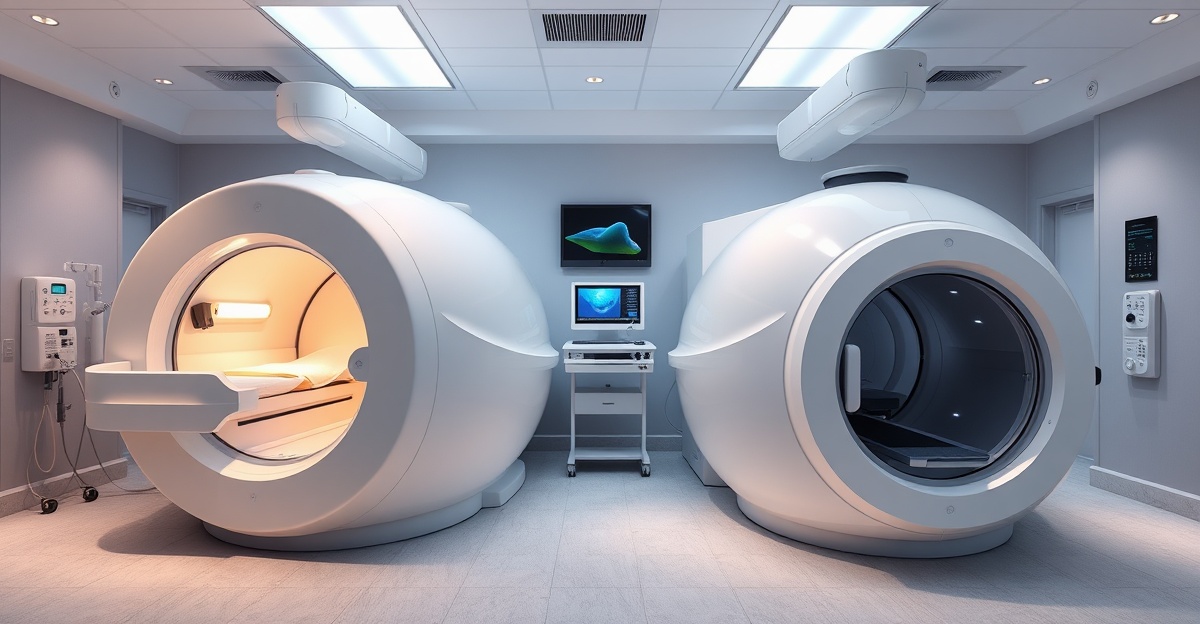
A hard shell hyperbaric chamber is the right choice for any medical use: it reaches 2.0 to 2.4 ATA with 100% oxygen and drives arterial oxygen to roughly 1,824 mmHg, while a soft shell chamber reaches about 1.3 ATA on air and roughly 230 mmHg. That is close to an 8x difference according to Burman’s 2019 analysis in the South African Medical Journal, and every major positive HBOT trial for wound and neurological outcomes used a hard chamber at 1.5 ATA or above.1 No randomized trial has shown those outcomes from a 1.3 ATA soft chamber, which the Undersea and Hyperbaric Medical Society notes is cleared only for acute mountain sickness. This is not a preference. It is physics.
Key takeaways
- Hard shell chambers reach about 1,824 mmHg arterial oxygen at 2.4 ATA on 100% oxygen; soft shell chambers reach about 230 mmHg at 1.3 ATA on air (Burman, 2019).
- The HBOT trials for long COVID, stroke, fibromyalgia and post-concussion symptoms all used hard chambers at 1.5 to 2.0 ATA (Zilberman-Itskovich 2022, Efrati 2013 and 2015, Harch 2012).
- The Undersea and Hyperbaric Medical Society (UHMS) warns that soft-sided bag chambers are cleared only for acute mountain sickness.
- Tissue oxygen at 1.4 ATA was roughly half the level at 2.0 ATA in 130 chronic ulcer patients (Sack et al., Undersea and Hyperbaric Medicine, 2024), and a soft chamber sits below 1.4 ATA.
- No randomized trial has compared soft shell and hard shell chambers head to head for any medical condition.
- ATA (atmospheres absolute): total pressure inside the chamber. Sea level is 1.0 ATA.
- Arterial pO2: the partial pressure of oxygen dissolved in arterial blood, in mmHg. It rises with both pressure and inspired oxygen fraction.
- Bacteriostatic threshold: the tissue oxygen level, reached only above roughly 1.5 ATA on 100% oxygen, at which oxygen begins suppressing bacterial and fungal growth.
Is a soft or hard hyperbaric chamber better?
For any condition with published clinical evidence, the hard chamber is the one the evidence was built on. The soft vs hard chamber decision determines whether you receive a therapy backed by randomized controlled trials or an intervention with limited published evidence at dramatically lower oxygen delivery. Soft chambers have real, narrow uses. They do not reproduce the pressures the trials used.
Clinical hyperbaric oxygen therapy (HBOT) means breathing close to 100% oxygen inside a rigid, pressurized chamber. A soft chamber, also sold as a mild hyperbaric chamber, portable hyperbaric chamber or mHBOT unit, is an inflatable fabric bag at lower pressure, usually supplied with room air. Our hyperbaric oxygen therapy treatment guide covers the clinical procedure in more depth.
Hard shell vs soft shell hyperbaric chamber: side by side
A hard shell chamber and a soft shell chamber differ in pressure, breathing gas, regulatory clearance and setting, using the figures cited throughout this page.
| Attribute | Hard shell chamber | Soft shell chamber |
|---|---|---|
| Construction | Rigid steel or acrylic monoplace, or a steel multiplace room | Inflatable fabric or nylon bag with zippers |
| Typical treatment pressure | 1.5 to 2.4 ATA in the cited trials | About 1.3 ATA |
| Breathing gas | 100% oxygen, by chamber fill or by mask or hood | Ambient air, sometimes with a concentrator |
| Arterial oxygen | About 1,520 to 1,824 mmHg | About 230 mmHg |
| Cleared medical uses | The FDA and UHMS list of HBOT indications | Acute mountain sickness only |
| Usual setting | Hospital wound centers and outpatient hyperbaric clinics | Homes, gyms and wellness studios |
| Supervision | Hyperbaric physician and certified hyperbaric technologist | Often none beyond the user |
What does Henry’s Law say about oxygen delivery?
Oxygen dissolves into blood plasma according to Henry’s Law: the amount of dissolved gas is directly proportional to the partial pressure of that gas above the liquid. Here is what that means in practice for each chamber type.1
| Chamber Type | Pressure (ATA) | O2 Content | Arterial O2 (mmHg) | Relative Delivery |
|---|---|---|---|---|
| Normal breathing | 1.0 | 21% | ~100 | 1x (baseline) |
| Soft chamber (ambient air) | 1.3 | ~24% | ~230 | 2.3x |
| O2 mask at sea level | 1.0 | ~90% | ~600 | 6x |
| Hard chamber (standard) | 2.0 | 100% | ~1,520 | 15x |
| Hard chamber (clinical) | 2.4 | 100% | ~1,824 | 18x |
At 1.3 ATA with ambient air, a soft chamber produces arterial oxygen of about 230 mmHg. A hard chamber at 2.4 ATA with 100% oxygen produces about 1,824 mmHg. Burman’s 2019 analysis makes the practical point bluntly: a mild exposure on air delivers no more oxygen than breathing oxygen through a mask at sea level.1
Why can’t soft chambers treat infected wounds?
The dividing line is the bacteriostatic threshold. Oxygen suppresses bacterial and fungal growth only at the tissue oxygen tensions produced above roughly 1.5 ATA on 100% oxygen.1 A soft chamber at 1.3 ATA on air cannot reach it. Burman’s SAUHMA analysis states that exposure below 2.0 ATA while breathing air does not meet the definition of therapeutic hyperbaric oxygen therapy at all.1
This is why soft chambers have no role in wound healing for infected tissue, gas gangrene, or necrotizing soft tissue infections, the conditions that most clearly benefit from clinical HBOT. The UHMS issued a formal consumer warning that soft-sided bag chambers do not meet clinical HBOT standards and are cleared only for acute mountain sickness.3
Diabetic foot ulcers, radiation injury and failing skin grafts are treated in hard chambers, usually in a hospital wound center under a physician trained in undersea and hyperbaric medicine. Our HBOT wound healing evidence review covers those indications.
What pressure did the clinical trials use?
Every major HBOT trial demonstrating positive outcomes for neurological conditions used a hard chamber. The pressures were not incidental. They were the intervention.
- Long COVID (Zilberman-Itskovich et al., 2022): 2.0 ATA, 100% O2, 40 sessions, hard chamber (full results)5
- TBI (Harch et al., 2012): 1.5 ATA, 100% O2, 40 sessions, hard chamber (full results)6
- Stroke (Efrati et al., 2013): 2.0 ATA, 100% O2, hard chamber (full results)7
- Fibromyalgia (Efrati et al., 2015): 2.0 ATA, 100% O2, 60 sessions, hard chamber8
- Anti-aging and telomeres (Hachmo et al., 2020): 2.0 ATA, 100% O2, 60 sessions, hard chamber9
No randomized controlled trial has compared soft-shell to hard-shell chambers head to head for any medical condition. Burman’s review of the low-pressure category concluded these units fall outside the definition of therapeutic HBOT, which is why the comparison trials were never run at 1.3 ATA in the first place.1 For the detailed protocol comparison between the two leading neurological research programs, see our Efrati vs Harch protocol comparison.
Two caveats apply. Harch 2012 was a Phase I trial without a control group, and Hachmo 2020 was a prospective, nonrandomized trial in healthy older adults. Even the positive hard chamber results for long COVID, traumatic brain injury and fibromyalgia come from small trials, and these remain off-label uses that insurers rarely cover.
Is a mild hyperbaric chamber the same as HBOT?
A mild hyperbaric chamber is not the same as hyperbaric oxygen therapy. According to the UHMS definition, HBOT means breathing near 100% oxygen in a chamber pressurized to at least 1.4 ATA. A soft chamber at about 1.3 ATA on air misses both parts of that definition, which is why clinicians call it mild hyperbaric therapy or mHBOT rather than HBOT.
An oxygen concentrator inside a soft chamber raises the oxygen fraction but not the pressure, and the UHMS warning flags it as a fire concern.3 Our mild HBOT vs clinical HBOT comparison goes further into the pressure and oxygen math.
Monoplace vs multiplace hard chambers: what is the difference?
Hard chambers come in two subtypes with important clinical differences.10 A 2024 study measuring tissue oxygenation in 130 chronic ulcer patients found levels at 1.4 ATA (161 mmHg) were roughly half those at 2.0 ATA (333 mmHg), which is why even the lowest clinical pressures still sit far above soft chamber territory.2
| Feature | Monoplace | Multiplace |
|---|---|---|
| Capacity | 1 patient | 2-20+ patients + attendant |
| O2 delivery | 100% O2 fills chamber | Air-pressurized; O2 via mask |
| Max pressure | Typically 3.0 ATA | Up to 6.0 ATA |
| Critical care capability | Limited (no inside attendant) | Full ICU-level care possible |
| Purchase cost | $50,000-$150,000 | $500,000-$2,000,000+ |
Lind’s 2015 review in Diving and Hyperbaric Medicine weighs the two for critical care: a multiplace chamber lets a nurse or physician stay inside with a ventilated patient, while a monoplace chamber keeps the attendant outside the hull.10 Both are hard shell chambers, and both reach pressures a soft chamber cannot.
What are soft chambers actually good for?
This is not an argument that soft chambers are worthless. They offer real value for specific use cases:
- Mild pressurization effects: the 1.3 ATA pressure provides a modest increase in plasma oxygen
- Relaxation and recovery: many users report improved sleep, reduced stress, and subjective well-being
- Athletic recovery: the modest oxygen increase may support recovery from intense training, though evidence is limited (athletic recovery data)
- Accessibility: at $4,495 to $12,000, soft chambers make pressurized therapy available to people who cannot access clinical HBOT
The one medical use with regulatory backing is acute mountain sickness, where a portable fabric chamber simulates a descent to lower altitude while a climber waits for evacuation.3 The sleep, stress and recovery benefits above are self-reported, not trial outcomes. For more on the devices, read our soft hyperbaric chamber overview.
Are soft hyperbaric chambers safe compared with hard chambers?
Both chamber types carry real but usually mild risks. Ear and sinus barotrauma is the most common side effect in either. Hard chambers on 100% oxygen add a small risk of oxygen toxicity seizures and temporary nearsightedness over long courses, one reason sessions are supervised.
Soft chambers run at lower pressure, so oxygen toxicity is not a practical concern, but home sessions usually run without trained staff. The FDA warns that any oxygen-rich chamber environment raises fire risk, and it cautions consumers that HBOT has not been cleared for conditions such as autism, cancer or Alzheimer’s disease, whatever chamber is used.4 An untreated collapsed lung is a contraindication in both. Our hyperbaric chamber side effects guide lists the rest.
How do the prices compare?
A soft chamber costs less up front, while hard chamber clinic sessions are paid one at a time. The table spreads each purchase across 40 sessions, the course length in the long COVID and TBI trials above.
| Option | Purchase Cost | Per-Session Cost (40 sessions amortized) |
|---|---|---|
| Soft chamber (home purchase) | $4,495-$12,000 | $112-$300 |
| Hard chamber clinic sessions | N/A (per-session) | $150-$400 per session |
| Hard chamber home purchase | $25,000-$42,999 | $625-$1,075 |
Medicare and many private insurers cover hard chamber HBOT for listed indications such as diabetic foot ulcers and radiation injury, while soft chamber use and off-label hard chamber sessions are almost always cash pay.
How do you choose between a soft and hard hyperbaric chamber?
The choice follows from the goal, not the price tag:
- Name the condition. If it is a wound, a radiation injury, carbon monoxide poisoning or another listed indication, you need a hard chamber under medical supervision.
- Match the protocol. For off-label neurological uses, ask whether the clinic runs the trial pressure, usually 1.5 to 2.0 ATA on 100% oxygen.
- Check the team. Look for a supervising physician with training in undersea and hyperbaric medicine and a certified hyperbaric technologist at the console.
- Treat a home soft chamber as a wellness purchase, not a medical treatment plan.
When you are ready to compare providers, the national directory of hyperbaric clinics lists hard chamber facilities by state. Listing order there is not paid ranking, Featured slots are labeled and capped, and a Verified label means the clinic completed credential checks, as our guide to Featured, Verified and organic listings explains. The directory is free for patients, and inclusion is not an endorsement.
The Bottom Line
If you are pursuing HBOT for a specific condition with published clinical evidence (long COVID, TBI, stroke, wound healing, fibromyalgia, anti-aging), that evidence was generated in hard chambers at 1.5 to 2.4 ATA. Expecting soft chamber results to match is not supported by published data. The 2024 chronic ulcer oximetry study is a useful reminder of the scale: even 1.4 ATA delivered only half the tissue oxygen of 2.0 ATA, and a soft chamber sits well below 1.4.2
If you want a wellness device for general health support, athletic recovery, and relaxation, a home-use soft chamber can be a reasonable investment, with the understanding that you are receiving a fundamentally different intervention than what the clinical trials studied.
Frequently asked questions
What is the difference between a hard shell and soft shell hyperbaric chamber?
A hard shell hyperbaric chamber is a rigid steel or acrylic vessel that reaches 2.0 to 2.4 ATA with 100% oxygen, producing arterial oxygen near 1,824 mmHg. A soft shell chamber is an inflatable fabric bag that reaches about 1.3 ATA on air, producing roughly 230 mmHg. According to Burman (2019), that is close to an 8x gap.
Can a soft hyperbaric chamber give the same results as a hard chamber?
No published trial shows a soft hyperbaric chamber matching hard chamber results. The long COVID, stroke, fibromyalgia and post-concussion trials all used hard chambers at 1.5 to 2.0 ATA with 100% oxygen, and no randomized study has compared the two chamber types head to head. A soft chamber also stays below the bacteriostatic threshold that infected wounds depend on.
Is 1.3 ATA enough to count as hyperbaric oxygen therapy?
No, 1.3 ATA does not meet the clinical definition of hyperbaric oxygen therapy. The Undersea and Hyperbaric Medical Society defines HBOT as breathing near 100% oxygen at 1.4 ATA or higher, and a soft chamber at 1.3 ATA usually supplies air. Burman (2019) goes further, stating that exposure below 2.0 ATA on air is not therapeutic HBOT.
What is a soft hyperbaric chamber cleared by the FDA for?
A soft hyperbaric chamber is cleared for one medical use: acute mountain sickness, where the bag simulates a descent to lower altitude until a climber can be evacuated. The UHMS consumer warning makes the same point and states that soft-sided bag chambers do not meet clinical HBOT standards. Hard chambers carry the full list of HBOT indications.
Is a hard chamber session cheaper than buying a soft chamber?
It depends on how many sessions you need and whether insurance pays. Clinic sessions in a hard chamber run about $150 to $400 each, while a home soft chamber costs about $4,495 to $12,000 up front, or roughly $112 to $300 per session across 40 uses. Insurance may cover hard chamber HBOT for listed indications, while soft chamber use is cash pay and delivers far less oxygen per session.
Sources
- Burman F. “Low-pressure fabric hyperbaric chambers.” South African Medical Journal. 2019;109(4):232-233. PMID: 31084683. Link
- Sack RA, et al. “Transcutaneous oximetry values in chronic ulcer patients during hyperbaric treatment at 1.4 ATA compared to 2 ATA.” Undersea and Hyperbaric Medicine. 2024;51(1):9-16. PMID: 38615347. Link
- Undersea and Hyperbaric Medical Society. “Consumer Warning: The Dangers of Soft-Sided Bag Chambers.” Link
- U.S. Food and Drug Administration. “Hyperbaric Oxygen Therapy: Get the Facts.” Link
- Zilberman-Itskovich S, et al. “Hyperbaric oxygen therapy improves neurocognitive functions and symptoms of post-COVID condition: randomized controlled trial.” Scientific Reports. 2022;12:11252. PMID: 35821512. Link
- Harch PG, et al. “A Phase I Study of Low-Pressure Hyperbaric Oxygen Therapy for Blast-Induced Post-Concussion Syndrome and Post-Traumatic Stress Disorder.” Journal of Neurotrauma. 2012;29(1):168-185. PMID: 22026588. Link
- Efrati S, et al. “Hyperbaric Oxygen Induces Late Neuroplasticity in Post Stroke Patients: Randomized, Prospective Trial.” PLoS One. 2013;8(1):e53716. Link
- Efrati S, et al. “Hyperbaric oxygen therapy can diminish fibromyalgia syndrome: prospective clinical trial.” PLoS One. 2015;10(5):e0127012. PMID: 26010952. Link
- Hachmo Y, et al. “Hyperbaric oxygen therapy increases telomere length and decreases immunosenescence in isolated blood cells: a prospective trial.” Aging. 2020;12(22):22445-22456. Link
- Lind F. “A pro/con review comparing the use of mono- and multiplace hyperbaric chambers for critical care.” Diving and Hyperbaric Medicine. 2015;45(1):56-60. PMID: 25964041. Link