AirPod Hyperbaric Chamber: Features, Pressure and What It Delivers
Explore the clinic directoryIn this article
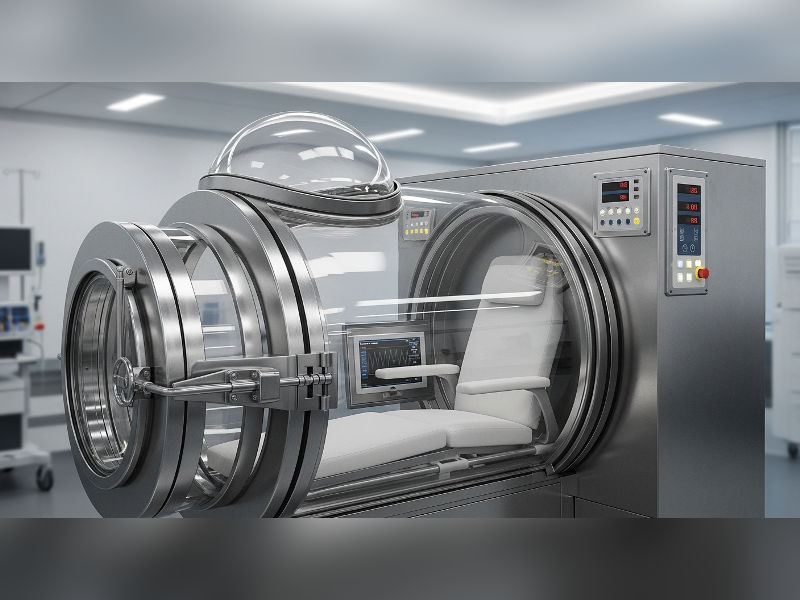
AirPod hyperbaric chambers are portable soft-shell units that operate at roughly 1.3 to 1.5 ATA, a mild pressure that delivers about 230 mmHg of arterial oxygen, versus the roughly 1,824 mmHg produced by clinical HBOT at 2.4 ATA on 100% oxygen. They cost $4,000 to $15,000. That pressure gap defines what an AirPod can and cannot do, and most of the benefits marketed for these units were actually measured in hard chambers at 2.0 ATA or higher.
What pressure does an AirPod chamber reach?
Most AirPod units run at 1.3 to 1.5 ATA, which classifies as mild hyperbaric therapy. Only 1.3 ATA units carry FDA clearance, and it is for acute mountain sickness only.5 The reason pressure matters is Henry’s Law: the oxygen dissolved into blood plasma is proportional to the pressure applied. A soft chamber on ambient air simply cannot reach the oxygen levels a hard chamber produces on 100% oxygen.
AirPod vs Clinical HBOT: Oxygen Delivery
| Setting | Pressure | Oxygen source | Approx. arterial pO2 |
|---|---|---|---|
| Normal breathing (sea level) | 1.0 ATA | Room air (21%) | ~100 mmHg |
| AirPod soft chamber | 1.3 ATA | Ambient air (~24%) | ~230 mmHg |
| Clinical HBOT (standard) | 2.0 ATA | 100% oxygen | ~1,520 mmHg |
| Clinical HBOT (wound care) | 2.4 ATA | 100% oxygen | ~1,824 mmHg |
The practical takeaway from Burman’s 2019 analysis of low-pressure fabric chambers is blunt: a mild exposure on air delivers no more oxygen than breathing oxygen through a mask at sea level, and exposure below 2.0 ATA on air does not meet the definition of therapeutic hyperbaric oxygen therapy.1 For the full breakdown, see hard-shell vs soft-shell chambers.
What can a 1.3 ATA AirPod chamber actually help with?
Honestly, the strong evidence for AirPod-level pressure is narrow. The FDA-cleared use is acute mountain sickness. Beyond that, the outcome data thins quickly, and the benefits often listed (wound healing, cognition, immune support) come from clinical HBOT at higher pressures, not from soft chambers.
There is a mechanistic argument for mild pressure. Hadanny and Efrati’s 2020 review of the hyperoxic-hypoxic paradox describes how repeated swings in oxygen concentration can trigger some of the same regenerative gene-expression and signaling pathways as hypoxia, and Thom’s 2011 review details how hyperbaric oxygen acts through reactive oxygen and nitrogen species in cell signaling.23 But both of those mechanistic literatures draw their efficacy data from clinical HBOT at 2.0 ATA and above. The mechanism being plausible at 1.3 ATA is not the same as the outcome being proven at 1.3 ATA. For the fuller case on where soft-chamber marketing outruns the evidence, see why soft chambers are oversold for neurological conditions.
Where an AirPod is reasonable: general wellness, relaxation, and light athletic recovery, understood as an intervention with limited controlled evidence rather than a substitute for clinical HBOT. Where it is not: any condition whose evidence base was built at 1.5 to 2.4 ATA, including the FDA-cleared medical indications.
AirPod vs clinical HBOT: what is the difference?
The two are different tools, not two grades of the same tool. AirPod units use flexible urethane-coated fabric, fold for storage, and set up in minutes without a dedicated room. Clinical hard chambers use rigid steel or acrylic, fill with 100% oxygen (monoplace) or pressurize with air while the patient breathes oxygen by mask (multiplace), and reach 2.0 to 3.0 ATA.
That construction difference is exactly why the pressures differ. A fabric bladder is engineered for mild pressurization; it is not built to hold the pressures that produce clinical oxygen levels. Convenience and cost are the real advantages of the AirPod, not therapeutic depth. If you are weighing models, our roundup of the best hyperbaric chambers for home use and the wider best hyperbaric chamber guide compare the options.
How much does an AirPod chamber cost vs clinic sessions?
AirPod units typically run $6,000 to $15,000 depending on size and features. Clinical HBOT sessions cost about $250 to $450 each, and a standard course runs 40 sessions. At $300 per session, that course is roughly $12,000, so a home unit reaches break-even quickly for anyone planning long-term or repeated use.
Running costs stay low, on the order of $20 to $40 a month in electricity plus occasional filter changes. The honest caveat: break-even math only favors the home unit if the therapy is actually helping your goal, which loops back to the pressure question above. Full purchase and per-session figures are in our hyperbaric chamber cost guide.
Is an AirPod chamber safe for home use?
Mild pressure makes AirPod units relatively safe, but not risk-free. The most common issue is ear-pressure equalization, milder than what you feel on a plane but still present; most users adapt quickly. People with significant sinus problems or eustachian-tube dysfunction may struggle at first. An untreated collapsed lung (pneumothorax) is a contraindication, and some medications and lung conditions warrant medical review before starting, even for a home unit.6
Set realistic timelines. Clinical hyperbaric research typically uses courses of 20 to 40 sessions, so any benefit from consistent home use is a matter of weeks, not one or two sessions.4 Talk to a clinician familiar with hyperbaric therapy about your personal risk factors before you begin.
What pressure do AirPod hyperbaric chambers reach?
Most AirPod chambers run between 1.3 and 1.5 ATA, which classifies as mild hyperbaric therapy. Only 1.3 ATA units hold FDA 510(k) clearance, and that clearance is for acute mountain sickness only. At 1.3 ATA on ambient air, arterial oxygen reaches roughly 230 mmHg, compared with about 1,824 mmHg at the 2.4 ATA and 100% oxygen used in clinical wound care, close to an eightfold difference in delivered oxygen.1
How long is an AirPod session, and how often?
Sessions typically last 60 to 90 minutes. Frequency depends on the goal: recovery-focused users often run several sessions per week, while wellness users may do two to three. Consistency matters more than any single session, because clinical hyperbaric research generally uses courses of 20 to 40 sessions rather than one-off exposures, so benefits from home use build over weeks.4
Can an AirPod chamber replace clinical HBOT?
No. An AirPod delivers mild pressure at 1.3 to 1.5 ATA and cannot reach the 2.0 to 2.4 ATA on 100% oxygen that clinical HBOT protocols use. Burman’s 2019 analysis of low-pressure fabric chambers concluded that exposure below 2.0 ATA on air does not meet the definition of therapeutic hyperbaric oxygen therapy. For any FDA-cleared medical indication, a soft chamber is the wrong tool regardless of brand.1
Sources
- Burman F. “Low-pressure fabric hyperbaric chambers.” South African Medical Journal. 2019;109(4):232-233. PMID: 31084683.
- Hadanny A, Efrati S. “The Hyperoxic-Hypoxic Paradox.” Biomolecules. 2020;10(6):958. PMID: 32630465.
- Thom SR. “Hyperbaric oxygen: its mechanisms and efficacy.” Plastic and Reconstructive Surgery. 2011;127(Suppl 1):131S-141S. PMID: 21200283.
- Efrati S, et al. “Hyperbaric Oxygen Induces Late Neuroplasticity in Post Stroke Patients: Randomized, Prospective Trial.” PLoS One. 2013;8(1):e53716. Link
- U.S. Food and Drug Administration. “Hyperbaric Oxygen Therapy: Don’t Be Misled.” Link
- Undersea and Hyperbaric Medical Society. “Hyperbaric Oxygen Therapy Indications” (approved indications and safety considerations). Link