Soft Hyperbaric Chamber: What It Delivers, What It Doesn’t, and Who Should Buy One
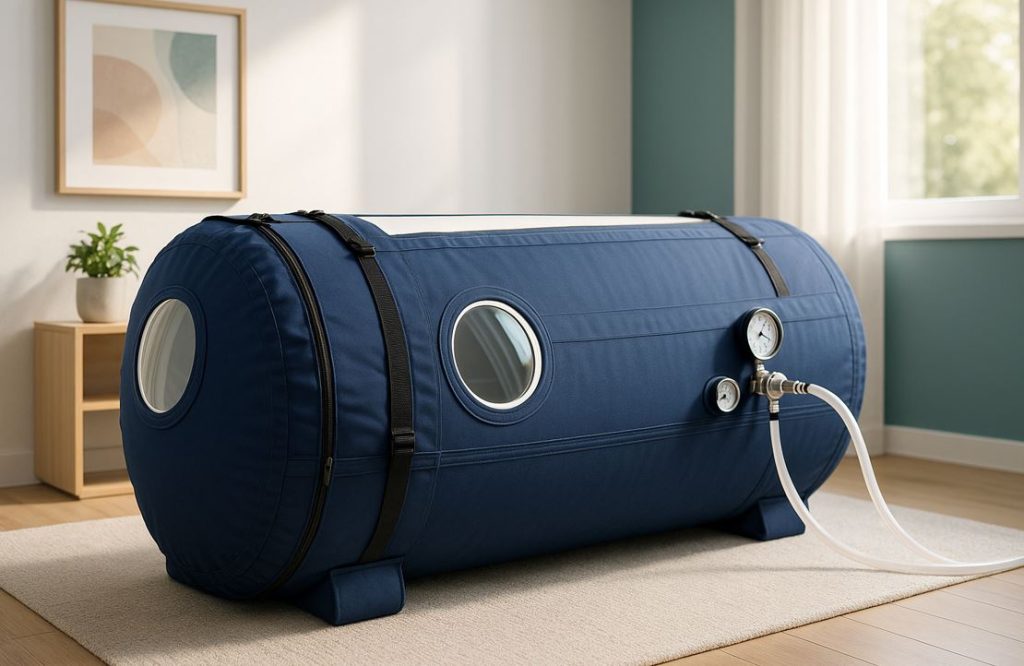
A soft hyperbaric chamber operates at a maximum of 1.3 ATA using ambient air, or concentrator oxygen delivered by face mask. It is a Class II medical device with a single FDA-cleared indication: acute mountain sickness. Every other marketed use, from recovery to anti-aging to brain health, is off-label and not equivalent to clinical HBOT, which runs at 2.0 to 3.0 ATA on 100% oxygen. Soft chambers are affordable, portable, and genuinely useful for the right buyer, provided you understand what they do and do not deliver.
Soft chamber vs mild HBOT vs clinical HBOT
The terms get used loosely, which is how buyers end up disappointed. Three tiers exist, separated by pressure, gas, and regulatory status.
The three tiers defined
| Tier | Pressure | Gas | FDA status |
|---|---|---|---|
| Soft chamber | Up to 1.3 ATA | Ambient air, or concentrator O2 by mask | Cleared for acute mountain sickness only |
| Mild HBOT | 1.3 to 1.5 ATA | Usually concentrator O2 by mask | Not cleared as HBOT; used off-label |
| Clinical HBOT | 2.0 to 3.0 ATA | 100% oxygen | Cleared for 14 medical indications |
For a fuller breakdown of the two chamber types, see the hard shell vs soft shell hyperbaric chamber guide and the dedicated mild hyperbaric chamber page.
What does a soft hyperbaric chamber actually deliver?
At 1.3 ATA with ambient air, a soft chamber raises dissolved oxygen only modestly, because arterial hemoglobin is already near-saturated at sea level. The South African Underwater and Hyperbaric Medical Association concluded that low-pressure fabric chambers breathing air deliver essentially no extra oxygen beyond what breathing oxygen by mask at sea level provides (Burman, 2019).
Adding an oxygen concentrator (90 to 95% oxygen by mask inside the chamber) increases the dose meaningfully, but the result still falls well short of clinical HBOT. The gap is driven by both pressure and gas: clinical treatment combines 2.0 to 2.4 ATA with 100% oxygen, while a soft chamber tops out at 1.3 ATA. This is why studies performed at clinical pressures cannot be used to justify what a soft chamber does.
Is there evidence soft chambers work?
Evidence at soft chamber pressures is limited and comes from small, uncontrolled studies. A study of 15 healthy volunteers found that sessions at 1.3 ATA reduced an oxidative stress marker by about 11% and improved fatigue scores, but the study had no control group and measured no clinical endpoints (Kim et al., 2011). A separate study of 10 participants recorded the highest oxygen saturation at 1.3 ATA with supplemental oxygen, again with no clinical endpoints and no disease population (Gonzalez et al., 2018).
For mild traumatic brain injury, a 2022 systematic review found that the strong Level 1 evidence sits at 1.5 ATA with 100% oxygen (four positive randomized trials at 40 sessions), while results at 1.3 ATA with ambient air were mixed and limited (Harch, 2022). No study has established benefit for wound healing, infection, or any UHMS-approved indication at soft chamber pressures. Oxygen only enhances the body’s oxygen-dependent killing of bacteria at higher tissue oxygen levels, with bactericidal effects generally reported above 2 ATA, which is why soft chambers are not cleared for wound care or infection (Knighton et al., 1984).
What do soft hyperbaric chambers cost?
Three brands hold FDA 510(k) clearance for soft hyperbaric chambers in the US: OxyHealth (Vitaeris and Solace lines), Summit to Sea, and Newtowne Hyperbarics. All are limited to 1.3 ATA. Chambers sold through Amazon, eBay, or international distributors at higher pressures generally lack FDA clearance and are marketed as wellness or recovery devices. Prices vary widely by reseller, so treat the figures below as ranges.
Soft chamber brands and pricing
| Brand / model | Approx. price | Max pressure | FDA cleared | Warranty |
|---|---|---|---|---|
| Newtowne C4-27 | ~$4,495 | 1.3 ATA | Yes | 2 years |
| Summit to Sea (Shallow Dive) | ~$8,000 | 1.3 ATA | Yes | 2 years |
| OxyHealth Solace 210 | ~$11,000+ | 1.3 ATA | Yes | 5 years |
| OxyRevo Apex32 | Varies | 1.5 ATA | No (wellness device) | Varies |
Note that the OxyRevo unit reaches 1.5 ATA but is sold as a wellness or recovery device rather than an FDA-cleared medical chamber. For a wider view of home options across both chamber types, see the best hyperbaric chamber for home use guide.
What are the side effects and risks?
Soft chambers have a favorable safety profile at their low operating pressure. A 2023 prospective cohort of about 170 patients treated at 1.45 ATA recorded a total adverse event rate of 7.1% per session, with all barotrauma events being subjective earache only and zero cases of eardrum damage (Monge et al., 2023). Fire risk is low because the chamber atmosphere is compressed air rather than concentrated oxygen. The main practical risk is ear barotrauma from failure to equalize pressure, which is more likely in users with active congestion or sinus issues.
Soft vs hard: which should you buy?
The decision comes down to what you are trying to do. If you are treating a UHMS-approved condition (a chronic wound, radiation injury, osteomyelitis, or decompression illness), a soft chamber is the wrong tool, because those indications require the tissue oxygen levels that only 2.0 ATA and above with 100% oxygen can produce. That means a hard shell chamber in a clinical setting.
If your goal is regular, low-intensity hyperbaric exposure for general wellness or recovery, and you accept that the clinical evidence at 1.3 ATA is thin, a soft chamber is the affordable and portable option. It is also the practical route for someone who has completed a clinical HBOT course and wants to maintain a light routine at home. The people who regret the purchase are usually those who expected clinical results from a wellness-grade device. Our companion piece on how soft chambers are oversold for neurological conditions covers where the marketing outruns the data.
Who should buy a soft hyperbaric chamber?
Soft chambers suit home wellness users who want regular hyperbaric exposure, athletes using mild pressure for recovery, and people maintaining a routine after a clinical course. For maintenance use, most owners settle into a schedule of a few sessions per week at 1.3 ATA, often with a concentrator feeding oxygen by mask to lift the delivered dose. They are not appropriate for anyone treating a UHMS-approved medical condition. Compare the 1.3 ATA soft option against the 1.5 ATA and 2.0 ATA tiers before deciding, since the pressure you choose determines what the chamber can realistically do.
What is the maximum pressure of a soft hyperbaric chamber?
FDA-cleared soft chamber models reach 1.3 ATA. Some non-cleared wellness chambers claim 1.5 ATA. No soft shell chamber reaches 2.0 ATA, which is the minimum pressure for clinical HBOT. The FDA clearance for these fabric chambers covers acute mountain sickness only, and every other advertised use is off-label (FDA 510(k) K051759).
Do soft chambers deliver real HBOT?
Soft chambers deliver compressed air, or concentrator oxygen by mask, at mild pressure. This differs meaningfully from clinical HBOT, which uses 100% oxygen at 2.0 to 3.0 ATA. At 1.3 ATA with air, the added dissolved oxygen is minimal because hemoglobin is already near-saturated at sea level (Burman, 2019). Regulators and hyperbaric societies do not classify soft chamber sessions as clinical HBOT.
Are soft chambers safe to use without medical supervision?
At 1.3 ATA with ambient air the risks are low. In a cohort treated near this pressure, adverse events were 7.1% per session and limited to subjective earache with no eardrum damage (Monge et al., 2023). The main risk is ear barotrauma if users do not equalize properly. People with active respiratory infections, pregnancy, or a seizure history should consult a physician first.
Sources
- US Food and Drug Administration. 510(k) premarket notification K051759 (Newtowne Hyperbarics fabric hyperbaric chamber). accessdata.fda.gov
- Burman F. Low-pressure fabric hyperbaric chambers. S Afr Med J. 2019;109(4). doi:10.7196/SAMJ.2019.v109i4.13524. PMID 31084683
- Kim S, et al. The effect of mild-pressure hyperbaric therapy (Oasis O2) on fatigue and oxidative stress. Health. 2011;3(7):432-436. doi:10.4236/health.2011.37071
- Gonzalez G, et al. Assessment of oxygen saturation levels during mild hyperbaric chamber treatment. J Clin Invest Stud. 2018;1(1). doi:10.15761/JCIS.1000108
- Harch PG. Systematic review and dosage analysis: hyperbaric oxygen therapy efficacy in mild traumatic brain injury persistent postconcussion syndrome. Front Neurol. 2022;13:815056. doi:10.3389/fneur.2022.815056. PMID 35370898
- Knighton DR, Halliday B, Hunt TK. Oxygen as an antibiotic: the effect of inspired oxygen on infection. Arch Surg. 1984;119(2):199-204. PMID 6691737
- Monge G, et al. Safety of hyperbaric oxygenation treatment and evaluation of associated clinical parameters: a single-institutional prospective cohort study. Int J Transl Med Res Public Health. 2023. doi:10.21106/ijtmrph.430

2 Comments