1.5 ATA Hyperbaric Chamber: Evidence, Chambers, and Who Should Use One
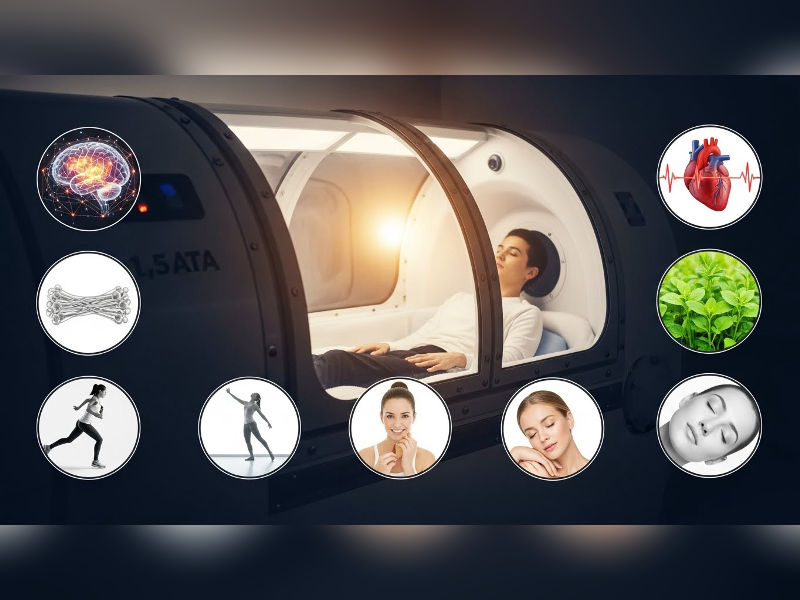
A 1.5 ATA hyperbaric chamber sits between soft home chambers (1.3 ATA) and standard clinical HBOT (2.0 ATA). At 1.5 ATA with 100% oxygen, the inspired oxygen partial pressure rises to roughly 1,140 mmHg, about seven times the 150 mmHg you get from room air at sea level. It is also the pressure at which the strongest mild-TBI research was run: four positive randomized trials meeting Level 1 evidence criteria in a 2022 systematic review.2
Understanding what 1.5 ATA actually delivers, which chambers reach it, and what the evidence shows helps buyers decide whether this pressure is the right choice.
What does 1.5 ATA deliver clinically?
At 1.5 ATA with 100% oxygen, the inspired oxygen partial pressure is roughly 1,140 mmHg, close to 1.5 atmospheres of pure oxygen. This is a common point of confusion: the pressure is 1.5 ATA, but the oxygen partial pressure is far higher than 1.5 ATA of ambient air would suggest. This is not soft chamber territory (1.3 ATA with air), and it is not standard clinical territory (2.0 ATA). It is a middle zone with a specific evidence profile.
A 2022 systematic review by Harch on HBOT for mild traumatic brain injury (mTBI) and persistent postconcussion syndrome found that 40 sessions at 1.5 ATA with 100% oxygen produced four positive randomized controlled trials meeting Centre for Evidence-Based Medicine Level 1 criteria. This was the strongest evidence level in the review, stronger than results at 1.3 ATA (mixed) and stronger than results at 2.4 ATA (negative for mTBI specifically). The review also argued that the pressure itself, within a narrow range, mattered more than the added oxygen.2
One caveat belongs alongside that finding: the Harch review is the work of a single author with commercial ties to hyperbaric medicine, and the constituent trials had small samples. It is the best synthesis available for mTBI at this pressure, but it is not the same as multiple independent large trials.
How does 1.5 ATA compare across the pressure spectrum?
| Pressure | Role | Evidence for mTBI | Chamber Type |
|---|---|---|---|
| 1.3 ATA | Soft-shell mild range | Mixed (1 pos, 1 neg) | Soft shell home chambers |
| 1.5 ATA | Strongest mTBI evidence (Harch 2022) | Strong (4 RCTs, Level 1) | Hard shell home models; some clinical |
| 2.0 ATA | Clinical minimum for most UHMS indications | Limited data for mTBI | Clinical monoplace standard |
| 2.4 ATA | Standard clinical (DCI, CO) | Negative for mTBI | Clinical standard |
The pattern shows that more pressure is not always better. For mTBI specifically, 1.5 ATA outperformed both lower and higher pressures in the best available evidence. The dose-response relationship in HBOT is condition-specific, not linear. For most UHMS-approved indications, though, 2.0 ATA and above remain the standard, as our 2.0 ATA chamber guide and comparison of mild versus clinical HBOT lay out.
Which chambers reach 1.5 ATA?
The FDA-cleared brands (OxyHealth, Summit to Sea, Newtowne) all cap at 1.3 ATA. Reaching 1.5 ATA means stepping outside FDA-cleared territory into CE-certified or hard-shell units. Prices below are approximate and drift over time, so confirm current figures with the seller.
| Model | Brand | Pressure | Type | Price (approx) | FDA |
|---|---|---|---|---|---|
| Apex32 / Apex36 | OxyRevo | 1.5 ATA | Soft shell | $8,499 to $8,999 | No (CE) |
| Sitting Pod | Dr Hugo / LANNX | 1.5 ATA | Soft shell upright | $6,000 to $10,000 | No (CE) |
| Eclipse Elite | Hyperbaric USA | 1.5 ATA | Hard shell | $21,450 | TBD |
| Zeugma Wellness | HPO Tech | 1.5 ATA | Hard shell aluminum | $15,000 to $30,000 | No (CE) |
How safe is 1.5 ATA?
At 1.5 ATA, adverse events are uncommon and mild. A 2023 prospective safety study of 175 patients treated at 1.45 ATA found adverse events in 7.1% of sessions, with all barotrauma recorded as subjective earache and zero objective eardrum injury (Teed scale 0).3 That profile is milder than what is typically seen at 2.0 ATA and above.
The trade-off is fire risk. At 1.5 ATA with supplemental oxygen, the fire hazard rises compared with ambient-air soft chambers. Chambers running at 1.5 ATA with an oxygen source require appropriate protocols: no open flames, no sparks, and no synthetic fabrics with high static potential. A broader survey of HBOT regimens and adverse effects across the pressure range confirms that serious events remain rare when protocols are followed.4
Who should use a 1.5 ATA chamber?
A 1.5 ATA chamber with oxygen is worth considering for users specifically interested in the mTBI and postconcussion evidence base, users who have found 1.3 ATA insufficient, or those who want a middle-zone pressure without going to full clinical HBOT. Bear in mind that the wound-healing and antimicrobial benefits associated with clinical HBOT depend on higher tissue oxygen than 1.5 ATA delivers: Sack and colleagues (2024) measured tissue oxygen of roughly 161 mmHg at 1.4 ATA versus 333 mmHg at 2.0 ATA, and found no evidence that the lower pressure benefits chronic ulcer patients.1 For those UHMS-approved conditions requiring 2.0+ ATA, see the 2.0 ATA hyperbaric chamber guide or the hospital hyperbaric chamber guide. For a comparison with 1.3 ATA options, see the mild hyperbaric chamber guide.
FAQs
Is 1.5 ATA considered clinical HBOT?
The UHMS minimum for most approved indications is around 2.0 ATA, and Burman notes that breathing air below 2.0 ATA does not meet the standard definition of therapeutic hyperbaric oxygen, which requires near-100% oxygen.5 At 1.5 ATA with 100% oxygen, a chamber is above soft-chamber territory and crosses clinical thresholds for specific conditions, particularly mTBI per the Harch 2022 review. For most other indications, clinicians still use 2.0 ATA or higher.2
Do any FDA-cleared chambers reach 1.5 ATA?
Not currently. All three FDA-cleared portable brands (OxyHealth, Summit to Sea, Newtowne) are limited to 1.3 ATA. Chambers that reach 1.5 ATA carry CE certification rather than FDA clearance, or are hard-shell units on a different regulatory pathway. Buyers should factor that regulatory difference into a purchase decision.
Is 1.5 ATA better than 2.0 ATA for everything?
No. For wound healing, radiation injury, and most UHMS indications, 2.0 ATA is the evidence-based standard, and tissue oxygen at 1.5 ATA is well below the levels those conditions require. The 1.5 ATA advantage is specific to the mTBI evidence base. Pressure should match the condition being treated, not a general assumption that lower or higher is universally better.1
References
- Sack RA, Pikkel YY, Leitner Shemy O, Ramon Y, Ullmann Y, Zeltzer AA. Transcutaneous oximetry values in chronic ulcer patients during hyperbaric treatment at 1.4 ATA compared to 2 ATA. Undersea Hyperb Med. 2024;51(1). PMID: 38615347. PubMed
- Harch PG. Systematic review and dosage analysis: hyperbaric oxygen therapy efficacy in mild traumatic brain injury persistent postconcussion syndrome. Front Neurol. 2022;13:815056. PMID: 35370898. doi:10.3389/fneur.2022.815056
- Monge G, Otto-Yáñez M, Norambuena N, Martínez V, Retamales D, Torres-Castro R. Safety of hyperbaric oxygenation treatment and evaluation of associated clinical parameters. Int J Transl Med Res Public Health. 2023. doi:10.21106/ijtmrph.430
- Laspro M, Wei LW, Brydges HT, Gorenstein SA, Huang ET, Chiu ES. Hyperbaric oxygen therapy regimens, treated conditions, and adverse effect profile: an Undersea and Hyperbaric Medical Society survey study. Undersea Hyperb Med. 2024;51(4):369-376. PMID: 39821765. PubMed
- Burman F. Low-pressure fabric hyperbaric chambers. S Afr Med J. 2019;109(4). PMID: 31084683. doi:10.7196/SAMJ.2019.v109i4.13934

2 Comments