EBOO vs 10-Pass Ozone Therapy: Differences, Costs, and Which Is Better
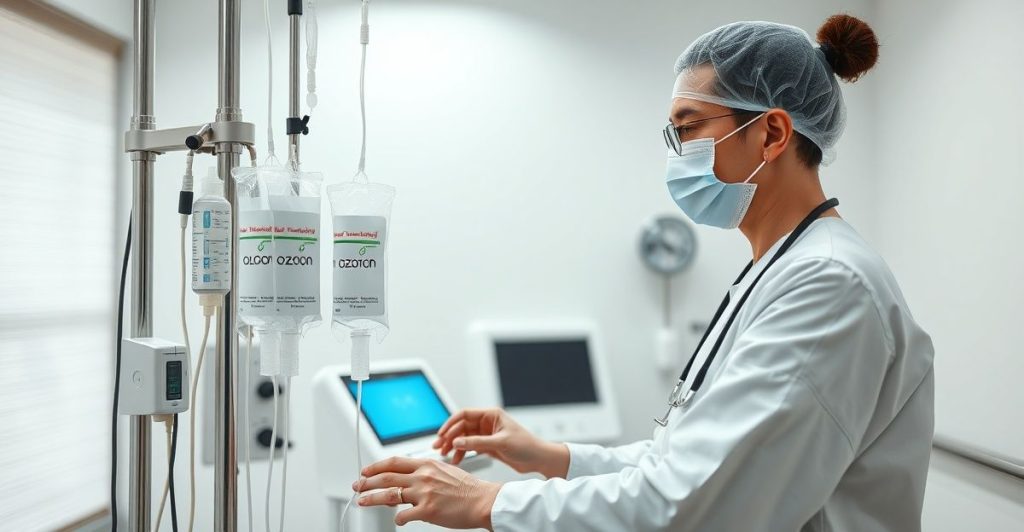
EBOO and 10-Pass ozone are the two most advanced systemic ozone therapies available, and they are frequently confused with each other despite working through fundamentally different mechanisms. EBOO (Extracorporeal Blood Oxygenation and Ozonation) filters blood outside the body through an ozone-infused dialysis-like circuit. 10-Pass (also called Multi-Pass or Hyperbaric Ozone) draws blood, ozonates it under pressure, and reinfuses it, repeating this cycle 10 times in a single session. Both deliver significantly more ozone than standard Major Autohemotherapy (MAH), but they do so in different ways and are suited to different clinical situations.
This guide provides a head-to-head comparison of EBOO and 10-Pass ozone therapy, covering mechanisms, session experience, costs, evidence quality, and which conditions each approach is best suited for.
Key Takeaways
- EBOO filters and ozonates blood extracorporeally, combining ozone therapy with a blood filtration/detoxification component
- 10-Pass delivers ozone under pressure (0.8 to 1.0 bar) via repeated draw-ozonate-reinfuse cycles, maximizing ozone saturation of blood1
- EBOO sessions take 45 to 90 minutes and cost $800 to $2,000; 10-Pass sessions take 60 to 120 minutes and cost $800 to $1,500
- Neither has strong clinical evidence: both are based on clinical experience and mechanistic reasoning rather than large RCTs
- 10-Pass has more clinical literature and a longer track record; EBOO is newer with more theoretical appeal
- Some practitioners use both in sequence for severe or complex cases
How EBOO Works
EBOO stands for Extracorporeal Blood Oxygenation and Ozonation. Think of it as a simplified dialysis-like procedure that adds ozone exposure to blood filtration.
The process:
- Blood is drawn from one arm via IV access
- It passes through an external circuit containing a specialized filter membrane
- Ozone/oxygen gas is introduced on one side of the membrane while blood flows on the other
- The membrane allows gas exchange: ozone contacts the blood while also filtering out certain waste products, fats, and inflammatory mediators
- The ozonated and filtered blood returns to the patient through the other arm
The dual action is what distinguishes EBOO from other ozone methods. It is not just ozone therapy. It is ozone therapy plus a filtration/detoxification step. Proponents argue this makes it particularly effective for conditions involving toxic burden, chronic infections, and metabolic dysfunction.2
You can see the filtration effect in real time: the blood going into the circuit appears dark, and the blood returning appears significantly brighter red (indicating improved oxygenation). The filter often collects visible yellow/brown waste material. While this visual effect is dramatic, it should be interpreted cautiously. Changes in blood color primarily reflect oxygenation status, and the filtered material has not been rigorously analyzed in published studies.
How 10-Pass Ozone Works
10-Pass ozone therapy, developed by Dr. Johann Lahodny in Austria, uses a specialized device (the Zotzmann Ozon 2000) that draws blood into a vacuum bottle, exposes it to ozone under positive pressure (0.8 to 1.0 bar), and reinfuses it. This cycle is repeated 10 times in a single session.1
The process:
- Approximately 200 mL of blood is drawn into a glass vacuum bottle
- Ozone is introduced under pressure, forcing more ozone into solution than atmospheric-pressure methods allow
- The ozonated blood is reinfused via gravity or mild pressure
- Steps 1-3 are repeated 9 more times
The key innovation is the hyperbaric ozone exposure. Henry’s Law dictates that gas solubility in liquid increases with pressure. By ozonating blood under pressure, 10-Pass dissolves significantly more ozone per volume of blood than standard MAH. Across 10 passes, the total ozone dose delivered is roughly 10 times what a single MAH session provides.3
For more detail on 10-Pass, see our full guide: 10-Pass Ozone Therapy. For more on EBOO, see: EBOO Ozone Therapy.
“EBOO adds a filtration component that 10-Pass does not have. 10-Pass delivers a higher total ozone dose under pressure. They are complementary technologies, not competing ones.”
Clinical observation from integrative medicine practitioners
Head-to-Head Comparison
| Factor | EBOO | 10-Pass |
|---|---|---|
| Core mechanism | Ozone + blood filtration through membrane | Ozone under pressure, 10 repeated cycles |
| Ozone dose | Moderate (continuous exposure, but through membrane) | High (10x standard MAH dose, under pressure) |
| Filtration/detox | Yes (removes lipids, inflammatory mediators, waste) | No (pure ozone therapy) |
| Session time | 45 to 90 minutes | 60 to 120 minutes |
| IV access | Two arms (draw and return) | One arm |
| Cost per session | $800 to $2,000 | $800 to $1,500 |
| Blood volume processed | 1.5 to 3 liters (continuous flow) | ~2 liters (200 mL x 10 passes) |
| Equipment | EBOO filter unit (various manufacturers) | Zotzmann Ozon 2000 (or similar hyperbaric ozone device) |
| Published studies | Very few (mostly case reports) | Several case series, small trials |
| Track record | Newer (~5-7 years in common use) | Longer (~10-15 years in use since Lahodny’s development) |
| Availability | Growing but still limited | More widely available |
Which Conditions Favor Which Approach?
| Condition/Goal | Better Option | Reasoning |
|---|---|---|
| Lyme disease | 10-Pass (then consider EBOO) | Higher ozone dose for antimicrobial effect; EBOO adds detox for Herxheimer management |
| Mold illness/CIRS | EBOO | Filtration component helps remove mycotoxins and inflammatory mediators |
| Chronic fatigue | Either (EBOO may have slight edge) | Both improve oxygenation; EBOO’s detox may address contributing toxic burden |
| Autoimmune conditions | 10-Pass (conservative dosing) | Better dose control with individual passes; can stop early if needed |
| High cholesterol/metabolic | EBOO | Filtration removes lipids and metabolic waste products |
| Viral infections (EBV, HSV) | 10-Pass | Maximum ozone dose for antiviral effect |
| Post-COVID/Long COVID | Both (combination ideal) | 10-Pass for immune modulation; EBOO for microclot/inflammatory mediator filtration |
| General wellness/optimization | 10-Pass (more cost-effective) | Higher ozone dose per dollar; filtration less necessary for healthy individuals |
Can You Do Both?
Yes. Some practitioners offer combined EBOO + 10-Pass protocols, typically scheduling them on different days within the same week. The rationale is that 10-Pass delivers maximum ozone dose while EBOO provides the filtration/detoxification component. Together, they address both the “treat” and “clean” aspects of systemic therapy.
Common combination protocols:
- Alternating: 10-Pass on Monday, EBOO on Thursday, for 4 to 6 weeks
- Sequential: EBOO first (filter blood), then 10-Pass 24 to 48 hours later (maximize ozone on cleaner blood)
- Front-loaded: Start with 3 to 4 EBOO sessions to detoxify, then switch to 10-Pass for maintenance
Combination protocols are expensive ($1,600 to $3,500 per week) and are typically reserved for complex, treatment-resistant cases like chronic Lyme disease, mold illness, or Long COVID.
Evidence Quality: An Honest Assessment
Neither EBOO nor 10-Pass has strong clinical evidence. Here is a frank assessment of where the evidence stands for each:
10-Pass Evidence
- More published case series and clinical observations
- Dr. Lahodny and collaborators have published protocol descriptions and outcome data
- Used in European clinics for over a decade with documented safety
- No large RCTs
EBOO Evidence
- Very few published studies specific to the EBOO procedure
- Draws theoretical support from both ozone therapy literature and dialysis/apheresis literature
- Growing adoption in US integrative medicine clinics but limited published outcomes
- No RCTs
Both therapies exist in the same evidence tier: mechanistically plausible, supported by clinical experience, but unproven by the standards of conventional evidence-based medicine. Patients choosing either approach should understand they are opting for an experimental treatment.
Cost Comparison
| Scenario | EBOO Cost | 10-Pass Cost |
|---|---|---|
| Single session | $800 to $2,000 | $800 to $1,500 |
| 6-session course | $4,800 to $12,000 | $4,800 to $9,000 |
| Monthly maintenance (1/month) | $9,600 to $24,000/year | $9,600 to $18,000/year |
| Combined protocol (6 weeks) | $9,600 to $21,000 total | |
Neither is covered by health insurance in the United States.
Safety
Both procedures require trained medical professionals and proper equipment:
- EBOO risks: Air embolism (if equipment malfunctions), hemolysis (if filter is damaged), infection (two IV sites), hypotension, hematoma at IV sites
- 10-Pass risks: Hemolysis (if ozone concentration too high), air embolism (rare with proper equipment), vasovagal reaction, bruising at IV site
- Shared contraindications: G6PD deficiency, active bleeding disorders, pregnancy, severe anemia
Both procedures are generally well tolerated by trained providers using properly maintained equipment. EBOO carries slightly more risk due to the complexity of the extracorporeal circuit and the need for two IV access points.
The Bottom Line
EBOO and 10-Pass are different tools for different jobs. 10-Pass is the better choice when the primary goal is maximum ozone delivery for conditions like chronic infections, immune modulation, or general optimization. EBOO is the better choice when blood filtration and detoxification are priorities, such as mold illness, toxic burden, or metabolic conditions.
For complex, multi-system conditions (chronic Lyme, Long COVID, CIRS), combining both approaches may offer the most comprehensive treatment, though at significant cost and without strong evidence to guide optimal protocols. Both remain experimental, and patients should make decisions based on their specific clinical situation, provider experience, and financial capacity.
References
- Lahodny J. “High-dose ozone therapy (OHT): Ten-pass ozone as a therapeutic method.” Zeitschrift fur Ganzheitliche Tiermedizin. 2014;28:45-50.
- Di Mauro R, et al. “EBOO therapy: a new approach in ozone treatment.” Journal of Ozone Therapy. 2019;3(4):1-6.
- Bocci V. “Ozone: A New Medical Drug.” 2nd ed. Springer; 2011.
- Smith NL, et al. “Ozone therapy: an overview of pharmacodynamics, current research, and clinical utility.” Medical Gas Research. 2017;7(3):212-219. doi:10.4103/2045-9912.215752
- Elvis AM, Ekta JS. “Ozone therapy: a clinical review.” Journal of Natural Science, Biology and Medicine. 2011;2(1):66-70. doi:10.4103/0976-9668.82319
- Sagai M, Bocci V. “Mechanisms of action involved in ozone therapy.” Medical Gas Research. 2011;1(1):29. doi:10.1186/2045-9912-1-29
- Bocci V, et al. “The ozone paradox: ozone is a strong oxidant as well as a medical drug.” Medicinal Research Reviews. 2009;29(4):646-682. doi:10.1002/med.20150