GLP-1 and Muscle Loss: How to Protect Lean Mass
The short answer: When you lose weight on a GLP-1 medicine like semaglutide or tirzepatide, some of what you lose is muscle, not just fat. Across the major trials, lean mass has accounted for somewhere in the range of 25 to 40 percent of total weight lost, depending on the study and the person. That sounds alarming, but it is largely manageable. Eating enough protein, lifting weights, not under-eating, and titrating the dose slowly under medical supervision can protect most of your lean mass while you keep losing fat.
Why GLP-1 medicines cause muscle loss in the first place
This is not a quirky side effect of the drug. It is mostly basic physiology. Whenever you lose weight quickly, your body draws on both fat and lean tissue. The faster and larger the weight loss, the more lean mass tends to come along for the ride. GLP-1 and dual GIP/GLP-1 medicines produce some of the fastest, largest weight loss we have seen from a pill or injection, so muscle loss becomes a real consideration rather than an afterthought.
Two things drive it:
- Rapid, substantial weight loss. Any significant calorie deficit pulls from muscle as well as fat. These medicines create a strong deficit by quieting appetite, so the deficit can be larger than what most people achieve through diet alone.
- Reduced food intake, especially protein. The appetite suppression is the point of the medicine, but it often means people simply eat less of everything, protein included. Without enough dietary protein and without a reason for the body to hold onto muscle, lean tissue gets broken down.
It is worth being honest about the numbers because they vary. In the semaglutide STEP-1 analysis, lean mass made up roughly 40 to 45 percent of total weight lost. In the tirzepatide SURMOUNT-1 analysis, the figure was closer to 25 to 26 percent. Different trials, different body composition methods, and different populations produce different results, which is exactly why you should treat any single headline percentage with caution. The trials that show the highest lean mass loss were generally done in people who were sedentary, not eating high protein, and not training. That is the key insight: the percentage is not fixed. It responds to what you do.
Why lean mass matters more than people realize
Muscle is not just for appearance or athletics. It does quiet, important work:
- Metabolism. Muscle is metabolically active tissue. Lose too much of it and your resting energy expenditure drops, which can make weight maintenance harder later.
- Strength and physical function. Lean mass supports everyday capability, from carrying groceries to climbing stairs. This matters at every age and becomes critical as people get older.
- Long-term weight maintenance. Preserving muscle helps protect the metabolic machinery you will rely on if you ever come off the medicine or reduce the dose. Losing fat while keeping muscle is a far more durable outcome than losing weight indiscriminately.
- Metabolic health. Skeletal muscle is a major site for glucose disposal. Keeping it supports blood sugar regulation, which is often part of the reason people are on these medicines to begin with.
The goal is not to lose less weight. It is to make sure the weight you lose is mostly fat.
The evidence-based countermeasures
Here is the encouraging part. The same strategies that preserve muscle during any weight loss work here, and the data on combining them is genuinely good. In one six-month study of about 200 adults who were taught resistance training and adequate protein intake when they started a GLP-1 medicine, participants lost roughly 13 percent of body weight but only around 3 percent of muscle mass. That is a dramatically better ratio than what the early sedentary trials showed.
1. Eat enough protein
Protein is the single most important nutritional lever for keeping muscle in a calorie deficit. The general guidance discussed in the literature for preserving lean mass during weight loss sits around 1.2 to 1.6 grams of protein per kilogram of body weight per day. People who are training hard may benefit from the higher end or slightly above, in the region of 1.6 to 2.2 g/kg. These are general ranges, not prescriptions, and the right target depends on your size, age, kidney health, and activity level, so confirm yours with your prescriber or a dietitian.
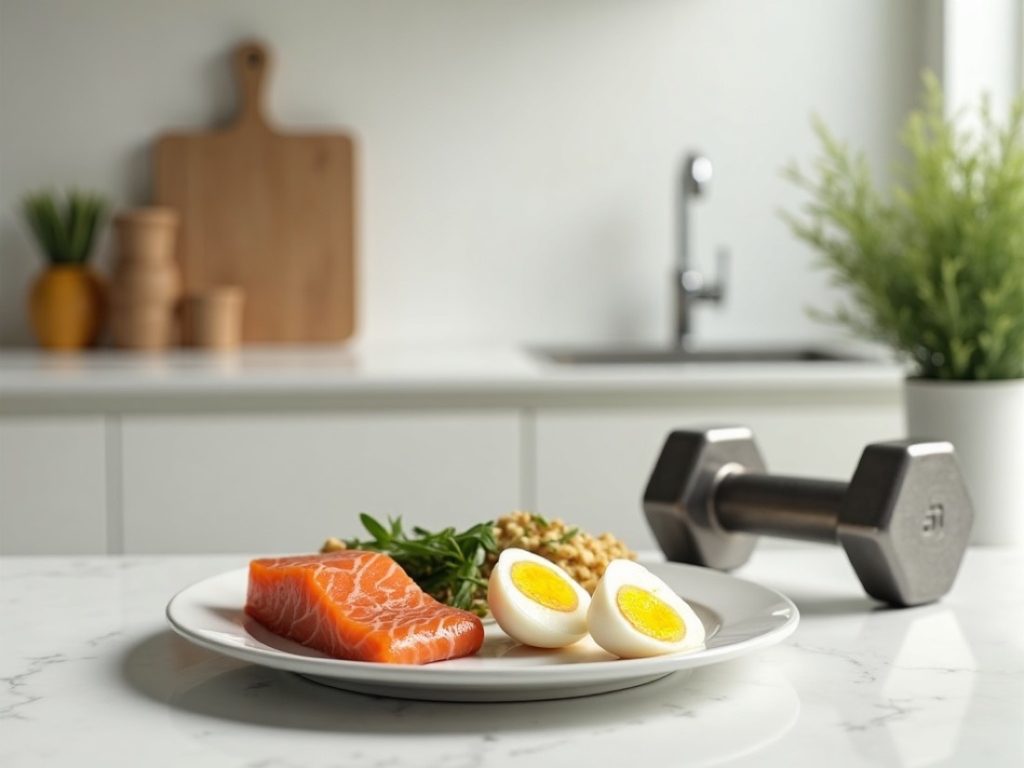
The practical challenge on a GLP-1 medicine is that you are not very hungry. That makes it easy to fall short. A few habits help: eat protein first at each meal, prioritize dense sources like eggs, dairy, fish, poultry, lean meat, tofu, and legumes, and consider a protein shake on days when solid food feels like too much.
2. Do resistance training
Protein gives your body the raw material. Resistance training gives it a reason to use that material for muscle rather than burn it for fuel. The research is consistent that protein and lifting together preserve more muscle than either one alone. Protein without the mechanical load of resistance work does not fully protect lean mass.
You do not need to become a bodybuilder. Two to three sessions a week covering the major movement patterns, with enough effort to be challenging, is a reasonable starting point. Bodyweight work, resistance bands, machines, or free weights all count. Progressing the difficulty over time is what matters most.
3. Do not under-eat
Because these medicines suppress appetite so effectively, some people drift into eating far too little overall. An extreme deficit accelerates muscle loss and can leave you fatigued and nutrient-deficient. Losing weight at a steady, moderate pace, while still eating real meals, protects lean mass better than crash-style restriction. Eating enough is a strategy, not a contradiction.
4. Titrate the dose slowly
Faster weight loss tends to mean more lean mass loss. A gradual dose increase, guided by your prescriber, generally produces a steadier rate of loss that is easier on your muscle and on your digestion. There is no prize for getting to the maximum dose quickly. This is a decision to make with your clinician, not on your own.
5. Emerging adjuncts
This area is moving quickly, and it is worth understanding without overstating it. Researchers are testing medicines designed specifically to preserve muscle during GLP-1 weight loss. Bimagrumab, an antibody that blocks activin type II receptors involved in myostatin signaling, has shown in early-phase trials that combining it with semaglutide can shift a much larger share of weight loss toward fat while protecting or even increasing lean mass. Other myostatin-pathway agents are in development.
These are promising but still investigational. They are not a substitute for protein and training, and they are not something to pursue on your own. Mention them to your prescriber if muscle loss is a particular concern, and watch the space as the data matures.
| Strategy | What it does | Practical starting point |
|---|---|---|
| Adequate protein | Supplies building blocks to retain muscle | ~1.2 to 1.6 g/kg/day, higher if training hard |
| Resistance training | Signals the body to keep muscle | 2 to 3 sessions per week, progressive |
| Eating enough | Prevents an extreme deficit | Steady, moderate weight loss |
| Slow titration | Slows the rate of loss | Increase dose gradually with your prescriber |
| Emerging adjuncts | Pharmacologically protect lean mass | Investigational, discuss with clinician |
Does this apply to both semaglutide and tirzepatide?
Yes. Lean mass loss is a feature of rapid weight loss generally, so it applies to both semaglutide and tirzepatide, and to the dual and triple agonists now coming through trials. Some analyses suggest tirzepatide may have a somewhat more favorable lean-to-fat loss ratio, but the differences are modest and the data is still developing. The protective strategies are the same regardless of which medicine you are on. If you are weighing the two, our comparison of semaglutide versus tirzepatide and our guide to tirzepatide for weight loss go deeper.
A word on medical supervision
Semaglutide and tirzepatide are prescription medicines. Dosing, titration, protein targets, and any adjunct therapy should be decided with a qualified clinician who knows your full history, including kidney function and any other conditions. Body composition is also worth tracking with something better than a bathroom scale, since the scale cannot tell muscle from fat. A DEXA scan or a clinical bioimpedance assessment gives you a real picture of what you are actually losing.
Frequently asked questions
How much muscle will I lose on semaglutide or tirzepatide?
It depends heavily on what you do. In sedentary trial populations, lean mass has accounted for roughly 25 to 40 percent of total weight lost. With adequate protein and regular resistance training, studies suggest muscle loss can be cut to a small fraction of total weight lost, with most of the weight coming from fat.
How much protein should I eat on a GLP-1 medicine?
General guidance for preserving muscle during weight loss is around 1.2 to 1.6 grams per kilogram of body weight per day, with higher amounts sometimes used by people training intensely. The right target for you depends on your size, age, activity, and kidney health, so confirm it with your prescriber or a dietitian.
Can I rebuild muscle while staying on the medicine?
Yes. With sufficient protein and consistent resistance training, many people maintain or even build strength while continuing to lose fat. The medicine does not prevent muscle growth. The main obstacle is usually eating enough protein when your appetite is suppressed.
Is muscle loss a reason to avoid these medicines?
Not by itself. For most people the metabolic benefits of significant fat loss are substantial, and muscle loss is largely preventable with the right habits. The sensible approach is to use the medicine under medical supervision while actively protecting your lean mass, rather than avoiding effective treatment.
Related reading
- Semaglutide vs Tirzepatide: How They Compare
- Tirzepatide for Weight Loss
- Peptide Therapy: What It Is and How It Works
- NAD+ IV Therapy and Anti-Aging
This article is for general educational purposes and is not medical advice. Semaglutide and tirzepatide are prescription medicines that should be used only under the supervision of a qualified healthcare professional. Always consult your own clinician before starting, stopping, or changing any treatment, supplement, protein target, or exercise program, particularly if you have an existing medical condition.