DIY Hyperbaric Chamber: Why It Is Dangerous and What to Use Instead
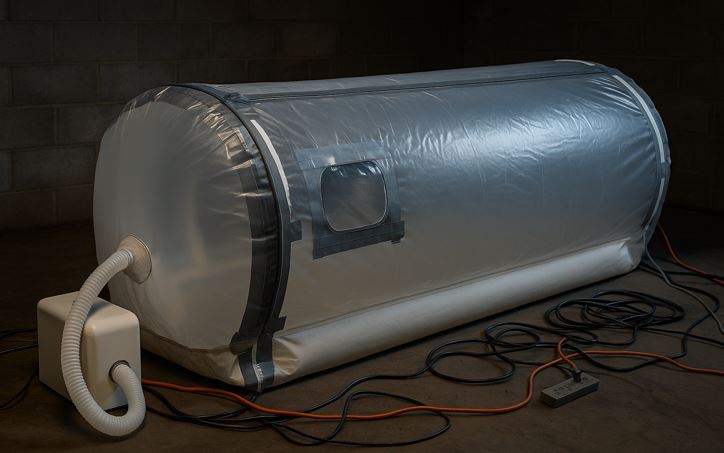
A DIY hyperbaric chamber is not a viable option. Hyperbaric chambers are FDA-classified Class II medical devices,1 and homemade pressure vessels lack the engineered safety systems, certified construction, and controlled oxygen delivery those devices require. Chamber fires have killed 77 people in 35 documented incidents, almost always traced to an ignition source an occupant carried inside.5 The FDA, UHMS, and AMA all explicitly warn against building or using improvised chambers.2
This guide explains why homemade chambers are dangerous, what people have attempted and why those attempts fail, and what the safe alternatives are at each price point. It does not provide build instructions, because there is no safe way to build one.
Why is a DIY hyperbaric chamber dangerous?
A DIY hyperbaric chamber is dangerous because pressurized oxygen combines four independent failure modes that certified chambers are engineered to control: fire, carbon dioxide buildup, structural rupture, and oxygen toxicity. Any one of them can be fatal, and a homemade build addresses none of them. The dangers are not theoretical. They follow directly from the physics of pressurized oxygen environments.
Fire and explosion. Oxygen under pressure is extraordinarily reactive. In an oxygen-enriched, pressurized space, static electricity from clothing, a metal zipper, or an electrical spark can ignite materials that would not normally burn, and the fire spreads far faster than in ordinary air. The Sheffield and Desautels analysis of 73 years of chamber fires found 77 human fatalities in 35 hyperbaric chamber fires, with post-1980 fires driven mainly by prohibited ignition sources carried inside by occupants.5 Clinical chambers require fire suppression systems, fire-retardant materials, and grounding protocols that no DIY build can replicate.2
CO2 buildup and suffocation. Without engineered ventilation, the carbon dioxide produced by normal breathing accumulates inside a sealed, pressurized vessel. A properly designed chamber uses CO2 scrubbing or continuous ventilation to prevent this. In a homemade chamber with no ventilation system, carbon dioxide can rise to dangerous levels and cause unconsciousness within minutes.2
Structural failure. PVC pipe, modified tanks, repurposed vessels, and improvised bags cannot safely contain hyperbaric pressure. The ASME PVHO-1 standard governs pressure vessels for human occupancy, and it exists because the failure of a pressurized vessel is violent.3 A rupture under pressure is an explosion, not a slow deflation.
Oxygen toxicity. Without precise oxygen concentration controls, users can inhale oxygen levels high enough to cause central nervous system toxicity, which can present as seizures, or pulmonary oxygen toxicity from prolonged high exposure. Clinical chambers monitor oxygen concentration continuously.2 Even properly run clinical sessions carry risks, which we detail in our guide to hyperbaric chamber side effects.
Legal liability. Building a pressure vessel that injures someone creates criminal exposure, not just civil liability. If guests use the device, that liability extends further.
Can you build a hyperbaric chamber at home?
You cannot safely build a hyperbaric chamber at home. Documented DIY attempts have included repurposed scuba tanks, modified PVC pressure chambers, sealed bags fed by air compressors, and modified industrial pressure vessels. None of these designs address the fundamental requirements: engineered pressure-cycling fatigue life, controlled oxygen delivery, CO2 scrubbing, pressure-relief valves rated to the correct specification, anti-static construction, and fire suppression.
The UHMS Consumer Warning notes that even commercial soft-sided bag chambers do not meet clinical HBOT standards.2 Homemade versions of those bags have additional failure modes that commercial chambers at least partially address through material selection and engineering testing. Because early chamber fires were largely electrical while modern ones stem from occupant-introduced ignition sources, a homemade build reintroduces both categories of risk at once.5
If you want to understand exactly how these vessels fail, our explainers on hyperbaric chamber fires and how a hyperbaric chamber explodes walk through the mechanisms in detail.
What are the safe alternatives to a DIY chamber?
The motivation behind a DIY chamber is usually cost. There are legitimate, lower-cost options that do not put you inside an uncertified pressure vessel, ranging from clinic sessions to rentals to entry-level FDA-cleared home units.
| Budget | Option | Pressure | FDA Status | What You Get |
|---|---|---|---|---|
| $0 to $500/mo | Clinic HBOT at a local facility | 2.0 to 2.4 ATA | FDA-cleared, physician-supervised | 100% O2, trained staff, full clinical HBOT |
| $300 to $700/mo | Soft chamber rental | 1.3 ATA | FDA-cleared | Home use without an ownership commitment |
| $4,000 to $5,500 purchase | Newtowne C4-27 or Summit to Sea Shallow Dive | 1.3 ATA | FDA-cleared, US-made | Certified materials, full warranty |
| $8,499 purchase | OxyRevo Apex32 | 1.5 ATA | CE-certified (not FDA-cleared) | Higher pressure than 1.3 ATA FDA-cleared units |
| $18,000 to $23,000 | OxyHealth Vitaeris 320 | 1.3 ATA | FDA-cleared | 5-year warranty, US-made |
The entry-level FDA-cleared options, such as the Newtowne C4-27 at about $4,495 or the Summit to Sea Shallow Dive at roughly $4,000, are the minimum safe starting point for home use. These are engineered devices with certified materials, pressure-relief systems, and manufacturer accountability. If budget is the barrier, a rental at $300 to $700 per month is a safer path than any DIY attempt. See our home hyperbaric chamber guide for the full breakdown of legitimate home options, and our portable hyperbaric chamber guide for the FDA-cleared travel-friendly units.
For a Clinical Condition, Go to a Facility
If you are considering HBOT for a specific medical condition, none of the home options, whether purchased or DIY, are appropriate. Clinical HBOT at 2.0 ATA or higher with 100% medical oxygen, supervised by a hyperbaric physician, is the standard of care. See our guide on whether hospitals have hyperbaric chambers for what clinical treatment involves.
Frequently Asked Questions
Is it legal to build a DIY hyperbaric chamber?
Building one for personal use is not explicitly illegal in most places, but using a non-certified pressure vessel for therapy conflicts with FDA medical device regulations, which classify hyperbaric chambers as Class II devices.1 If someone is injured, criminal charges and civil liability can follow. The legal exposure is a secondary concern next to the physical risk of fire, asphyxiation, and rupture.
What about a modified oxygen concentrator at low pressure?
Using an oxygen concentrator with a sealed bag or tent at low pressure is not the same as HBOT, and it is still a DIY pressure chamber by definition. It lacks the pressure-vessel safety engineering and the precise pressure and oxygen controls needed to avoid CO2 buildup and oxygen enrichment.2 The oxygen-enriched environment also reintroduces the fire risk documented in chamber-fire analyses.5
Are cheap chambers on Amazon safe?
Low-cost chambers from unbranded overseas manufacturers typically lack FDA clearance, offer limited accountability if something fails, and often include no verified pressure testing. They are not DIY builds, but they carry meaningful risks compared with FDA-cleared alternatives. Our portable hyperbaric chamber guide covers the FDA-cleared options to look for instead.
Sources
- US Food and Drug Administration. Hyperbaric Chambers and Hyperbaric Oxygen Therapy: Class II Medical Device Classification. fda.gov/medical-devices
- Undersea and Hyperbaric Medical Society. Consumer Warning: The Dangers of Soft-Sided Bag Chambers. uhms.org
- ASME. PVHO-1: Safety Standard for Pressure Vessels for Human Occupancy, 2022. asme.org
- US Food and Drug Administration. Letter to Health Care Providers: Follow Instructions for Safe Use of Hyperbaric Oxygen Therapy Devices. fda.gov
- Sheffield PJ, Desautels DA. Hyperbaric and hypobaric chamber fires: a 73-year analysis. Undersea Hyperb Med, 1997;24(3):153-164. PMID: 9308138
- Laspro M, et al. Hyperbaric Oxygen Therapy Regimens, Treated Conditions, and Adverse Effect Profile: A UHMS Survey Study. Undersea Hyperb Med, 2024. PMID: 39821765



One Comment