EBOO Ozone Therapy Price: Full Cost Breakdown and Comparison
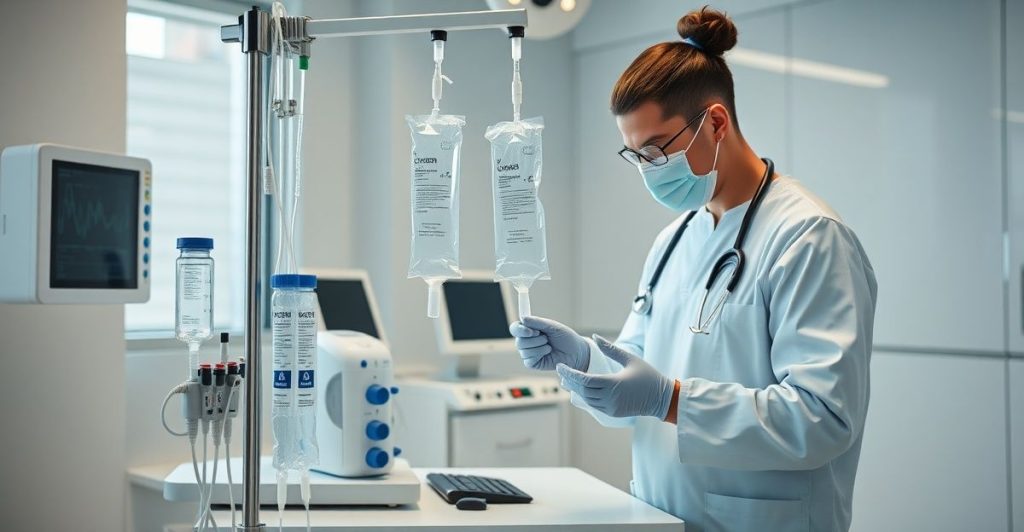
EBOO ozone therapy costs $900 to $1,500 per session, making it the most expensive form of ozone therapy available. EBOO (Extracorporeal Blood Oxygenation and Ozonation) filters and ozonates your entire blood volume outside the body, which requires specialized equipment, trained staff, and 1 to 3 hours of treatment time. This guide breaks down what EBOO costs, why it is priced higher than other ozone modalities, package pricing, and whether the premium is worth it.
Key Takeaways
- Single EBOO sessions cost $900 to $1,500. Package pricing brings per-session costs to $800 to $1,200.
- A full treatment course (6 to 10 sessions) typically costs $5,400 to $12,000 total.
- EBOO is 3 to 10 times more expensive than MAH and 1.5 to 2 times more than 10-pass ozone.
- Insurance does not cover EBOO. All costs are out of pocket.
- Equipment costs ($30,000 to $80,000) and staffing requirements drive the higher price.
- Clinical evidence is limited to one 28-patient controlled trial. There is no FDA clearance or Cochrane review.
What does EBOO ozone therapy cost?
EBOO pricing varies by clinic, location, and what is included in the session. A single session runs $900 to $1,500, and package pricing brings the per-session figure down to $800 to $1,200. Here is what you can expect to pay across the United States:
| Pricing Structure | Cost Range |
|---|---|
| Single EBOO session | $900 to $1,500 |
| 3-session package | $2,400 to $3,900 |
| 5-session package | $3,900 to $6,000 |
| 10-session package | $7,500 to $12,000 |
| Maintenance sessions (monthly) | $800 to $1,200 |
Real-world clinic pricing examples from across the US:
- A Florida clinic charges $875 per session, or $2,400 for 3 sessions and $3,900 for 5 sessions
- A Las Vegas practice prices EBOO at $1,400 per session, or 4 sessions for $4,800
- A Virginia clinic offers EBOO Quantum+ (ozone with ultraviolet blood irradiation and methylene blue) for $795
- An Oregon provider charges $830 per session
For a broader view of ozone therapy costs across every modality, see our complete pricing guide.
Why does EBOO cost more than other ozone therapy?
EBOO costs significantly more than other forms of ozone therapy because it processes the full blood volume through a dialysis-type filter, which demands costly equipment, single-use consumables, and hours of continuous practitioner monitoring. The price reflects those inputs, not a markup.
Equipment cost. An EBOO machine costs $30,000 to $80,000. The device includes a dialysis-type filter, ozone generator, blood pumps, and monitoring systems. Compare this to a standard ozone generator for major autohemotherapy (MAH) that costs $3,000 to $8,000.
Disposable supplies. Each EBOO session requires a single-use extracorporeal circuit (tubing set, filter, connectors) that costs the clinic $100 to $300. These cannot be reused for safety reasons.
Time. An EBOO session takes 1 to 3 hours, during which a trained practitioner monitors the patient continuously. A standard MAH session takes 30 to 45 minutes with less monitoring.
Training and staffing. EBOO requires practitioners with specific training in extracorporeal blood handling. The procedure involves establishing IV access in both arms (blood is drawn from one and returned to the other), managing anticoagulation, and monitoring for adverse reactions.
Volume of blood treated. EBOO can process up to 4,800 mL of heparinized blood in about 1 hour of extracorporeal circulation, as documented by Di Paolo and colleagues across more than 1,200 treatments in 82 patients.3 By comparison, MAH treats only 100 to 250 mL of blood per session.
How does EBOO compare to MAH and 10-pass on cost?
EBOO runs 3 to 10 times the cost of MAH and roughly 1.5 to 2 times the cost of 10-pass ozone. Understanding how EBOO pricing compares to other IV ozone modalities helps you judge whether the premium is justified:
EBOO vs MAH vs 10-Pass: Cost and Delivery
| Feature | MAH | 10-Pass | EBOO |
|---|---|---|---|
| Cost per session | $150 to $300 | $750 to $900 | $900 to $1,500 |
| Blood volume treated | 100 to 250 mL | 2,000 mL (200 mL x 10) | ~4,800 mL (full volume) |
| Ozone dose delivered | Low (single pass) | High (10 consecutive passes) | Highest (continuous circulation) |
| Session duration | 30 to 45 min | 60 to 90 min | 60 to 180 min |
| Filtration included | No | No | Yes (dialysis-type filter) |
| IV access points | 1 | 1 | 2 (both arms) |
| Typical course (sessions) | 10 to 20 | 6 to 10 | 6 to 10 |
Ozone dialysis (the countercurrent method behind EBOO) delivers at least 3 times more ozone into the blood than other blood-ozonation methods, according to Rowen and colleagues, who published the first quantitative measurement of ozone uptake using the technique.4 That higher delivery, combined with full-volume filtration, is the core of the premium. For a side-by-side on protocol and value, see our 10-pass ozone therapy cost breakdown and the broader IV ozone pricing guide.
What is included in the price?
Before comparing clinics on price alone, understand what each clinic includes in their EBOO session fee.
Standard inclusions:
- Pre-treatment vitals and health assessment
- IV access setup (both arms)
- The EBOO procedure itself (1 to 3 hours)
- Practitioner monitoring throughout
- Post-treatment observation (15 to 30 minutes)
- Disposable circuit and supplies
Common add-ons (may or may not be included in the quoted price):
- Ultraviolet blood irradiation (UBI/UVBI): +$100 to $200
- Methylene blue infusion: +$50 to $150
- Glutathione push: +$50 to $100
- IV vitamin C drip: +$100 to $250
- Initial consultation: +$150 to $400 (often waived with package purchase)
- Blood work (pre-screening labs): +$100 to $300
Some clinics quote an all-inclusive price. Others quote a base price and add extras. Always ask for an itemized breakdown before committing.
How much does EBOO cost by region?
EBOO ozone therapy cost varies by region, from roughly $800 in smaller markets to $1,500 in major metros:
- Major metropolitan areas (NYC, LA, Miami): tend toward the high end ($1,200 to $1,500 per session)
- Mid-size cities (Austin, Denver, Charlotte): mid-range ($900 to $1,200 per session)
- Smaller cities and rural areas: often lower ($800 to $1,000 per session), but fewer clinics offer EBOO
Medical clinics with physician oversight generally charge more than wellness spas or naturopathic offices. Physician-supervised EBOO may be safer, particularly for patients with complex health conditions.
Does insurance cover EBOO ozone therapy?
No. EBOO ozone therapy is not covered by insurance. No major US health insurer covers it, because ozone therapy is classified as experimental or investigational. This applies to all forms of ozone therapy, not just EBOO. Insurers that exclude it include:
- Medicare and Medicaid
- Blue Cross Blue Shield
- UnitedHealthcare
- Aetna
- Cigna
Payment options: most EBOO clinics accept credit cards and offer payment plans. Some accept HSA (Health Savings Account) and FSA (Flexible Spending Account) funds since ozone therapy may qualify as a medical expense. Check with your HSA/FSA administrator to confirm eligibility.
Is EBOO worth the premium?
Whether EBOO is worth 3 to 10 times the cost of MAH depends on your situation. There is no controlled trial comparing EBOO head-to-head against cheaper ozone modalities, so the decision rests on your condition, prior response, and budget rather than settled outcome data.
EBOO may be worth considering if:
- You have a serious chronic condition (Lyme disease, chronic infections, autoimmune conditions) that has not responded to other ozone modalities
- You want the blood filtration component (removes debris, immune complexes, inflammatory byproducts)
- You have tried MAH and 10-pass without adequate results
- You prefer fewer sessions at higher intensity over many sessions at lower intensity
MAH or 10-pass may be better if:
- You are new to ozone therapy and want to start with a less intensive (and less expensive) modality
- Budget is a primary concern
- Your condition responds well to standard ozone protocols
- You prefer gradual treatment over intensive sessions
How should you budget for a full EBOO course?
A full initial course of 6 to 10 sessions plus workup runs roughly $5,000 to $10,700 out of pocket, before any maintenance. Here is a realistic framework.
Initial treatment course:
- Initial consultation: $150 to $400
- Pre-treatment labs: $100 to $300
- 6 to 10 EBOO sessions (package pricing): $4,800 to $10,000
- Total initial investment: $5,050 to $10,700
Maintenance phase:
- Monthly maintenance session: $800 to $1,200
- Annual maintenance cost: $9,600 to $14,400
Cost-saving strategies:
- Ask about package discounts (5 to 20% savings)
- Inquire about introductory pricing for new patients
- Consider combining EBOO with at-home ozone therapies (rectal insufflation) to extend the time between clinic visits
- Use HSA/FSA funds if eligible
- Ask about referral discounts
Does the evidence justify EBOO’s cost?
The clinical evidence for EBOO is limited to one small controlled trial and several case series from a single research group. There is no Cochrane review and no FDA clearance for EBOO, so the cost buys a more intensive procedure, not a proven advantage over cheaper ozone methods.
The strongest study is a controlled trial of 28 patients with peripheral artery disease that compared EBOO to intravenous prostacyclin. Patients treated with EBOO showed significant regression of skin lesions compared to the prostacyclin group.1 The technique was first described in a 2000 preliminary report after the research team built an apparatus capable of treating large blood volumes in extracorporeal circulation.2
On biochemistry, an EBOO session produces a controlled rise in oxidative-stress markers (a several-fold increase in thiobarbituric acid reactants) without appreciable red blood cell damage, consistent with the hormesis rationale behind ozone therapy generally.3 EBOO has been performed for roughly two decades with no published reports of serious injury, which supports a reasonable safety record even though efficacy remains under-studied.1
How many EBOO sessions do I need?
Most practitioners recommend 6 to 10 sessions for an initial treatment course, followed by monthly maintenance. The exact number depends on your condition, severity, and response to treatment. Some patients report improvement after 3 sessions; others complete the full course. There is no controlled trial defining an optimal session count, so protocols vary by clinic and are not standardized.
Can I negotiate EBOO pricing?
Yes. Many clinics are open to discussing pricing, especially if you commit to a package upfront. Ask about new patient specials, referral discounts, or payment plans. Package pricing typically brings the per-session cost from $900 to $1,500 down to $800 to $1,200, a saving of roughly 5 to 20 percent versus paying session by session.
Why do some clinics charge less than $900?
Some lower-priced clinics offer a modified version of EBOO (sometimes marketed as “ozone dialysis”) with different equipment, smaller filters, or reduced blood volume. Ask specifically about the equipment used, the blood volume treated per session, and whether the session includes true dialysis-type filtration. A lower price can mean a less intensive procedure rather than a better deal.
Is EBOO tax-deductible?
Medical expenses that exceed 7.5 percent of your adjusted gross income may be tax-deductible in the US, and ozone therapy expenses may qualify. HSA and FSA funds can also be used at many clinics. Eligibility is not guaranteed, so consult a tax professional and your plan administrator for advice specific to your situation.
Sources
- Di Paolo N, Bocci V, Salvo DP, et al. “Extracorporeal blood oxygenation and ozonation (EBOO): a controlled trial in patients with peripheral artery disease.” International Journal of Artificial Organs, 2005;28(10):1039-1050. PubMed
- Di Paolo N, Bocci V, Garosi G, et al. “Extracorporeal blood oxygenation and ozonation (EBOO) in man. Preliminary report.” International Journal of Artificial Organs, 2000;23(2):131-141. PubMed
- Di Paolo N, Gaggiotti E, Galli F. “Extracorporeal blood oxygenation and ozonation: clinical and biological implications of ozone therapy.” Redox Report, 2005;10(3):121-130. 10.1179/135100005X38888
- Rowen RJ, Grabovac S, Su TB. “Ozone dialysis delivers three or more times the ozone than other forms of ozone blood treatment.” Medical Gas Research, 2023;13(2):73-76. PMC9555023


One Comment