Portable Oxygen Therapy: Types, Cost, Travel, and Insurance Coverage
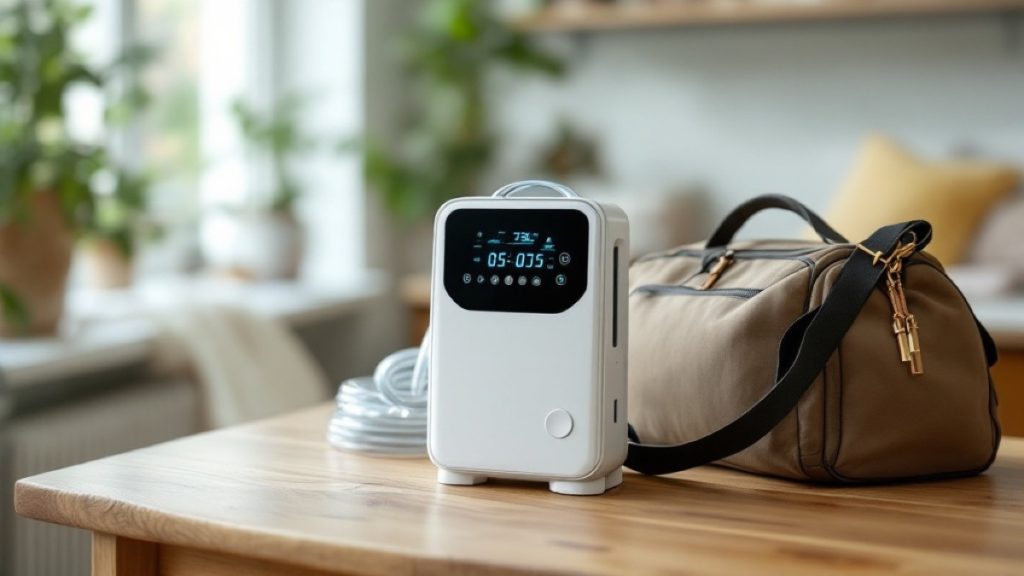
Portable oxygen therapy replaces the house-bound reality of stationary tanks with devices light enough to carry in a shoulder bag. Modern portable oxygen concentrators (POCs) weigh as little as 3 pounds, run on rechargeable batteries, and are FAA-approved for air travel. Choosing well comes down to one decision: pulse dose versus continuous flow. Get that wrong and the device sits in a closet. Costs run $1,000 to $3,500 to buy or $200 to $400 a month to rent, and Medicare covers most of the rental for qualifying patients.
Key Takeaways
- Three types of portable oxygen: portable oxygen concentrators (POCs), small compressed cylinders, and liquid oxygen portables.
- Pulse dose POCs weigh 3 to 5 lbs but deliver oxygen only when you inhale. Continuous flow POCs weigh 8 to 18 lbs and provide steady oxygen for sleep and high flow needs.
- All major POCs are FAA-approved for air travel with advance airline notification.
- Cost is $1,000 to $3,500 to buy, or $200 to $400 a month to rent.
- Medicare Part B covers 80% of the rental after the deductible if you meet the medical criteria (PaO2 of 55 mmHg or below, or SpO2 of 88% or below).
Quick definitions
- POC: portable oxygen concentrator, an electronic device that filters oxygen out of room air.
- Pulse dose: delivers a bolus of oxygen only when it senses you inhaling.
- Continuous flow: delivers a steady stream of oxygen regardless of breathing.
- LPM: liters per minute, the unit for continuous flow rate.
- Hypoxemia: low oxygen level in the blood, the reason supplemental oxygen is prescribed.
What are the types of portable oxygen?
There are three categories of portable oxygen equipment, each with distinct advantages and limits.
Portable oxygen concentrators (POCs)
POCs are the most popular option for active patients. They pull in ambient air (21% oxygen), filter out nitrogen with a molecular sieve, and deliver concentrated oxygen to the user. In a bench comparison of four POCs, Chatburn and Williams measured oxygen purity of 91.9% to 94.4% across the devices.2 They run on rechargeable batteries and also plug into wall or car outlets.
POCs have largely replaced tanks for ambulatory patients because they never run out. As long as the battery is charged or the unit is plugged in, it keeps producing oxygen from the surrounding air.
Small oxygen cylinders
Compressed gas cylinders store pressurized medical oxygen. Portable versions range from small “M2” cylinders (about the size of a water bottle, lasting 30 to 60 minutes) to larger “M6” cylinders (2 to 4 hours at 2 LPM). They deliver true continuous flow and need no batteries, but they run empty and must be refilled, which limits range.
Liquid oxygen portables
Liquid oxygen systems store oxygen at about minus 297 degrees F. A small portable unit is filled from a larger home reservoir. Liquid portables are lighter than equivalent compressed cylinders and provide continuous flow, but they are less common than POCs, require home delivery for reservoir refills, and slowly evaporate even when unused.
Pulse dose vs continuous flow: which do you need?
This is the most important distinction in portable oxygen, and the source of the most confusion. Pulse dose devices give a measured burst of oxygen only when you inhale. Continuous flow devices give a steady stream regardless of breathing. Pulse dose wins on portability. Continuous flow wins on reliability during sleep and at high flow needs.
Pulse dose (demand flow)
A pulse dose POC uses a sensor at the nasal cannula to detect the start of a breath, then releases a pulse of oxygen. On exhalation it delivers nothing, since exhaled air is wasted anyway. The advantages are real:
- Battery life: much longer, because no oxygen is wasted during exhalation.
- Size and weight: 3 to 5 lbs, small enough for a shoulder bag or small backpack.
The catch is that pulse settings (typically 1 to 6) are not liters per minute. Each setting delivers a set bolus volume, and total oxygen depends on your breathing rate. That matters more than it sounds: Chatburn and Williams found the effective fraction of inspired oxygen dropped as breathing sped up, from roughly 28.6% to 31.4% at 15 breaths per minute down to 23.0% to 25.3% at 30 breaths per minute at maximum settings.2 When you breathe faster, a pulse device can deliver proportionally less.
Continuous flow
A continuous flow POC delivers a steady stream measured in LPM, during both inhalation and exhalation. It is essential in specific situations:
- Sleep: breathing slows and shallows during sleep, and pulse sensors may miss shallow breaths. Continuous flow delivers regardless of breath depth.
- Mouth breathing: pulse sensors work through the nasal cannula and may not trigger reliably for mouth breathers.
- Higher flow needs: patients requiring 3+ LPM often need continuous flow reliability.
The trade-off: continuous flow POCs are larger (8 to 18 lbs) with shorter battery life because they produce oxygen nonstop.
Comparison table
| Feature | Pulse Dose POC | Continuous Flow POC |
|---|---|---|
| Weight | 3-5 lbs | 8-18 lbs |
| Battery life | 4-13 hours | 1.5-4 hours |
| Flow settings | 1-6 (bolus volumes) | 0.5-3 LPM |
| Sleep use | Not recommended | Yes |
| Price range | $1,000-2,500 | $2,000-3,500 |
| FAA approved | Yes (most models) | Yes (most models) |
Which specifications matter most?
Weight
Often the deciding factor for active users. Pulse dose POCs run from about 3 pounds (Inogen One G5, Caire FreeStyle Comfort) to 5 pounds. Continuous flow models are heavier, with home-capable units reaching about 18 pounds. Every pound counts when you carry the device all day.
Battery life
Battery life varies widely by setting and model. Manufacturers usually quote it at the lowest flow setting; at higher settings it drops sharply. Always check battery life at your prescribed setting, not the maximum advertised.
| Device Type | Battery Life (Setting 2) | Battery Life (Max Setting) |
|---|---|---|
| Lightweight pulse dose | 6-10 hours | 2-4 hours |
| Standard pulse dose | 8-13 hours | 3-5 hours |
| Continuous flow | 2-4 hours | 1-2 hours |
Noise level
POCs are not silent. The compressor and sieve beds produce a rhythmic clicking or hissing. Most modern pulse dose units run at 37 to 43 decibels, comparable to a library or quiet conversation. Continuous flow models tend to be louder (43 to 50 dB). Check decibel ratings if noise concerns you.
FAA approval
All major commercial POCs meet FAA acceptance criteria for use on aircraft.3 Airlines still require advance notification (typically 48 to 72 hours) and proof of enough battery capacity for the flight plus a buffer. Most require battery life covering 150% of the planned flight time.
Who needs portable oxygen?
Portable oxygen therapy is prescribed for chronic conditions that cause sustained low blood oxygen:
- COPD: the most common reason for supplemental oxygen. Advanced COPD impairs gas exchange, causing chronic hypoxemia. Some patients also explore adjunct options like a hyperbaric chamber for COPD, though that is a separate therapy with different evidence.
- Pulmonary fibrosis: scarring reduces the surface area available for gas exchange.
- Cystic fibrosis: thick mucus and repeated infections progressively damage the lungs.
- Pulmonary hypertension: elevated pressure in the lung vessels impairs oxygen uptake.
- Heart failure: reduced pumping cuts oxygen delivery to tissues.
- Post-COVID lung damage: some patients with lasting COVID-19 lung injury need supplemental oxygen.
Doctors prescribe supplemental oxygen based on arterial blood gas or pulse oximetry showing consistently low levels, typically PaO2 of 55 mmHg or below, or SpO2 of 88% or below at rest, consistent with the American Thoracic Society home oxygen guideline.4 Not everyone with a lung condition qualifies. The threshold matters, and some conditions carry oxygen therapy contraindications worth reviewing first.
Traveling with portable oxygen
One of the biggest quality-of-life gains from POCs is travel.
Air travel
- Notify your airline 48 to 72 hours before departure.
- Carry a physician’s statement confirming your need for oxygen.
- Bring battery capacity for 150% of total travel time, including layovers and possible delays.
- Keep your POC in the cabin. Do not check it.
- Carry extra batteries and know where to charge during layovers.
Road trips
- Most POCs include DC car adapters for charging while driving.
- Compressed cylinders should be secured upright and kept away from heat.
- Keep liquid oxygen units upright to prevent spills.
International travel
- Check voltage compatibility (most POCs accept 100 to 240V worldwide with a plug adapter).
- Carry documentation in the local language if possible.
- Research oxygen refill or rental options at your destination.
How much does portable oxygen therapy cost?
| Option | Cost | Notes |
|---|---|---|
| Buy pulse dose POC | $1,000-2,500 | One-time purchase, lowest long-term cost |
| Buy continuous flow POC | $2,000-3,500 | Heavier, needed for sleep and high flow |
| Rent POC | $200-400/month | Includes maintenance and swap if it breaks |
| Rent for travel only | $25-75/day | Short-term rental companies available |
| Extra batteries | $150-400 each | Essential for travel |
| Replacement nasal cannulas | $5-15 each | Replace every 2-4 weeks |
Does Medicare pay for a portable oxygen concentrator?
Medicare Part B covers portable oxygen equipment when specific medical criteria are met, and it generally pays for rental rather than purchase.5
Medicare coverage at a glance
- Qualifying test: arterial PaO2 of 55 mmHg or below, or SpO2 of 88% or below at rest (or PaO2 56 to 59 mmHg with cor pulmonale, pulmonary hypertension, or polycythemia).
- What you pay: Medicare covers 80% of the approved rental after the Part B deductible, which is $283 in 2026.6
- Rental term: 36 months, after which the supplier must furnish the equipment for an additional 24 months.
- Included: the concentrator, tubing and cannula, and maintenance.
One limitation: Medicare covers rental, not purchase, and the approved equipment may not be the newest or lightest model. If portability is your priority, compare the Medicare-offered unit against what is available to buy. Private insurance varies, and many plans follow Medicare’s criteria with different equipment lists and cost-sharing.
Maintenance and care
- Filters: clean or replace intake filters every 1 to 2 weeks. Clogged filters cut oxygen output.
- Nasal cannula: replace every 2 to 4 weeks, sooner if stiff or discolored.
- Tubing: replace every 2 to 3 months.
- Battery: rechargeable batteries lose capacity over time. Plan to replace every 1 to 2 years.
- Annual service: most manufacturers recommend yearly professional servicing of sieve beds, compressor, and oxygen purity output.
Because oxygen accelerates combustion, safe handling matters. Review our oxygen therapy safety precautions before first use, and note that supplemental oxygen has uses beyond lung disease, including in oxygen therapy for ARDS and interest in oxygen therapy for brain fog.
The bottom line
Portable oxygen therapy gives people with chronic lung disease the freedom to leave home, travel, and stay active. Pulse dose POCs offer the best portability (3 to 5 lbs, long battery life) for daytime use, while continuous flow devices are essential for sleep and higher oxygen needs. Costs run $1,000 to $3,500 to buy or $200 to $400 a month to rent, with Medicare covering 80% of the rental for qualifying patients. The single most important step is working with your doctor to match the device type, flow setting, and schedule to your condition, and testing it at rest, on exertion, and during sleep before you commit.
Frequently Asked Questions
Can I fly with a portable oxygen concentrator?
Yes. All major POC brands meet FAA acceptance criteria for in-flight use.3 Notify your airline 48 to 72 hours in advance and carry enough battery life for 150% of your total travel time, including layovers. Keep the device in the cabin with you, and bring a physician’s statement confirming your oxygen need.
Can I use a pulse dose POC while sleeping?
Generally not recommended. Breathing slows and shallows during sleep, which may not trigger the pulse sensor reliably, so most sleep oxygen needs require continuous flow. Some newer pulse models have sleep modes, but use them only if your doctor has confirmed adequate oxygenation during sleep with that specific device.
How long do portable oxygen concentrator batteries last?
It depends heavily on model and flow setting. At the lowest setting, most pulse dose POCs last 4 to 13 hours. At higher settings, battery life drops to 2 to 4 hours, and continuous flow units run 1.5 to 4 hours. Always check battery life at your prescribed setting, not the maximum advertised number.
Does Medicare pay for portable oxygen concentrators?
Medicare Part B covers 80% of the rental cost of oxygen equipment after the annual deductible ($283 in 2026) if you meet the medical criteria, primarily PaO2 of 55 mmHg or below, or SpO2 of 88% or below.5 Medicare generally covers rental rather than purchase.
Sources
- American Thoracic Society. Supplemental Oxygen (patient education series). thoracic.org
- Chatburn RL, Williams TJ. Performance comparison of 4 portable oxygen concentrators. Respir Care. 2010;55(4):433-442. PMID: 20406511
- Federal Aviation Administration. Acceptance Criteria for Portable Oxygen Concentrators Used On Board Aircraft. faa.gov
- Jacobs SS, Krishnan JA, Lederer DJ, et al. Home Oxygen Therapy for Adults with Chronic Lung Disease: An Official American Thoracic Society Clinical Practice Guideline. Am J Respir Crit Care Med. 2020;202(10):e121-e141. PMID: 33185464
- Medicare.gov. Oxygen equipment and accessories coverage. Centers for Medicare & Medicaid Services. medicare.gov
- Centers for Medicare & Medicaid Services. 2026 Medicare Parts A & B Premiums and Deductibles (Part B annual deductible $283). federalregister.gov