Can Hyperbaric Chamber Cause Hearing Loss? What Experts Say
Explore the clinic directoryIn this article
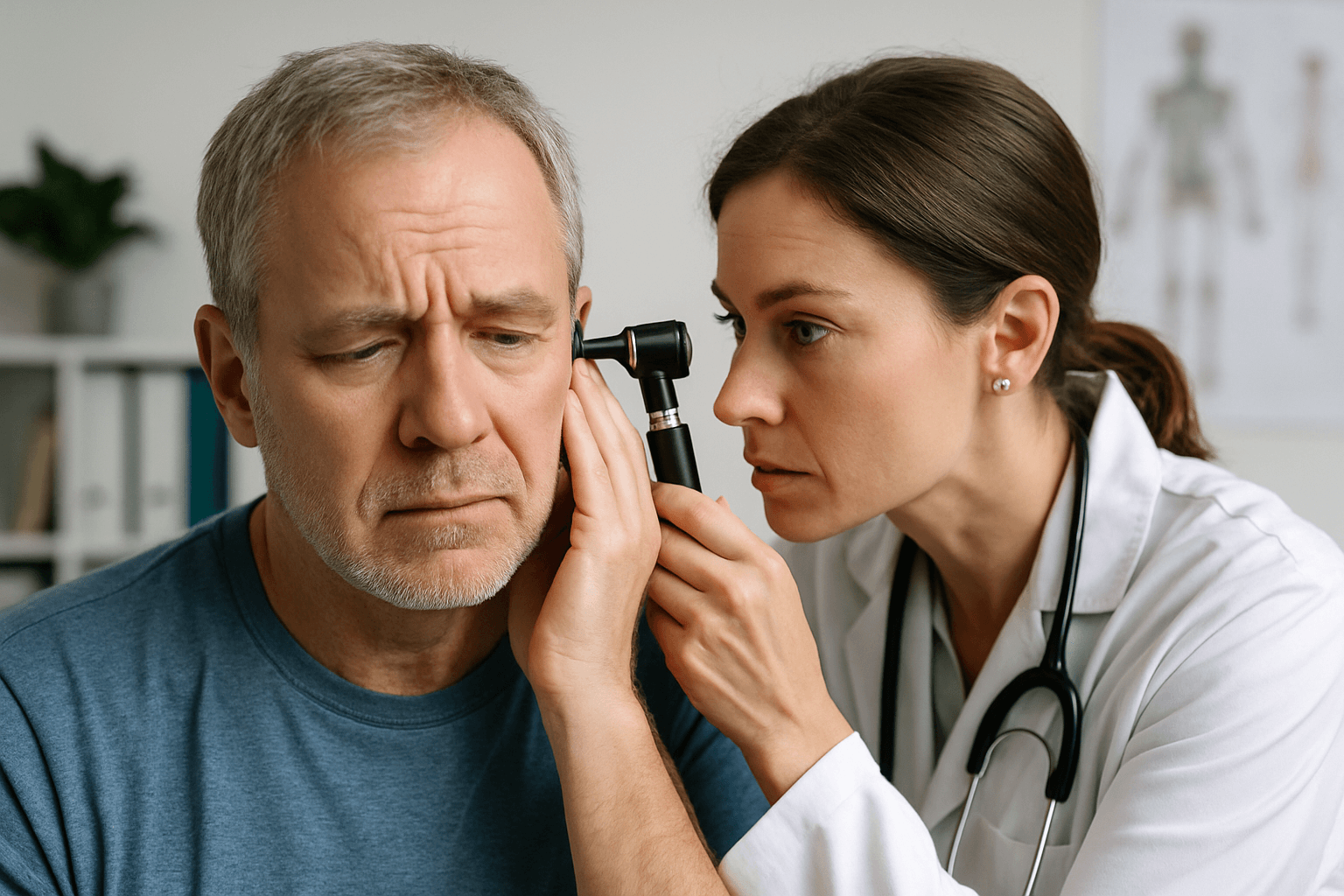
Hyperbaric chambers can cause ear pressure and temporary discomfort, but permanent hearing loss from HBOT is not documented in large clinical studies. The most common ear issue is middle ear barotrauma, a pressure equalization problem that affects roughly 9 to 15 percent of patients. Most cases are mild and self-resolving. This guide covers what the research shows, who is at higher risk, and how to protect your ears during HBOT.
What Is Middle Ear Barotrauma?
Middle ear barotrauma (MEB) occurs when the air pressure outside your eardrum rises faster than the middle ear can equalize through the Eustachian tube. It is the same sensation you feel on an airplane during descent, amplified by the faster and larger pressure changes of a hyperbaric session.
During compression, if you cannot equalize the pressure difference, it creates pain, a feeling of fullness, and sometimes temporary muffled hearing. In mild cases the discomfort resolves once the chamber reaches operating pressure. In more severe cases, fluid may accumulate behind the eardrum, or the eardrum itself may be damaged.[2] Barotrauma and other ear and sinus effects are among the most frequently reported complications of HBOT overall.[5]
The condition is classified using the Teed Ear Drum (TEED) scale, from Grade 0 (no injury) to Grade 5 (tympanic membrane perforation). In Heyboer et al.’s study of 236 patients, 84 percent of MEB cases were Grade 1 to 2, meaning minor and requiring no medical intervention.[6]
Middle Ear Barotrauma Rates Across Studies
| Study | Patients | Finding |
|---|---|---|
| Nasole et al., 2019[3] | 5,962 | Review of MEB during HBOT; consistent risk factors identified, most cases mild |
| Heyboer et al., 2014[6] | 236 | 84% of MEB cases were Grade 1 to 2 (minor) |
| Mirasoglu et al., 2017[4] | Multiplace cohort | 8.7% barotrauma rate, falling to 3.1% with in-chamber staff attendance |
| Voigt et al., 2025[1] | Systematic review | No permanent sensorineural hearing loss attributable to standard HBOT |
Who Is at Higher Risk of Ear Problems During HBOT?
Multiple large studies have identified consistent risk factors:[1]
- Female sex: Consistently identified across multiple studies (Voigt 2025, Nasole 2019)
- Age over 55: Eustachian tube function declines with age
- Head and neck pathology: Cancer, or previous radiotherapy to the head and neck region
- Upper respiratory infection: Active congestion impairs Eustachian tube function
- Sensory neuropathy: Inability to feel ear pain means inability to report a failure to equalize
- Prior difficulty equalizing: Self-reported pre-treatment difficulty is the most practical predictor
- Thyroid disorders, obesity, and obstructive breathing disorders
Protective factors: experience with effective equalization techniques, a slow compression rate, thorough pre-treatment training, and in-chamber health professional attendance in multiplace chambers.[1]
Can HBOT Treat Hearing Loss?
Yes, for one specific type. While HBOT can cause temporary ear pressure issues, it is also an established treatment for sudden sensorineural hearing loss (SSNHL) when treatment begins within days of onset.
Studies support HBOT as an adjunct to steroid therapy for SSNHL, with protocols of 10 to 20 sessions at 2.0 to 2.5 ATA. Results are time-sensitive: the best outcomes occur when treatment begins within the first 7 to 14 days of hearing loss onset.[7] Idiopathic sudden sensorineural hearing loss is one of the recognized approved indications for HBOT, which is why it appears on the standard list of FDA-cleared and UHMS-approved HBOT indications.
How to Protect Your Ears During HBOT
- Learn equalization techniques before your first session. Practice the Valsalva maneuver (pinch your nose and blow gently), yawning, and swallowing. Ask your provider to demonstrate these before you start.
- Report ear pain immediately during compression. Alert the technician if you cannot equalize. Pausing compression briefly prevents a mild issue from becoming significant barotrauma.
- Do not go into HBOT with a respiratory infection. Congestion impairs Eustachian tube function and sharply increases barotrauma risk. Reschedule if you are unwell.
- Slow compression helps. Ask your provider about their compression rate protocol. Staged compression reduces the severity of barotrauma even if it does not reduce overall incidence.[8]
- Discuss pre-existing ear conditions with your provider. Previous ear surgery, chronic ear infections, or auditory conditions require evaluation before starting HBOT. If claustrophobia is also a concern, see our guide on managing claustrophobia in a hyperbaric chamber.
For the fuller risk picture beyond the ears, see our overview of HBOT side effect statistics.
Frequently Asked Questions
Will HBOT damage my hearing permanently?
Large pooled cohorts including more than 18,000 patients have not documented permanent sensorineural hearing loss as a consequence of standard HBOT. Middle ear barotrauma is a pressure equalization issue that affects the middle ear, not the inner ear or auditory nerve where permanent hearing damage occurs.[1]
My ears always hurt on airplanes. Will HBOT be worse?
Potentially, yes. Difficulty equalizing ear pressure on airplanes is a predictor of higher barotrauma risk during HBOT. Discuss it with your provider before starting. Slow compression rates and practiced equalization techniques significantly reduce risk, and in some cases ear specialists recommend myringotomy tubes for patients who cannot equalize reliably.
Can I do HBOT if I have a perforated eardrum?
This requires physician evaluation. A perforated eardrum equalizes pressure differently than an intact one. Some providers clear patients with healed perforations, while active perforations require careful assessment. Do not start HBOT without disclosing any ear surgery or known ear condition.
Sources
- Voigt A, Laspro M, Thys E, Jethanamest D, Chiu ES. Systematic Review of Otologic Adverse Events in HBOT. Undersea & Hyperbaric Medicine. 2025. PMID: 41429031 ↩
- Beuerlein M, Nelson R, Welling DB. Inner and Middle Ear Hyperbaric Oxygen-Induced Barotrauma. The Laryngoscope. 1997;107(10):1350-1356. DOI: 10.1097/00005537-199710000-00011 PMID: 9331312 ↩
- Nasole E, Zanon V, Marcolin P, Bosco G. Middle ear barotrauma during hyperbaric oxygen therapy; a review of 5,962 patients. Undersea & Hyperbaric Medicine. 2019;46(2):207-216. DOI: 10.22462/04.06.2019.2 PMID: 31051054 ↩
- Mirasoglu B, Cakkalkurt A, Aktas S, Cimsit M. Complication of hyperbaric oxygen therapy: symptomatic middle ear and cranial sinus barotrauma. J Ist Faculty Med. 2017. DOI: 10.18017/IUITFD.308489 ↩
- Plafki C, Peters P, Almeling M, et al. Complications and side effects of hyperbaric oxygen therapy. Aviation, Space, and Environmental Medicine. 2000;71(2):119-124. PMID: 10685584 ↩
- Heyboer M, Wojcik S, Grant W, et al. Middle ear barotrauma in hyperbaric oxygen therapy. Undersea & Hyperbaric Medicine. 2014;41(5):393-397. PMID: 25558548 ↩
- Kim H, et al. The Optimized Protocol of Hyperbaric Oxygen Therapy for Sudden Sensorineural Hearing Loss. The Laryngoscope. 2023;133(4). DOI: 10.1002/lary.30181 PMID: 35548932 ↩
- Ng A, Muller R, Orton J. Incidence of middle ear barotrauma in staged versus linear chamber compression during HBOT. Undersea & Hyperbaric Medicine. 2017;44(2):121-128. DOI: 10.22462/3.4.2017.3 PMID: 28777900 ↩